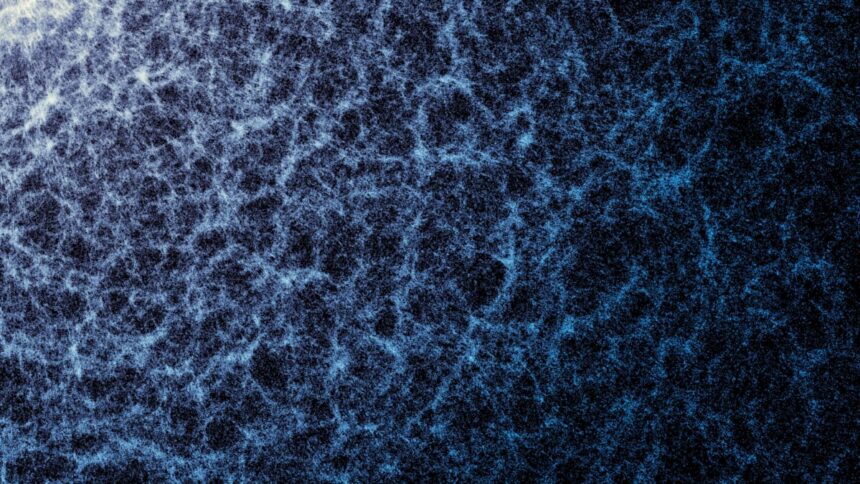
Last week, the Dark Energy Spectroscopy Instrument (DESI) concluded its first official survey. Over the past five years, the experiment recorded more than 47 million galaxies and 20 million stars over 11 billion years of cosmic history.
The idea of a big, important observatory wrapping up a “final run” suggests that, as the phrase implies, the experiment is done. But for scientists, that couldn’t be further from the truth. The conclusion of a major survey is, in many ways, the start of exciting science, as hundreds of hungry scientists dissect the new data in detail. That process can take anywhere from a couple of months to several years—especially for data collected by an instrument as capable as DESI.
“As soon as you have a galaxy survey like that, it’s a real gold mine of information,” DESI co-spokesperson Will Percival told Gizmodo during a video call. “There’s a lot of physics encoded in the distribution of galaxies and a whole wealth of science and analysis still to come.”
It takes a lot to explain the cosmos
If you follow cosmology, you might remember a big DESI announcement in 2025 that took a swipe at a static cosmological constant. The investigation suggested dark energy was evolving, not constant. According to Percival, an astrophysicist at the University of Waterloo in Canada, this finding came from studying DESI observations from its first three years of operations—a giant dataset that scientists are still investigating.
So, if last year’s analysis was a tiny preview into what DESI data could uncover, the observatory’s first completed run—the “full” dataset—will certainly do much more. Then again, the stakes are high. After all, the relevant questions here concern how the universe came to be, how it’s growing—and, perhaps most importantly, how it might end.
“With data that’s as good as you get from DESI, we really need to do a careful and robust analysis,” Percival explained. Just preparing the data for scientific analysis is a huge task in itself, he said, adding, “We have to do things like creating mock universes and mock catalogues of galaxies, and then we look at how our observations impact the original physics that [dictate] these fake universes.”
Confirmed, but not really
This level of precaution ensures the data is ready to investigate ideas like Einstein’s cosmological constant, lambda (Λ). This metric drives an accelerated expansion of the recent universe, as Andrew Liddle, an astrophysicist at the University of Lisbon in Portugal, explained to Gizmodo. The standard cosmological model uses lambda to assume that whatever causes this acceleration—typically represented as dark energy—“maintains a perfectly constant energy density while the universe is expanding,” said Liddle, who isn’t directly involved with DESI.
Most observations thus far have affirmed this account of the universe’s evolution, which is why suggesting otherwise—as DESI’s 2025 analysis did—would be a “huge discovery that would overturn the standard model of cosmology,” noted Kev Abazajian, an astrophysicist at the University of California, Irvine, also uninvolved with DESI.
“However, the statistical significance of the result is not yet that significant,” Abazajian said, “and it would need to be detected by an independent survey as well for it to be taken as truly credible.”
“These kinds of questions really depend on how well we know the errors in the data,” Percival explained. “So we spend a lot of time making sure they’re as accurate as we can make them.”
Why even ask the question?
It might seem odd that, if observational results are compliant with lambda, scientists are even considering different options. This has to do with major complications on the theoretical side of cosmology and physics at large, according to Marina Cortês, an astrophysicist at the University of Portugal.
“It is so difficult to insert lambda into the century-old body of theoretical physics that no one knows how or where to even begin to change that edifice […] due to unsolvable discrepancies with particle physics,” Cortês, who was involved with DESI’s earliest stages, told Gizmodo. “Regardless of the increased ingenuity, complexity, and collaborative effort of surveys, the universe has remained firm [that lambda is correct]. It is a tug of war between the universe and established physics.”
As for the cosmological model as a whole, there were some discrepancies regarding the diversity of galaxy densities, as well as the infamous “Hubble tension” surrounding the expansion rate of the universe, added Abazajian.
“It is here where the DESI survey plays a vital role by suggesting possible dark energy evolution,” Cortês said. “If verified, this provides new quantitative properties of dark energy to diagnose its true nature. Even if DESI ultimately verifies [lambda] once more, it will have done so with substantially greater accuracy… leaving no maneuver space for lazy theorists to delay moving on with [devising new models].”
What now?
Both Abazajian and Cortês anticipate we’ll get some answers with DESI and also Euclid, another space telescope launched to explore all things dark in the universe. The latter is slated to publish its first data release in October this year.
“If evolving dark energy is seen in both and with the same features, this is on the path to becoming a major discovery,” Abazajian said.
Cortês, who recently visited DESI members, told Gizmodo that the team is considering a collaborative supernova survey with Rubin Observatory, another major institution with monster-level capabilities. Other teams are already planning for successor projects to both DESI and Rubin, too, she said.
Meanwhile, the DESI team reportedly has six batches of five to ten scientific papers on different topics, all planned to come out later this year, Percival told Gizmodo. Again, this comes from the dataset up to DESI’s third year of operations. It’s worth noting that the instrument itself hasn’t physically turned off and will run supplementary surveys until around 2028.
As of now, the team is working on processing the five-year data dump for scientific analysis, which Percival predicts will take about two to four months.
“And hopefully, by that point, the team will have finished with the [data up to the third year] and will be ready to move on,” Percival mused. “It’s a really exciting time to be working in cosmology, because we’re working with things we don’t understand. I’m biased, but I think getting more information is really key. It’s really exciting science that’s happening now.”
Read the full article here