All eyes are on the Pacific Ocean as an exceptionally strong El Niño takes shape, but meanwhile, something unusual is brewing in the Atlantic.
According to Severe Weather Europe, a rare Atlantic Niña is emerging in the tropics—not to be confused with La Niña, the cold phase of the El Niño Southern Oscillation (ENSO). Like La Niña, this phenomenon occurs when sea surface temperatures drop below average, but it affects the eastern equatorial Atlantic Ocean instead of the central and eastern equatorial Pacific. If Atlantic sea surface temperatures remain 0.9 degrees Fahrenheit (0.5 degrees Celsius) below average for at least two overlapping seasons, this anomaly will become the sixth Atlantic Niña of the last 40 years.
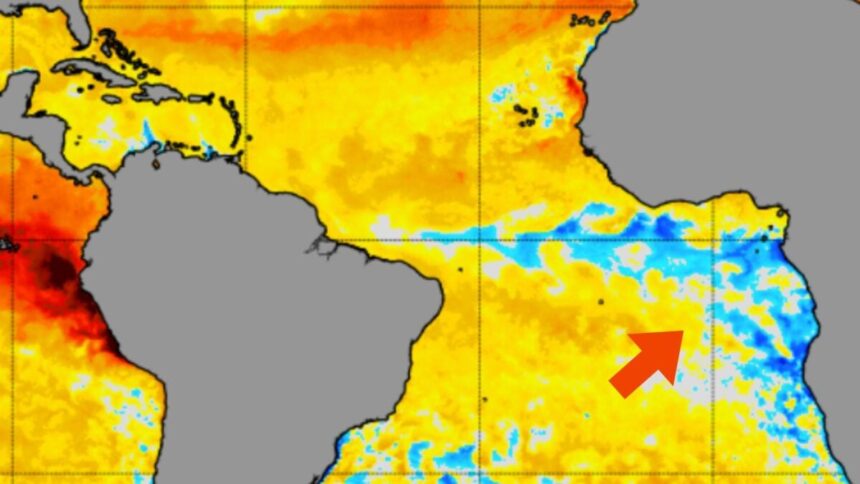
The onset of an Atlantic Niña and the opposing “super” El Niño are clearly visible on the National Oceanic and Atmospheric Administration’s latest sea surface temperature anomaly map, shown below. El Niño appears as a long band of warmer-than-average temperatures stretching outward from the northeastern coast of South America, while the Atlantic Niña is the smaller region of colder-than-average temperatures off the southeastern coast of Africa.
“These two anomalies appear to work on opposite poles (warm vs. cold), but they are actually perfectly aligned in their atmospheric impact,” senior meteorologist and long-range forecaster Andrej Flis writes for Severe Weather Europe. Here’s what that means for weather in the United States.
Significant Atlantic hurricane suppression
El Niño increases vertical wind shear across the Atlantic Ocean, making it harder for thunderstorms to organize into hurricanes, according to NOAA. The agency’s outlook for the 2026 Atlantic hurricane season reflects El Niño’s influence, predicting below-normal activity with just eight to 14 named storms, three to six hurricanes, and one to three major hurricanes.
Atlantic Niña has a similar effect, but through different mechanisms. Cooler waters in the eastern equatorial Atlantic rob thunderstorms of the heat and moisture needed to fuel convection, suppressing thunderstorm formation and organization. During Atlantic Niña, the number of tropical cyclones is 50% lower than during a warm phase, or Atlantic Niño, according to Severe Weather Europe. That also applies to landfalling hurricanes in the United States.
In an average year, two named storms would form in the Atlantic Basin by July 17, but there’s only been one so far. Tropical Storm Arthur brought flash flooding and tornadoes to the South in June, causing significant damage, but it was disorganized and short-lived. We have yet to see a hurricane take shape, but on average, the first one develops by August 11.
The National Hurricane Center (NHC) is currently monitoring two Atlantic disturbances with slight chances of cyclone formation within the next seven days. One located on the southeast coast of the U.S., stretching from the northeastern Gulf of Mexico across northern Florida and offshore of the Carolinas, has a 20% chance of developing. The other, located much farther away in the eastern tropical Atlantic, has a 10% chance.
Meanwhile, the Pacific Basin is churning with activity. That’s typical for an El Niño year, as warmer sea surface temperatures provide excess fuel (heat) for storm formation and reduce wind shear, making it easier for hurricanes to take shape. Tropical storm Elida, the fifth named storm in the Pacific this year, is currently tracking westward away from land, according to the NHC.
Fortunately for folks on the Atlantic Coast, both El Niño and Atlantic Niña will be working together to shield them from landfalling storms this season. It will be interesting to see whether any tropical storms manage to overcome these conditions as we head into August, which is when Atlantic hurricane activity typically picks up.
Read the full article here