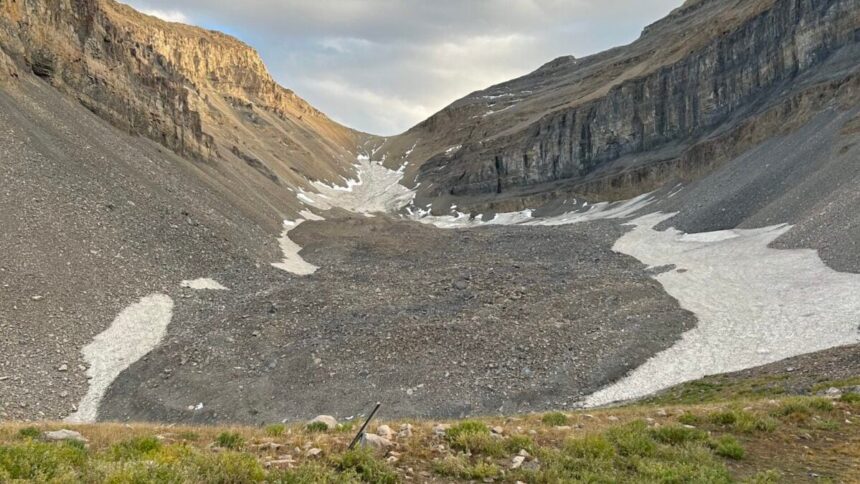
When we picture a glacier, we tend to imagine an enormous chunk of ice sprawling across a mountain valley or descending from a snow-covered peak. But not all glaciers look the way we expect. Some are hidden beneath a jumble of rocks, their ice buried from view. These formations, known as rock glaciers, can conceal vast reservoirs of ice beneath their rocky surfaces. Now, scientists are taking a closer look at one of these hidden ice stores beneath Utah’s mountains—and finding that it may contain far more water than its unassuming appearance suggests.
A team of geologists from the University of Utah took a closer look at one of the state’s largest rock glaciers located beneath Mount Timpanogos to examine how much ice it contained. By creating a 3D image of the hidden ice, the team found that Timpanogos Rock Glacier stores 1.5 million cubic meters of frozen water, enough to fill 600 Olympic-sized swimming pools.
The findings suggest that rock glaciers could collectively hold about 1 billion tons of ice, according to a new study published in the Journal of Geophysical Research: Earth Surfaces.
Buried ice
There are more than 50,000 known rock glaciers around the world, more than 10,000 of which are located in the U.S. Utah alone has 836 rock glaciers.
These vast formations of ice are hidden from sight, buried beneath a dense layer of rock. “There’s a lot of ice that’s hidden in Utah’s mountains,” Leif Anderson, a glaciology professor at the University of Utah and co-author of the study, said in a statement. “When we are high in the mountains and walking across loose rocks or rubble, you don’t realize there could be 120 feet [37 meters] of ice buried beneath your feet.”
To measure the amount of ice lurking within the Timpanogos Rock Glacier, the team behind the study measured small differences in the gravitational pull of rock and ice at 232 spots in a grid on top of the glacier. The measurements allowed the researchers to differentiate between the denser surrounding rock that makes up Mount Timpanogos and the much lighter buried ice.
The team then created a virtual map of the interior of Timpanogos Rock Glacier that measured 150 feet [46 meters] deep at its thickest. “Timpanogos Rock Glacier is surprisingly ice-rich. It is 83% ice and 17% loose rock,” Bronson Cvijanovich, a former graduate student in the Department of Geology & Geophysics at the University of Utah and lead author of the study, said in a statement.
Rocky layers
Based on the recent findings, the researchers estimate that Utah’s rock glaciers may hold a 1-gigaton, or 815,000 acre-feet, of water.
An accompanying study examined the origin of the rock glaciers and suggests that they are water stores that formed over the thousands of years after the Ice Age glaciers melted away. Despite warming weather, the rock glaciers appear to be adding ice to this very day.
“This is not just ice that’s left from the time of Lake Bonneville and mammoths. We don’t yet know which rock glaciers are still adding ice today outside of a few dozen under active research. Some of these rubble fields hold ice today, but some have melted out,” Anderson said. “But Timpanogos rock glacier is still adding ice today!”
The glaciers could then become a crucial source of water for places where there may be a shortage.
“Rock glaciers flow downhill just like a glacier or river, but the important distinction here is that the thick carapace of loose rock actually protects and hides the ice, making these climate-resilient water storage sites that may still be adding frozen water,” Cvijanovich said. “From a water resource standpoint, it is really important, especially in a warm and arid state like Utah.”
Read the full article here