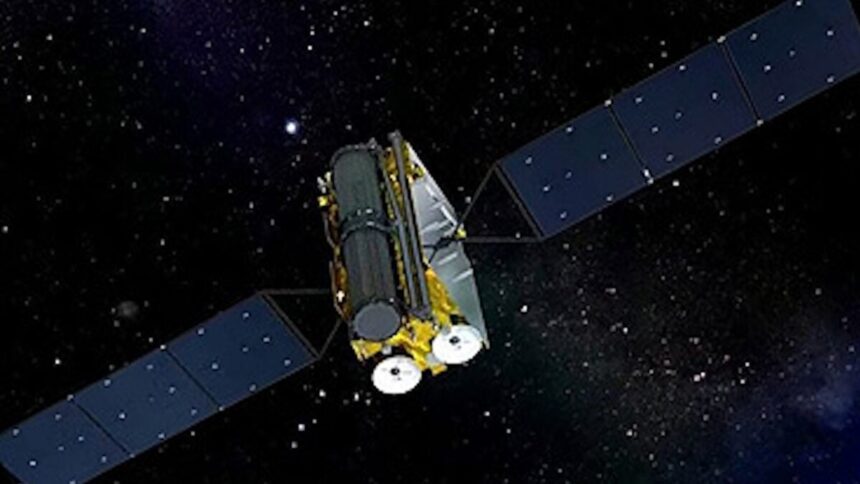
Nearly three years ago, China launched a radar satellite capable of monitoring nearly a third of Earth’s surface around the clock. The satellite’s unique capability has left many researchers in the U.S. stumped, unable to recreate the groundbreaking technology. Now, a new study disclosed that the satellite’s secret sauce is China’s near-total dominance over the supply of a high-performance semiconductor material.
The Ludi Tance 4-01 radar satellite is powered by gallium nitride semiconductors, allowing it to operate at a high altitude of 22,370 miles (36,000 kilometers) while being fixed over the same geographic position at all times, the South China Morning Post reported.
It just so happens that China has a global monopoly over the supply of gallium, and it’s making sure that no one else can get it. China has restricted gallium exports since the satellite launched in 2023.
One of a kind
Ludi Tance 4-01 is the only satellite of its kind, and it will likely stay that way for a long time. The world’s first, and only, geosynchronous orbit synthetic aperture radar (SAR) satellite maintains continuous coverage over the Asia-Pacific region.
Normally, radar satellites are at an altitude of around 370 miles (600 kilometers) in low Earth orbit. That’s because the radar signal strength begins to dwindle the farther away they are. Satellites in geosynchronous orbit sit at an average altitude of 22,236 miles (35,786 kilometers), which allows them to cover more area, but they would need a lot more power in order to achieve the same imaging capabilities as the satellites in low-Earth orbit.
In order to overcome this problem, Ludi Tance 4-01 relies on gallium nitride technology to power its solid-state amplifiers, which send electromagnetic waves to its synthetic-aperture radar, according to the study published in the Journal of Microwaves.
Since the satellite is positioned so far away from Earth, it needs stronger microwave transmission power to generate radar images than if it were in low-Earth orbit. Each of the satellite’s solid-state amplifiers generates 800 watts, and combined together, they produce up to 18,000 watts.
The recent paper, led by researchers at the Xian Institute of Space Radio Technology, found that the device reached a power-added efficiency of 50.3%.
My gallium!
The majority of the world’s gallium supply is extracted during the industrial production of aluminum. China is the world’s largest producer of aluminum and therefore has the global supply of its byproduct in a chokehold.
China produces more than 95% of the world’s gallium supply and is keeping the majority of it to itself. China restricted the export of gallium in August 2023, the same month when its radar satellite launched.
While China asserts that its Ludi satellite is primarily for civilian applications, such as meteorology, disaster response, and agricultural research, the U.S. military is still concerned over the satellite’s unmatched surveillance capabilities.
U.S. military experts have previously expressed concern over China’s advancing satellite capabilities, including its geosynchronous imaging satellites. “Relentless advances in Chinese surveillance capabilities could soon produce an Indo-Pacific region where there is no place to hide,” Clayton Swope, a former U.S. intelligence official and now a senior fellow at the Center for Strategic and International Studies, said during a conference in 2024.
Read the full article here