

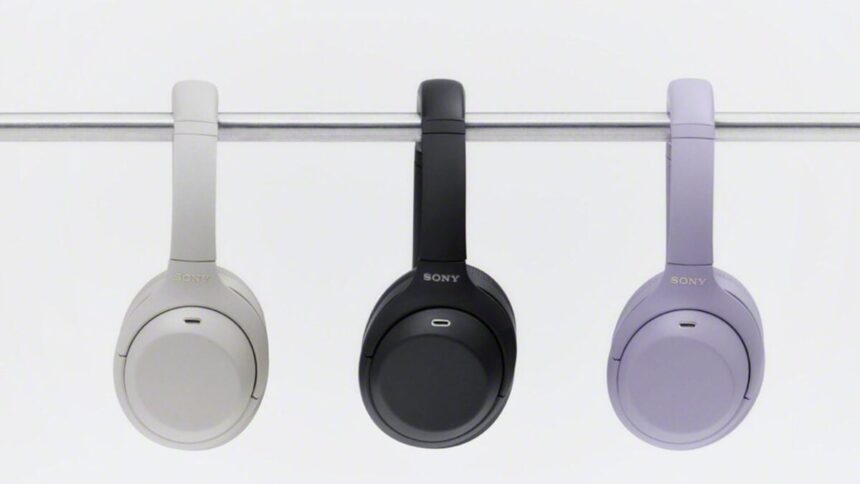
Sony’s old wireless headphones are new once more. The company has resurrected the WH-1000XM4 with the new $299 WH-1000XM4C, about six years after the former’s initial release.
While the WH-1000XM4C share the exact same design as the previous generation, there are some significant upgrades under the hood. Arguably the biggest is new sound tuning (though it’s hard to say how big of an impact that makes without hearing them for myself). The WH-1000XM4C are $50 cheaper than the first-gen XM4 that debuted six years ago, which is not a huge price drop, but not nothing, either.
Active noise cancellation (ANC) remains the same as it was in the first pair, with a four-mic array and Sony’s Q1 noise-cancelling chip, but there is better EQ this time around. Instead of the five-band EQ on the last generation, you’ll get 10 bands now, which came in handy when I tested the $70 WH-CH530, which Sony also annouced this week.
If there’s one area that I’m surprised that Sony didn’t improve on, it’s battery life. The WH-1000XM4C have 27 hours of battery with ANC on, which is actually three fewer hours than the first-gen model.
Even with that slightly deflated battery life figure and the incremental upgrades, it’s hard to be disappointed about the WH-1000XM4 coming back. When Gizmodo reviewed the original back in 2020, we declared that Sony has “practically perfected noise-cancelling headphones.” Not only was the ANC great, but the headphones were also incredibly comfortable and easy to pair and switch between devices.
Whether the WH-1000XM4C reach the same heights will ride on the new sound profile, in my opinion, but there’s no denying that the lineage here is strong. And if you don’t care as much about ANC and are looking for a budget option, the new $70 WH-CH530 might surprise you. In the midrange, Sony also released the WH-CH730N, which upgrades the sound, ANC, and battery life over the previous generation. That pair costs $180 and is on sale now.
The WH-1000XM4C are avaible for preorder now, with shipping expected at the end of September.
Read the full article here