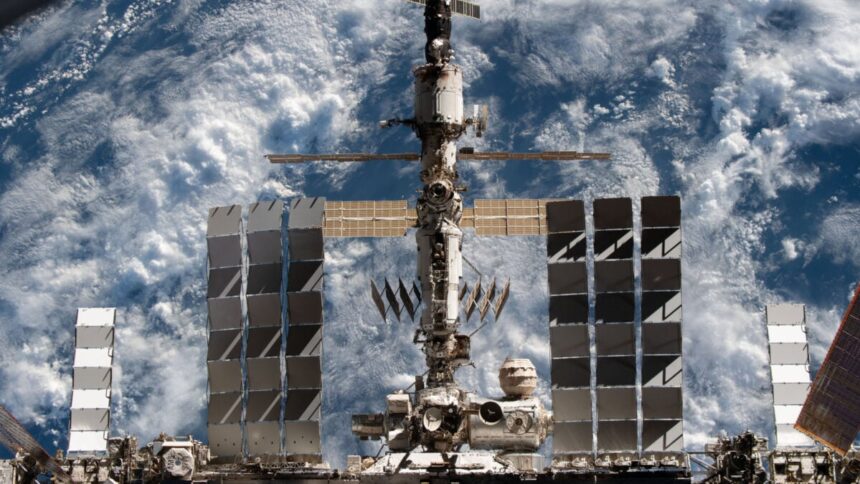
Like a recurring nightmare, a troubling leak from the Russian segment of the International Space Station has returned despite several attempts to patch it up.
NASA and Roscosmos have spent years trying to find and repair the source of the air leak on the orbiting lab. Last year, a new pressure signal in a segment of the Zvezda module suggested that the leak was finally repaired. Alas, the space station appears to be leaking again.
Earlier this month, the Russian space agency (Roscosmos) noted a slow pressure drop in the transfer tunnel that connects to the Zvezda Service Module, indicating that the ISS is still leaking air from microscopic cracks, Ars Technica reported. Data analysis indicated that air is leaking from the Russian module at a rate of about one pound per day, NASA spokesperson Josh Finch told Ars on Thursday.
A timeline of the ISS leak
Roscosmos first reported a leak on board the ISS in September 2019, tracing it to the vestibule (named PrK) that connects a docking port to the Russian Zvezda module. Since it was discovered, the rate at which air was leaking from the service module doubled from one pound a day to a little over two pounds a day, according to a report released in 2024. That led NASA to elevate the leak to the highest level of risk.
NASA and Roscosmos could not agree on the root cause of the leak or a way to fix it, and the issue persisted for six years. In June 2025, things began to look more promising. NASA reported that attempts to repair the air leak were successful after measuring a new pressure signal (a change in airflow or cabin pressure picked up by sensors), which may be a sign that the leaks have been sealed.
There was a chance, however, that the new pressure signal was due to air flowing to a different area in the aft segment of the Russian module.
The leak that won’t quit
On May 1, Russian cosmonauts were unloading cargo from the Progress 95 spacecraft when they noticed a slow pressure drop in the Zvezda module. The leak was back again, or rather, it never left.
“Roscosmos allowed the pressure in the transfer tunnel to gradually decrease while monitoring the rate,” NASA’s Finch is quoted in Ars as saying. “The area now is being maintained at a lower pressure, with small repressurizations as needed.”
The spokesperson noted that the air leak posed no risk to the crew on board the ISS and that NASA and Roscosmos are working on next steps.
The ISS is due to retire in 2030 after spending nearly three decades in low-Earth orbit. All that time in the harsh space environment has taken a toll on the aging hardware of the space station, and the pesky air leak highlights its worsening state.
Earlier this year, U.S. Congress suggested that NASA delay the space station’s retirement until there’s a viable commercial alternative to avoid having a gap in human presence in Earth orbit. At the same time, a safety advisory panel warned that there are growing risks threatening the space station as it nears the end of its use, including the persisting issue with the air leak.
It’s taken several years for NASA and Roscosmos to try and repair the air leak, and so far those efforts have gone in vain as the space station continues to decay.
Read the full article here