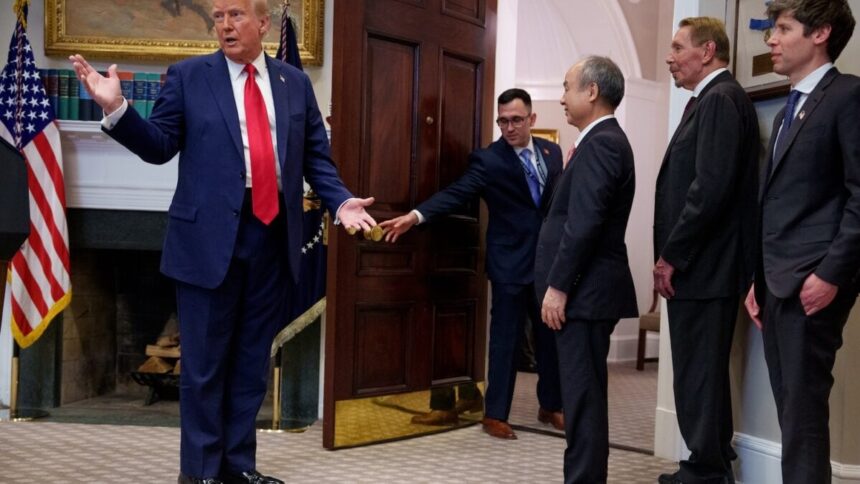
Donald Trump was supposed to sign an executive order on Thursday that would have created a voluntary framework for frontier AI companies to have their models reviewed by the federal government for security risks before being made available publicly, according to Alex Heath. It was reportedly canceled because tech execs couldn’t get to D.C. fast enough for the photo op—though Trump claimed that it was because he “didn’t like certain aspects of it” and doesn’t want to “do anything that will get in the way” of America’s AI battle with China, per PunchBowl News’ Diego Munhoz.
It’s just the latest instance of the Trump administration’s general disinterest in regulating AI companies (except the ones that piss him off; those get swift and immediate penalties). It’s a disinterest they have even tried to force onto states by passing a 10-year moratorium on any AI regulation, though that effort has repeatedly failed.
But in the absence of any federal regulation or guidance, and with the state policy up for grabs, the AI companies are doing everything in their power to work the refs. According to a report from Politico, OpenAI has been at the forefront of this strategy, launching a state-by-state lobbying effort to make the patchwork of regulation as favorable across the country as possible.
Per Politico, OpenAI’s chief global affairs officer Chris Lehane calls the plan “reverse federalism”—basically trying to pass similar laws in enough states to create something that feels closer to a unified regulatory framework for the country. The company’s lobbying efforts have thus far targeted California (which passed an AI safety law late last year that OpenAI ultimately endorsed) and New York (which likewise passed an AI safety law).
It’s now on to Illinois, where OpenAI has offered its endorsement for an AI safety law that would require frontier labs to submit to audits. It should be no surprise that the bill the company backed shares a lot of similarities with the laws passed in New York and California.
Should the bill pass, OpenAI will have successfully shaped the foundational policy that it is subject to in three of the most populous and influential blue states in the country. However, the company does have one major hurdle to complete the trifecta: Anthropic. The rival AI lab is also reportedly working behind the scenes in Illinois to guide policy and has thrown its weight behind a competing bill.
As these AI giants continue to raise more and more money at absurd valuations, larger portions of those funds are being spent on shaping laws. CalMatters estimated that tech companies broadly spent about $40 million last year on lobbying efforts in California alone, and efforts have ramped up this year with millions flowing to pro-AI super PACs meant to influence public opinion.
In this way, Trump’s strategy of not governing has worked as intended: these companies are now dictating their own rules.
Read the full article here