As data centers proliferate across the United States, scientists are scrambling to quantify their impacts on nearby communities. Studies have shown that these facilities strain local power and water supplies, drive up utility costs, and emit harmful pollutants. Now, research suggests their waste heat can actually crank up the temperature in downwind neighborhoods.
The study, published May 18 in the Journal of Engineering for Sustainable Buildings and Cities, measured heat pollution from a 36-megawatt data center in Mesa, Arizona, and a 169-megawatt data center campus in the neighboring city of Chandler. The researchers found that air temperatures downwind of these facilities were up to 4 degrees F (2 degrees C) higher than upwind temperatures. This heat impact extended up to a third of a mile (half a kilometer) out from the perimeter of the data centers.
These findings suggest data centers can compound the urban heat island effect, which is when a city experiences much warmer temperatures than nearby rural areas. This is especially concerning for cities where extreme heat already poses a significant public health risk, like Mesa and Chandler.
“Even if these data centers only contribute to an additional heat island magnitude of 1 degree or 2 degrees, that can still have a very significant impact on our lives,” lead author David Sailor, director of Arizona State University’s School of Geographical Sciences and Urban Planning, said in a press release.
Measuring and mapping waste heat
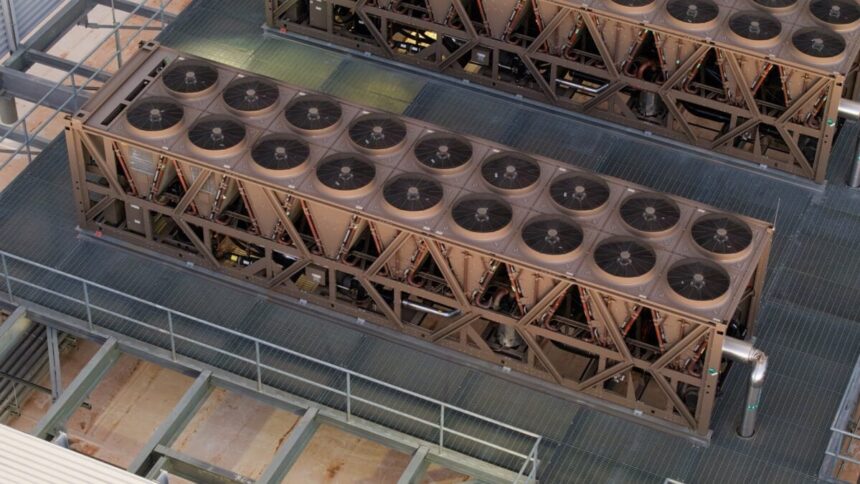
According to Sailor, a single data center can produce more waste heat than 40,000 households. The study explains that many of these facilities use air-cooled condenser arrays to offload server-generated heat, creating plumes of hot air that can be 14 to 25 degrees F (8 to 14 degrees C) warmer than the surrounding temperature. Wind can then push that air beyond the perimeter of the facility, expanding its impact.
To quantify the ambient warming effect of the Mesa and Chandler data centers, Sailor and his colleagues mounted high-precision, rapid-response air temperature sensors on cars and drove them around the facilities and through nearby neighborhoods, logging their GPS location as they went. Data collection took place from June through October, 2025.
Using multiple vehicles allowed the researchers to simultaneously measure temperatures upwind and downwind of the data centers. When they compared them, they found downwind temperatures to be 1.3 to 1.6 degrees F (0.7 to 0.9 degrees C) on average, with individual readings reaching as high as 4 degrees F (2 degrees C) above upwind temperatures. Based on consistent alignment of the temperature signal with the prevailing wind direction across multiple sites, dates, and weather conditions, they attributed the warming effect to the facilities.
A growing threat to heat-vulnerable cities
An average air temperature boost of roughly 1 degree F (less than 1 degree C) may not sound like a lot, but that’s enough to drive up air conditioning use across entire neighborhoods and produce even more heat pollution, according to Sailor.
Prior modeling for Phoenix, Arizona, has shown that waste heat from residential air conditioning alone increases overnight temperatures by roughly 2 degrees F (1 degree C). This creates a feedback loop where data center operations increase the energy burden on surrounding neighborhoods, the study states.
What’s more, Sailor believes his team’s findings are a conservative estimate. “As we do more measurements under different kinds of atmospheric conditions, I think we’re going to see more significant impacts around data centers,” he said.
Previous research suggests that may in fact be the case. For example, a separate study that is still awaiting peer review found that data centers can create heat islands that affect neighborhoods within a 6-mile radius, much larger than the radius Sailor and his colleagues identified.
As the tech industry builds more and more data centers near cities that are vulnerable to extreme heat, understanding—and mitigating—their impact on local temperatures will be critical. Sailor’s team plans to gather more extensive data over a wider range of times and weather conditions. This will help the researchers build an atmospheric model for studying measures to reduce heat pollution from data centers.
Read the full article here