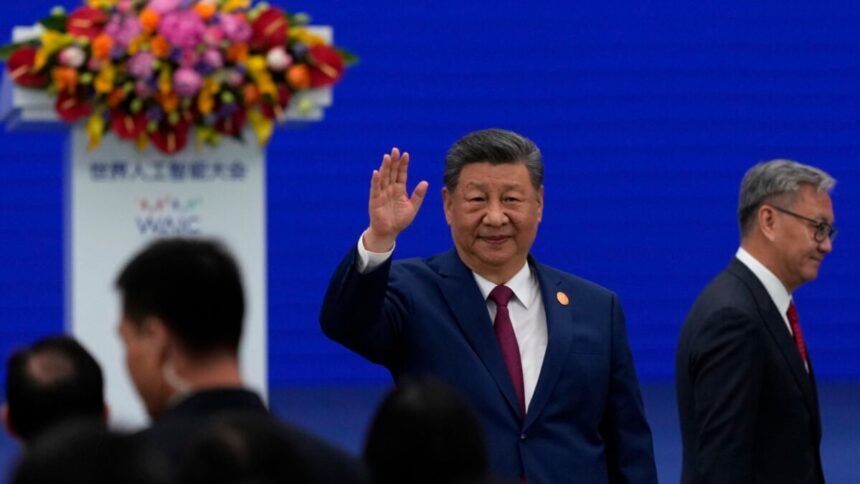
On Friday, Chinese President Xi Jinping had his first in-person appearance at his country’s biggest artificial intelligence event, the annual World Artificial Intelligence Conference in Shanghai. In his long-awaited debut speech, Xi called for more open-source AI and cooperation across borders, taking a stance squarely opposite to his American counterpart, the tariff-loving President Donald Trump.
“We often say in China, ‘A single string cannot make music, and a single tree does not make a forest,’” Xi told the crowd in Shanghai, per China Daily. “AI development should not be a solo performance by a single country, but a symphony of international cooperation.”
Xi has reason to say this. China and the United States have been locked in a contest for global AI industry domination. With frontier American labs like OpenAI and Anthropic and the industry’s number one chip supplier, Nvidia, the United States has the lead for now. But Chinese companies are quickly bridging that gap, providing open models that can outperform some of American Big Tech’s closed offerings.
The shocking performance upgrades in some of these models have caused the Trump administration to take a stricter stance on AI trade with China, much to the dismay of chip giant Nvidia, which used to count China as one of its largest markets. Nvidia CEO Jensen Huang has advocated for the normalization of trade ties between the two superpowers, arguing that the wide prevalence of American technology abroad, particularly in China, would mean that their AI industry would be entirely dependent on American technology, ensuring American hegemony.
At Nvidia’s first GTC to be held in Washington, D.C. late last year, Huang warned the politicians in the crowd that this dynamic can be switched at any time. With China’s renewed focus on open-source AI, Silicon Valley’s complete retreat from the Chinese market would make the U.S. “ill-prepared” for when Chinese software “permeates the world.” Huang’s plea for American dominance in China seems to be Xi’s game plan for Chinese dominance globally. Though for now, Xi’s framing of Chinese dominance is all about no one dominating anyone else.
“We should seize this rare, historic opportunity to encourage open source, openness, collaboration, and sharing,” Xi said. “As a responsible major country, China is always committed to providing international public goods relating to AI.”
China is not just calling for global solidarity, but is basing AI cooperation on Chinese terms. At last year’s World AI Conference, Chinese government officials proposed the formation of a global AI cooperation organization headquartered in Shanghai. At this year’s conference, Beijing officially announced the new coalition, the World Artificial Intelligence Cooperation Organization, and said that it had 29 member nations, including some heavy-hitters like Brazil and Russia.
This emphasis on open cooperation and joint research kills two birds with one stone: it furthers the development of AI within China, and it ensures global AI development is guided by Chinese principles and under China’s wings, positioning the country as the industry leader globally.
Especially by investing in Global South economies where the AI landscape is just developing, China is looking to establish control early on in AI industries around the world. Also on Friday, Xi committed to providing developing countries with 5,000 opportunities in AI training programs over the next five years and to developing international AI application cooperation centers across the Global South.
“This is a major move by China to answer the call of the Global South and unite the international community together to promote vigorous AI development and governance,” Xi said on Friday. “It will be an important milestone in the history of AI development.”
Although Xi praises “true multilateralism” with all countries, reports suggest Beijing sings a different tune behind the scenes when it comes to the United States. According to Reuters, Chinese officials have met with top labs in the country to discuss limiting overseas access to open-source and proprietary models. Chinese authorities also recently forced Meta to dismantle its acquisition of Chinese AI startup Manus and suspend all data-sharing. Chinese AI developers are also increasingly switching from Nvidia to local silicon providers at the encouragement of the Chinese government.
So, this Chinese vision of global AI cooperation might not necessarily include the United States, even if the Trump administration were to walk back its hard-line trade stance.
On Friday, Xi also made pleas for AI safety and took a more pro-regulatory stance, highlighting yet another way he wants Beijing to differ from Washington under Trump, while also taking a rather apparent jab at his Administration’s national security policy decisions.
Last month, Trump barred Anthropic from sharing Mythos—its latest model, which is said to have powerful hacking capabilities—with foreign nationals inside or outside the United States. He has since partially lifted that ban, allowing the company to resume sharing the model with select companies and agencies. It’s safe to assume that Chinese companies and agencies don’t make that short list, considering that when Washington says “national security concerns” in the context of AI, they more often than not are referring to China.
“We should put in place laws and regulations, technological monitoring, early warning, and emergency response systems in order to strengthen the line of security, prevent abuses and malicious use, and ensure that AI is always under human control,” Xi said. “In the meantime, we should jointly oppose overstretching the national security concept in the field of AI and placing one country’s security over that of others.”
Read the full article here