Governments and private companies are racing to master the art of space-based refueling, whether the goal is recharging satellites or reloading spacecraft with a full tank of fresh chemical propellant. U.S. Space Force, to cite just one example, has awarded tens of millions of dollars to private contractors promising orbital fueling stations capable of delivering hydrazine to its space-based platforms.
Now, researchers with China’s Xidian University have announced progress in their plan to develop a far cleaner and more sustainable alternative: a space-based solar power plant capable of remotely recharging drones while these uncrewed aerial platforms are still in flight. According to an announcement Monday by China’s official state news site, Xinhuanet, scientists and engineers with the university’s “Sun Chasing” project managed to deliver 143 watts of stable power from their prototype solar platform to a drone flying at roughly 19 miles per hour (30 kilometers per hour) from 98 feet (30 meters) away.
And the device apparently fared even better delivering wireless electricity to stationary targets, Xinhuanet reported. “In recent tests, the system achieved a wireless power transmission efficiency of 20.8% from direct current to direct current over a distance of [328 feet] 100 meters,” the news agency said. “It delivered 1,180 watts of power.”
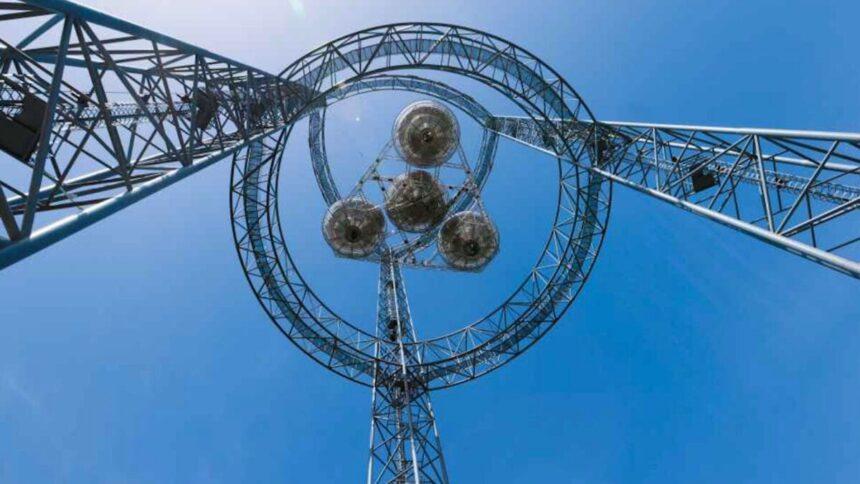
Xidian’s Sun Chasing team foresees broad “civilian and military” applications for its project, which has been suspending its prototype orbital solar-power plant from Eiffel Tower-like metal scaffolds in the northwest Shaanxi province for years. As the university explained in 2022, the project could one day power “disaster relief” efforts in remote areas as easily as it could power “military emergency radars, stratospheric vehicles, and drone swarms,” according to a Google-translated statement.
Drone on and on
Duan Baoyan—leader of the Sun Chasing project and a professor at Xidian University’s school of mechano-electronic engineering—said that his team has now solved the technical problem of powering multiple moving targets simultaneously via a lone transmitter.
Duan added that his fellow researchers expect that one space-based solar power station, like their prototype, could eventually deliver electricity to multiple satellites and ground-based vehicles all at once, according to comments reported by China Daily.
The team’s new milestone improves upon 2022 tests in which its direct current-to-direct current transmission between the platform and moving targets, such as drones, achieved 15.05% efficiency.
Sun Chasing’s wireless energy beam, transmitted via a high-power microwave antenna, can now reportedly be collected via the team’s specialized receiving antenna systems at an efficiency of 88%. The team has also worked to make these antennas smaller and lighter—improving their economic feasibility for space deployment.
The next big step, according to Duan, is to finally conduct tests in orbit.
Solar-power space race
China is, of course, not alone in its ambitions for space-based wireless solar power platforms. Researchers at the California Institute of Technology have already launched their own successful prototype of this technology, their MAPLE phased array for wireless power transmission, onboard their Space Solar Power Demonstrator-1 back in 2023.
And, of course, famed electrical pioneer Nikola Tesla demonstrated the basic feasibility of wireless power transmission all the way back in 1899 at his Colorado Springs lab. (A century-plus head start that titans of American industry like J.P. Morgan and George Westinghouse fumbled, whether for lack of vision or lack of profit potential.)
But that history does not mean Sun Chasing’s effort to make these systems a reality has been a cakewalk.
“Scientific research, especially engineering projects like ours, requires hands-on experience, practical operation, and repeated field visits,” as Duan explained in a 2022 statement, translated via Google. The team took three years to construct its ground verification system, which included hauling over a 440-pound (200-kilogram) microwave antenna and other preliminary equipment around Shaanxi.
“Computational simulation, installation and debugging, these are nothing compared to the challenges we sometimes encounter,” Duan’s colleague Professor Zhang Yiqun added. “They don’t feel like research at all.”
Read the full article here