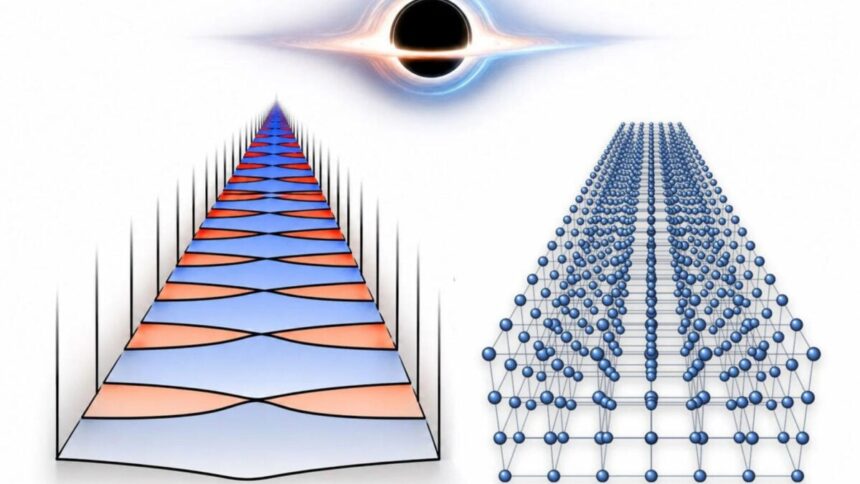
In 1993, Canadian physicist Matthew Choptuik demonstrated black holes may emerge spontaneously from critical collapse, during which spacetime curvatures organize themselves into a defined, repeating crystal-like pattern. But researchers weren’t quite able to describe this nicely in formulaic language—until now.
A team of theoretical physicists say it’s found the long-sought formula for how spacetime crystals could collapse into black holes, reporting its work in a recent Physical Review Letters paper. To be clear, the heavily mathematical study will need further testing via empirical investigations. But the theoretical results, nevertheless, offer astronomers more precise parameters for exploring a fascinating alternative for how black holes emerged, particularly in the universe’s earliest days.
“Depending on the desired precision, we can systematically improve our formulas using additional approximation methods,” Florian Ecker, the study’s co-author and a theoretical physicist at TU Wien in Austria, said in a statement. “This gives us a new method for studying black-hole-related phenomena that could previously not be analyzed analytically.”
Small ripples, big consequences
Albert Einstein’s general relativity views gravity as the curvature of spacetime. As one of the most successful theories in physics, this idea has been confirmed observation after observation, particularly through faraway, massive objects that only make themselves visible to us via gravitational lensing, which warps and magnifies their light.
“But smaller masses also produce spacetime curvature, just to a lesser extent,” Christian Ecker, the study’s first author and a theoretical physicist at Goethe University Frankfurt in Germany, said in the release.
And in physics, the tiniest shifts can trigger huge changes, added Daniel Grumiller, the study’s co-author and a theoretical physicist at TU Wien. For instance, the slightest change in temperature can push disordered water molecules to organize into crystalline ice structures at 32 degrees Fahrenheit (0 degrees Celsius).
Critical collapse!
Similarly, relatively small relativistic effects allow relatively smaller objects to trigger the reorganization of spacetime curvature. According to Choptuik’s 1993 simulations, spacetime falls into a repeating pattern—a kind of spacetime crystal—and the process leading to this state is referred to as critical collapse. According to the statement, these states are believed to have existed shortly after the Big Bang, meaning spacetime crystals could even be responsible for primordial black holes.
“This spacetime crystal is a very peculiar and fascinating object,” Grumiller said. “It is a kind of intermediate state, an unstable point that can evolve in two different directions.”
That could mean the crystal could simply dissolve. But a tiny drop of energy could set off something entirely different—the formation of a black hole, he added. That story is quite the deviation from typical origin stories for black holes, which most often emerge from “spectacular” events like supernovas.
Bringing theory to life
Theoretically speaking, however, arbitrarily small black holes can exist. The team behind the latest research bet on this possibility, entertaining a multi-dimensional approach “encoded in a single function of time,” according to the paper. When applied to critical collapse structures, the researchers found their solution nicely provided “systematic analytic control” of a hypothesis physicists long struggled to describe mathematically.
For now, everything is in the realm of theory. The team expressed in the statement that from here, the goal is to translate its solutions to a smaller number of dimensions that better reflect the observable universe. For all we’ve learned about black holes, there’s arguable more that we don’t know.
So again, we’ll have to see if astrophysicists decide to give the new framework a try. But if the framework really can empirically confirm Choptuik’s conjecture—that some black holes emerge from more “tame” conditions—that’d be huge for black hole astronomy.
Read the full article here