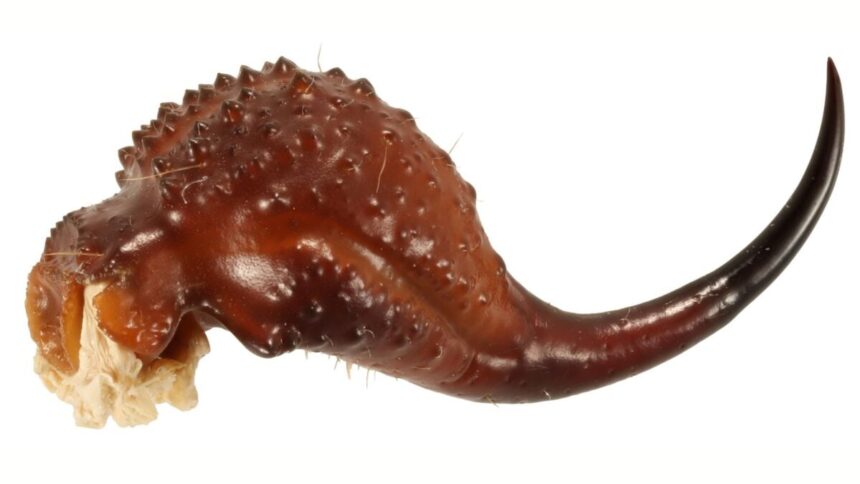
One of the more fascinating and fearsome creatures in the world, the scorpion, is even cooler than you might have thought. Research out today confirms these arachnids’ weapons are quite literally laced with metal.
Scientists at the Smithsonian National Museum of Natural History and others studied more than a dozen species across the scorpion family tree up close. All of the scorpions had various kinds of metal in their pincers and stingers, albeit in unique, sometimes unexpected configurations. These metals play an important role in helping scorpions hunt and defend themselves, the researchers say.
“This study highlights that metal enrichment has strongly diversified in relation to how different species have evolved to use their pincers and stingers,” lead author Sam Campbell, who was a pre-doctoral scholar at the Smithsonian at the time of the research’s completion, told Gizmodo.
Metal arachnids
Scorpions are part of the arachnid family, though they split off on their own branch around 435 million years ago. They’re thought to be one of the first animals to have jumped from the sea to land, and they’ve been a rousing success story ever since. Much of this success is due to their body shape, which has remained remarkably consistent to this day. Their grasping pincers and rapidly striking tail, equipped with a stinger that delivers potent venom, can be used to both subdue prey and defend against potential threats.
Previous studies have shown that some species have metal in their pincers and tails. That said, it wasn’t known if this is a universal feature or whether the composition and location of these metals could differ in relevant ways throughout the large order of scorpions, according to the researchers.
“To our knowledge, our study is the first that performs statistical analysis of metal uptake across scorpions while also accounting for phylogenetic relationships,” senior study author Hannah Wood, a research entomologist and curator at the Smithsonian National Museum of Natural History, told Gizmodo. “This meant we were able to effectively map out how metal enrichment varies between species, and statistically test whether different metals were evolving together, while accounting for shared ancestry.”
Thanks to the National Museum of Natural History’s extensive collection of preserved samples, the researchers were able to study 18 species representing different broad groups of scorpionkind. They used high‑resolution electron microscopy and X‑rays to closely examine the scorpions’ pointy appendages.
They found several similarities and differences between the various scorpions. Zinc was the most prevalent metal found at the very tip of the scorpions’ stingers, for instance, followed by a layer of manganese. The scorpions’ pincers tended to have either zinc or a mix of zinc and iron, though typically only on the cutting edge; that suggests these metals are critical to ensuring the durability of these weapons when hunting prey. And the more zinc a scorpion had in its tail or pincers, the less it had in the other, indicating an evolutionary trade-off, according to Campbell.
Surprisingly, the researchers found less zinc in species that had stronger pincers for crushing, contrary to their expectations that zinc would be vital for boosting the strength of these weapons. “This means that scorpions with slender, weaker claws have higher concentrations of zinc in the claws, likely to improve wear resistance and hardness where physical leverage is lacking,” Campbell said.
Though scorpions might rely on them in different ways, they’re probably all at least a little heavy metal, the researchers say.
“Arguably, that is exactly what this study shows, though it is important to note in this study we tested 18 species,” Campbell said. “There are close to 3,000 species of scorpion, and they all likely feature metal enrichment!”
The team’s findings were published Tuesday in the Journal of the Royal Society Interface.
What might come next
Campbell worked on this project as part of his thesis. His main area of research is now venom, particularly scorpion venom. But there’s plenty more that other researchers could learn about the metals in scorpions and similar arthropods (the broad group of invertebrates that include arachnids, insects, and other creepy crawlies).
It would be nice to look for metals in an even greater variety of scorpion species, for instance. Some researchers have also speculated that diet might play a part in how much metal a scorpion is able to have. And since female scorpions are typically much bigger than males, perhaps they have much more metal, too.
It’s also known that spider fangs as well as the stingers of bees and wasps contain metal. Yet it’s not clear whether these body parts have the same composition as those in scorpions or whether the infusion of metal in these natural weapons is an inherited, evolutionary trait spread across arthropods, Campbell noted.
The team has created a method intended to standardize how scientists can measure metal in arthropod exoskeletons. So with any luck, these and other questions could be answered in the near future.
In the meantime, I’m just hoping this discovery inspires some video game developers out there to create one hell of a scorpion-themed boss to fight against one day (for the nerds out there, yes, I’m already aware of the Guard Scorpion from Final Fantasy 7).
Read the full article here