

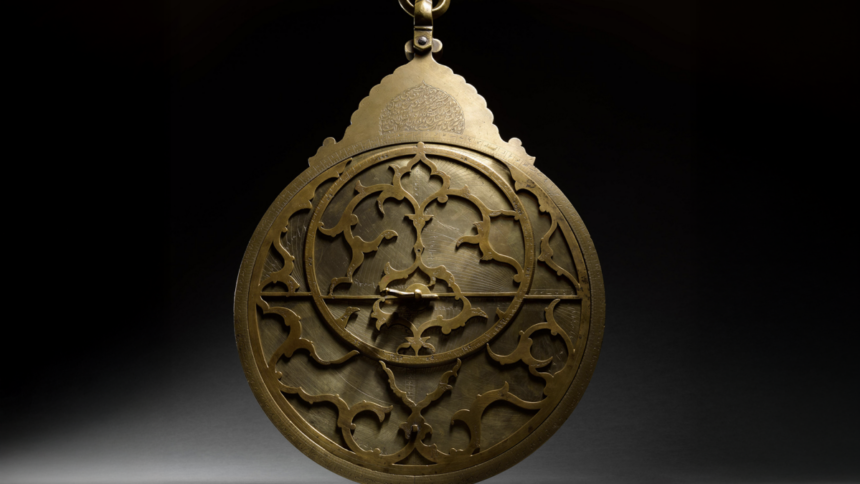
Big news from the world of auctions, where what might well be the single largest astrolabe on Earth is up for sale. And what, you might wonder, is an astrolabe? Oh, boy, am I glad that you asked.
The astrolabe is essentially a specialized analog calculator designed to be used as a clock and a navigation aid. They date back to the Ancient Greeks, and are also identified strongly with Islam, largely because it was Muslim scholars in the 8th and 9th centuries who reintroduced the devices to the world, refining and improving on their design in the process. And they are fascinating, strikingly clever devices.
In the most basic sense, an astrolabe is a flat disc with a ring that allows it to be hung from a hook or nail. On one side of the device, a two-dimensional projection of the night sky is superimposed over a projection of the horizon. The night sky projection is mounted on a rotating disk, and rotating it simulates the movement of the stars over the course of a single day and night. Multiple prominent stars are identified on the rotating disk, allowing their positions to be referenced against the actual sky, and the device can accommodate different horizon plates depending on how far north a user was.
The other side of the disk is essentially a chart with information about the sun’s trajectory through the sky on every day of the year, over which is mounted a straight ruler that can be rotated freely. The outside of this side is printed with an angular scale, a key innovation introduced by Muslim astronomers in the 9th century.
To tell the time, you align the ruler with the sun, allowing you to read off the sun’s elevation above the horizon from the angular scale on the disk’s perimeter. (This is the adjacent angle of the triangle that a given object in the sky forms with the observer and the horizon, with 0 degrees meaning the object is sitting exactly on the horizon, and 90 degrees meaning it is directly overhead). Cross-referencing the sun’s elevation with the day of the year gives you the time of day.
But what about at night? Well, you can take a similar reading of angular elevation for one of the stars marked on the device’s rotating portion. If you then rotate the celestial map so that the star sits at the given elevation, you can calculate the sun’s position, even when it’s below the horizon. Clever!
The other main function of the astrolabe was as a navigation aid. Calculating the sun’s position also gives you its position between east and west, which in turn allows you to calculate true north. It would also allow you to calculate the direction to Mecca, an important function given the astrolabe’s ubiquity in the Muslim world.
The device also had many other uses—so many, in fact, that one 10th century enthusiast reportedly wrote a 386-chapter book listing over 1,000 ways that you could use an astrolabe. For example, you could use the same method for sighting celestial objects’ angular elevation to measure the angular elevation of other objects, and if you knew how far away such objects were, then basic trigonometry would allow you to calculate their height.
Anyway, the astrolabe that’s on sale can do all this, and also has the distinction of being huge. Your average astrolabe falls somewhere around the size of the plates in your kitchen cupboard, with the smallest being around the size of tea saucers and the largest about the size of a dinner plate. This monster, meanwhile, has a diameter of about a foot, has an ornate housing that adds another six inches to its height, and weighs 18 pounds. This makes it “perhaps the largest in existence,” according to Sotheby’s.
It was made in Lahore during the early 17th century by brothers Qa’im Muhammad and Muhammad Muqim, who were renowned astrolabe craftsmen of their era. It was commissioned by one Aqa Afzal, an important administrator in the Mughal empire. It eventually caught the eye of Maharaja Sawai Man Singh II of Jaipur, where the rulers were famous for both a love of astronomy, and a certain lack of subtlety or restraint.
Anyway, it’s easy to assume that the pre-digital era simply lacked the facility for computing that we take for granted. And while the advent of the transistor has obviously been transformative, previous generations showed all manner of ingenuity in constructing analogue devices like the astrolabe to make their lives easier. Sadly, if you want to play around with an astrolabe, you’ll probably want to look elsewhere—as per the BBC, this one is “coming to the market at an [estimated price] of £1.5m–2.5m.”
Read the full article here