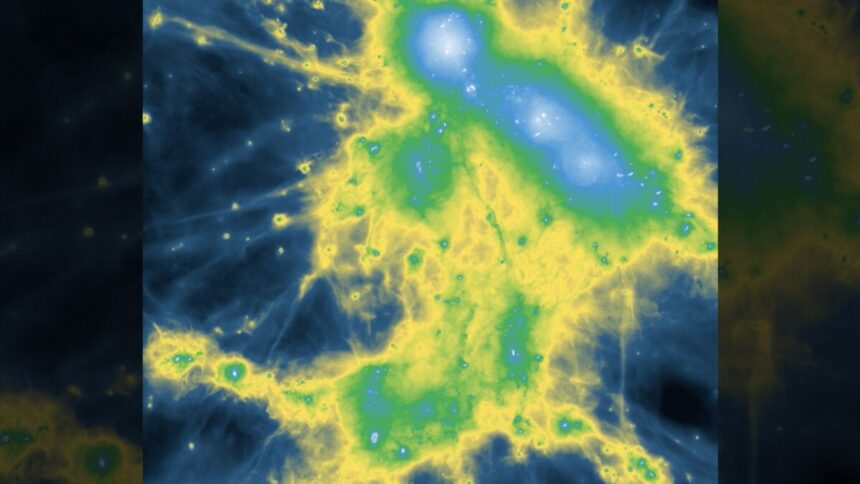
A huge missing chunk of our universe has been found at last, but I’m not talking about dark matter.
For decades, there’s been a discrepancy between the amount of ordinary—neither invisible nor dark—matter that we should see and that which we actually observe. A new study published today in Physical Review Letters suggests that, fortunately, this conflict does not reflect poorly upon leading astrophysical models. By studying “smears” in fast radio bursts, researchers successfully mapped the distribution of this missing ordinary matter, which turned out to be diffuse clouds of baryonic gas surrounding galaxy clusters. These diffuse clouds may be flung outside galaxies through black hole jets, according to the researchers.
“We are finding that the activity in galaxies is messier than we thought,” Haochen Wang, the study’s first author and a graduate student at the Massachusetts Institute of Technology (MIT), told MIT News. “They’re more like fountains and really push out gas to very large distances.”
Ordinarily elusive
More formally, “ordinary” matter in this context refers to matter consisting of baryons, a family of particles that include protons and neutrons. Estimates posit that about 17% of the early universe consisted of baryonic matter, some of which evolved to become planets, stars, galaxies, and more. However, the total mass of all visible objects in the universe adds up to a measly 10% of that 17%, according to the paper.
That led scientists to hypothesize that the remaining 90% resided elsewhere in the universe—but where? If we’re not seeing these baryons in stars or galaxies, there should be a good chance that we could find them in the cooler, widely dispersed gas surrounding galaxies, according to the study. And to trace the whereabouts of this elusive gas, the researchers employed an equally puzzling cosmic phenomenon: fast radio bursts.
An uncanny pair
First detected in 2007, fast radio bursts are fleeting flashes of radiation that can “outshine an entire galaxy,” often with cryptic origins, according to NASA. For the latest study, the team harnessed the extreme energy of fast radio bursts to search for signs of missing ordinary matter. The researchers analyzed thousands of past fast radio burst measurements and paid close attention to how the signal shifted on its way to Earthbound laboratories.
Fast radio bursts “start out as a very quick flash, and as they pass through matter, they smear out in time,” Wang explained. “And we can measure that smearing very precisely, which is directly proportional to how much missing matter the FRB passed through.”
Specifically, the team compared these “smears” to the amount of baryonic matter that the fast radio burst must have traveled through to experience this distortion. Then, the researchers examined the relationship between these measurements and the locations of over 6 million galaxies.
Concealed in the open
According to the analysis, there was indeed a pattern of “missing” baryonic matter widely dispersed across galaxies and galaxy clusters. However, the team was slightly surprised at its sheer range. Overall, this missing matter was scattered like a “diffuse puff” millions of light years away from galaxies.
“A galaxy is maybe a few 100,000 light years across, and we found missing matter out to about 4 million light years,” Kiyoshi Masui, the study’s co-author and a physicist at MIT, told MIT News. “That’s further than the simulations predict, by quite a bit.”
What this could mean is that highly energetic processes such as black hole jets or exploding stars are flinging baryonic matter far, far across the universe. The energy levels involved in these processes appear to be much stronger and more violent than we thought, Masui added.
That said, there’s much we’ve yet to understand about missing baryonic matter and, in fact, fast radio bursts. While the latest work demonstrates that the latter can give some clues to the former, we’ll surely see some more discoveries as we continue to detect more radio bursts, the team concluded in the paper.
“We got it to work for the first time and will get it to work even more precisely as data gets better,” Masui said.
Read the full article here