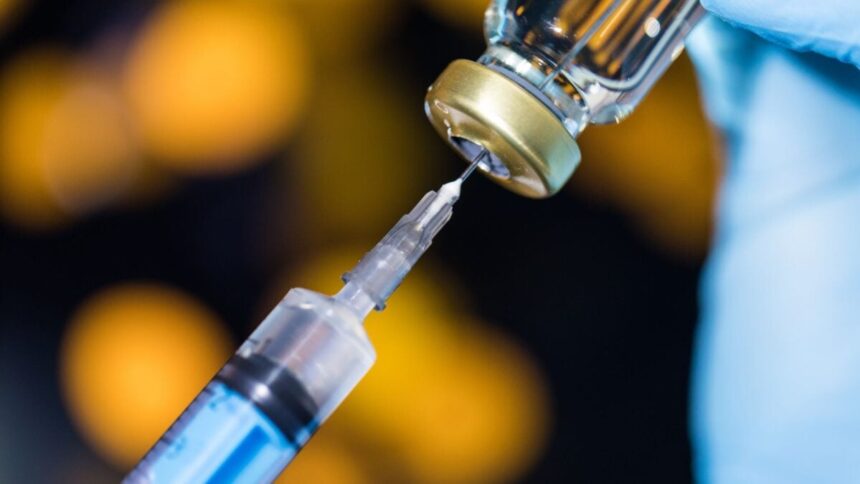
As bad a reputation as artificial intelligence has gotten in the public eye as of late, it’s helping to push medicine further. Case in point, an experimental pan-coronavirus vaccine developed with AI has just passed a phase I trial in the UK.
Scientists at the University of Cambridge used AI to find a kink in the armor of coronaviruses, including SARS-CoV-2, the cause of covid-19. In healthy human volunteers, the vaccine candidate appeared to be safe and generated an immune response to multiple coronaviruses. The researchers are also hoping to use their platform to develop broadly effective vaccines against flu and the Ebola virus.
“We’ve overcome the problem of traditional vaccines, which have limited protection,” said study author Jonathan Heeney, a researcher from the Lab of Viral Zoonotics at Cambridge, in a statement from the university. “It means we can escape the constant cycle of chasing the virus variants circulating in humans and updating the vaccines to try to catch up, like a dog chasing its tail.”
The universal holy grail of vaccines
Vaccines train the immune system to recognize a germ before it actually infects us. This can be done by exposing the body to a weakened or killed version of the pathogen or a piece of it, known as an antigen.
Some vaccines can provide sustained and even lifelong immunity, typically because the germ doesn’t change enough in meaningful ways to avoid this recognition. Yet other germs, like coronaviruses and influenza viruses, mutate constantly, shifting the parts of themselves that today’s vaccines use for training. As such, these vaccines have to be constantly updated and taken to ensure a decent level of immunity. To get around this limitation, some scientists are trying to develop universal vaccines that rely on distinct, rarely changing antigens found in a wide range of the target virus group.
What makes this experimental vaccine unique is that the researchers used AI to pinpoint the “super-antigen” deployed as its target. Their model was trained on genetic data collected from all known sarbecoviruses, including SARS-CoV-2, the original SARS virus, and bat coronaviruses. Importantly, it’s these latter viruses that could someday spill over into humans and trigger the next major epidemic or pandemic (the lineage of SARS and possibly SARS-CoV-2 likely originated in bats).
The researchers then tested their vaccine candidate, dubbed pEVAC-PS, on 39 healthy human volunteers—reportedly the first ever human trial of a vaccine designed completely with AI. It was delivered via a needle-free injection, with people given one of four varying doses.
Phase I trials are mainly intended to assess the safety of an experimental drug or vaccine. And pEVAC-PS seemed to do well, with no serious or unexpected adverse events detected during the study. The researchers also found early evidence in their volunteers that the vaccine could produce an immune response to several coronaviruses at once.
“In summary, pEVAC-PS was safe and well tolerated, with evidence of cross-reactive binding to conserved sarbecovirus epitopes,” the authors wrote in their paper, published last month in the Journal of Infection.
What comes next
Successful Phase I trials alone are not sturdy proof that a drug or vaccine can work as hoped, only a potentially promising sign. Notably, pEVAC-PS generated modest and variable immune reactions to the coronaviruses the researchers looked at, though this might have been because the volunteers (and most everyone in the world) were extensively exposed to SARS-CoV-2 already.
The researchers are next planning to test pEVAC-PS in a Phase II trial. And they’ve created a spinoff company to further develop the AI platform used to create pEVAC-PS, called DIOSynVax (short for Digitally Immune Optimized Synthetic Vaccines). The team is hopeful that other universal vaccines against pandemic-level threats like flu can be produced with the help of AI.
“If we can develop and clinically advance this new class of vaccines before a virus outbreak begins, millions of lives could be saved, lockdowns avoided and the economy preserved,” said lead trial researcher Saul Faust from the University of Southampton in a statement.
Read the full article here