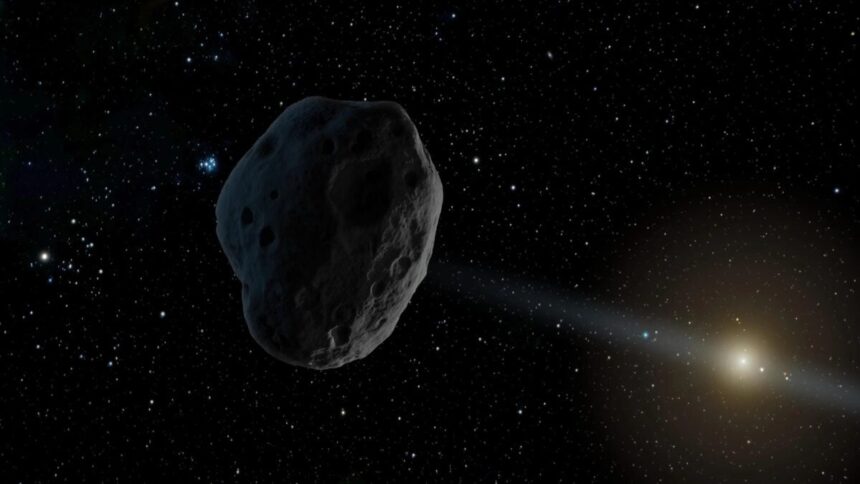
On August 28, 2025, astronomers aimed NASA’s radar system at a region of space where a near-Earth asteroid was expected to appear. Instead, the object failed to show up, leaving researchers puzzled. The unexpected no-show turned what seemed like a routine observation into a surprising case of mistaken identity.
In a study published in Nature Astronomy, a team of scientists reveals the true identity of a near-Earth object with an apparent dual personality. Scientists had been tracking the object for 28 years, assuming it might be an asteroid. Its recent deviation from its predicted path, however, suggested something unexpected is influencing the object’s motion.
Although previous observations of asteroid 1998 SH2 didn’t show obvious comet-like behavior, a more precise measurement of its position in the sky proved that its motion is irregular like that of a comet.
A comet in disguise
Scientists tracked the object’s orbit around the Sun from 1998 to 2016, where it circled our star twice. It wasn’t until 2025 that scientists attempted to carry out additional observations using NASA’s Deep Space Network.
The object, provisionally known as the asteroid 1998 SH2, passed safely within 2 million miles (3 million kilometers) of our planet during its 4.5-year orbit around the Sun. Researchers calculated its position using data from previous orbits and factored in the effects the Sun’s gravity, as well as the planets, would have on its path. They then pointed NASA’s array of giant radio antennas toward that specific point in the sky, but asteroid 1998 SH2 didn’t show up.
“After we measured the nongravitational perturbations affecting the motion of 1998 SH2 and recognized they weren’t compatible with the object being an asteroid, we suspected the object could be an active comet,” Davide Farnocchia, a navigation engineer with the Center for Near-Earth Object Studies at NASA’s Jet Propulsion Laboratory and lead author of the study, said in a statement.
By scouring previous observations of the near-Earth object, the researchers determined that it may be generating a small thrust by venting gas into space. That small thrust would cause it to deviate from its predicted path.
A closer look
When a comet passes closely to the Sun, the heat from the star turns its ice to gas. Scientists usually identify regular comets by their trademark tail and coma, the gas and dust surrounding a comet’s nucleus. In the case of 1998 SH2, the amount of outpouring gas and dust was in much smaller quantities, so its resulting tail and coma were not detectable in most observations.
The researchers behind the new study set out to get a closer look at 1998 SH2 during its August 2025 close approach. They enlisted the help of astronomers at the 3.6-meter (12-foot) Canada-France-Hawaii Telescope near the summit of Mauna Kea, Hawaii, and the 1.5-meter (5-foot) European Southern Observatory’s Danish Telescope in La Silla, Chile, as well as the European Southern Observatory’s 8.2-meter (27-foot) Very Large Telescope on the Chilean mountain Cerro Paranal.
“The images we collected from these observatories showed a weak but clear tail, thus confirming that 1998 SH2 is, in fact, a comet,” Olivier Hainaut, an astronomer with the European Southern Observatory and coauthor of the study, said in a statement. “That’s how science works — you form a hypothesis, and you set out to test it. This data is exactly what was needed to confirm our hypothesis that 1998 SH2 was a comet.”
As a result, 1998 SH2 will receive an additional comet provisional designation as P/1998 SH2.
The new study also sheds light on an enigmatic class of objects known as dark comets, which tend to look like an asteroid but behave like a comet. Dark comets also exhibit trajectories that are a little unusual for asteroids, and yet they don’t show the trademark tail and coma of a regular comet.
The researchers behind the study believe that some of these dark comets may just be regular comets with a faint tail and coma. Therefore, they should be observed with powerful telescopes to reveal their true identity.
“This work shows the importance of continuously tracking near-Earth objects,” Farnocchia said. “Because of outgassing, the motion of comets is more significantly perturbed than that of asteroids. Detecting these perturbations can be an important diagnostic tool for planetary defense that will help understand which objects may be comets rather than asteroids, how their orbits evolve, and how that influences their Earth impact risks.”
Read the full article here