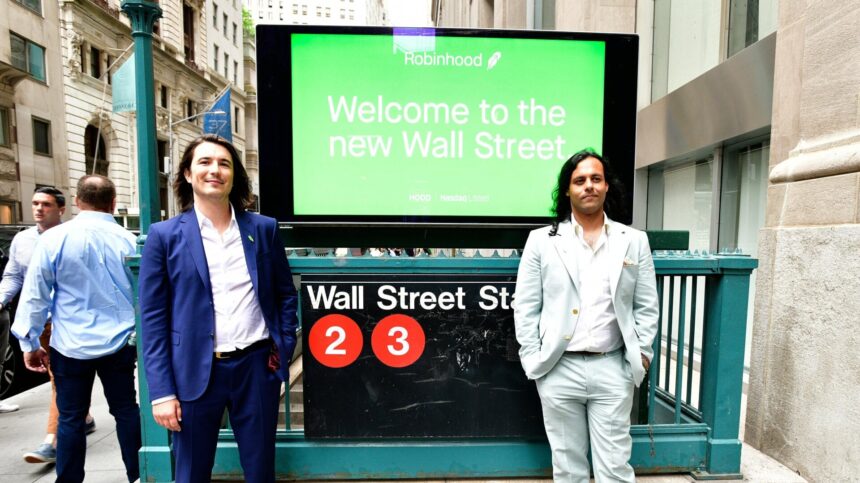
Robinhood and AMC were both central characters in the infamous 2021 meme-stock frenzy. Five years later, they have found themselves on opposite sides of a very different fight regarding whether Robinhood can create and sell blockchain-based financial products tied to publicly-traded companies without those companies’ approval.
AMC CEO Adam Aron says the practice may violate securities laws and hurt his company’s ability to raise capital, while Robinhood says it knows the rules and has no intention of stopping.
Robinhood has spent the past year pushing deeper into tokenization. Its original Stock Tokens launched for eligible European customers in 2025, and the company also launched the mainnet for its own Robinhood Chain in July. The new system was designed specifically around tokenized real-world assets, with more than 190 Robinhood Stock Tokens tied to U.S. companies and ETFs available to eligible investors in more than 120 countries. The tokens can trade 24/7 and be used in decentralized finance (DeFi) applications.
Robinhood says its Stock Tokens are tokenized debt securities issued by Robinhood Assets (Jersey) Limited, rather than shares issued by the companies whose tickers they reference. They provide economic exposure to an underlying stock but do not give holders legal or beneficial rights in that company, including voting rights.
AMC CEO Adam Aron was furious when he discovered his company’s stock was among the assets being tokenized.
“I find this practice to be contemptible, outrageous, disgusting, detestable, inexcusable, vile,” Aron wrote on X. He said AMC had “no connection to this at all” and did not condone it, adding that the company would immediately have outside securities counsel investigate. Aron’s X post:
What’s the concern?
— Vlad Tenev (@vladtenev) September 4, 2026
When Robinhood CEO Vlad Tenev asked Aron, “What’s the concern?”, Aron responded that the list of potential issues was “almost existential.” He questioned how a U.S. company could establish an operation in Jersey, roughly 3,000 miles away, and market a security that appears to represent AMC without complying with U.S. securities laws. Aron also argued that the structure could interfere with AMC’s ability to raise capital and could create issues around shareholder rights. He described the resulting market as a “quasi-fake market” that could further undermine public confidence in financial markets.
He called on Robinhood to voluntarily “CEASE AND DECIST” trading in AMC tokens and said AMC’s securities lawyers had been asked to determine whether the company could force Robinhood to stop.
Robinhood’s chief legal officer, Dan Gallagher, responded, “We know a little something about the U.S. securities laws and will not ‘DECIST.’ Send your lawyers and we’ll educate them.”
This is not the first time a company has objected to Robinhood putting its name on a token. In 2025, Robinhood offered European customers promotional “OpenAI” and SpaceX tokens. OpenAI quickly disavowed the offering.
“These ‘OpenAI tokens’ are not OpenAI equity,” OpenAI’s newsroom account wrote. “We did not partner with Robinhood, were not involved in this, and do not endorse it.” OpenAI also said that any transfer of its equity required the company’s approval, which it had not given.
The AMC fight comes as tokenization has become one of crypto’s favorite narratives. According to proponents, issuing tokens associated with stocks, bonds, dollars, and other real-world assets on a blockchain allows users to trade them around the clock, move them between wallets, use them as collateral, and make financial markets accessible to people who cannot easily access the traditional system.
Robinhood is explicitly selling that vision, and so are other major exchanges and financial institutions. The New York Stock Exchange, for example, has proposed a blockchain-based platform for 24/7 trading and faster settlement.
However, the more tokenization resembles traditional finance, the more questions pop up around what’s really going on here.
A growing share of the industry now involves centralized companies issuing tokens that represent claims on traditional assets. The technology can make those assets easier to move and program, but it can also amount to rebuilding the existing financial system on blockchain infrastructure while leaving the important points of control in roughly the same hands. That tension has become a recurring theme in crypto, as stablecoins, corporate blockchains, tokenized securities, and other centrally controlled products have grown in importance.
These sorts of initiatives make obvious sense for financial institutions from a business point of view, but it’s difficult to square them with crypto’s original distrust of financial middlemen.
The legal debate between AMC and Robinhood is considerably murkier than either side’s rhetoric suggests.
In January, SEC staff explicitly recognized that securities can be tokenized by third parties unaffiliated with the companies that issued the underlying securities. But Aron has a legitimate point about what investors actually own and what happens when a product with the ticker “AMC” trades like AMC without conveying ownership of AMC. Securitize CEO Carlos Domingo sided with him, writing that he would not want offshore derivatives of his company’s stock trading everywhere and pointing to an AMC-linked token that he said had traded at roughly 60 times the actual stock price. “Tokenization was meant to improve markets, not make them worse,” Domingo wrote.
Potential legal issues aside, Columbia Business School Adjunct Assistant Professor Omid Malekan offered an argument for stock tokenization winning out over the long term, noting companies that embrace “full on tokenization” could eventually have the lowest cost of capital. Malekan also pointed out that regulators who permit more bearer-style securities may attract companies looking for cheaper financing. He also pointed to a somewhat similar phenomenon already taking place with the U.S. Treasury’s promotion of dollar-pegged stablecoins viewed as a way of increasing demand for U.S. debt.
If you buy an AMC token on @RobinhoodApp you don’t own AMC.
Then what do you own?
Proof of Compliance, No. 01 pic.twitter.com/Da1TIwaYuC
— Criptolawyer (@criptolawyer) September 4, 2026
On X, crypto compliance lawyer Ana Ojeda pointed out that buying an AMC Stock Token does not make someone an AMC shareholder. The buyer has a promise from the Jersey issuer, not the AMC share itself. As she put it in her analysis, “If what you bought is a promise, putting it on a blockchain does not turn it into a share.”
Ojeda’s broader point is that Robinhood may not necessarily need AMC’s permission to create a derivative tied to AMC’s price, but calling that product a “stock token” does not give its buyers the rights of AMC shareholders and could create confusion about what they actually own. “Once a token lives on a blockchain it is very hard to stop it from reaching people who were not supposed to buy it,” Ojeda added.
Read the full article here