

By using this site, you agree to the Privacy Policy and Terms of Use.
Accept
Tech Consumer JournalTech Consumer JournalTech Consumer Journal
  • News
  • Phones
  • Tablets
  • Wearable
  • Home Tech
  • Streaming
  • More Articles
Reading: This Hidden Pattern in the Sun Could Predict Solar Storms Years in Advance
Share
Sign In
Notification Show More
Font ResizerAa
Tech Consumer JournalTech Consumer Journal
Font ResizerAa
  • News
  • Phones
  • Tablets
  • Wearable
  • Home Tech
  • Streaming
  • More Articles
Search
  • News
  • Phones
  • Tablets
  • Wearable
  • Home Tech
  • Streaming
  • More Articles
Have an existing account? Sign In
Follow US
  • Contact
  • Blog
  • Complaint
  • Advertise
© 2022 Foxiz News Network. Ruby Design Company. All Rights Reserved.
Tech Consumer Journal > News > This Hidden Pattern in the Sun Could Predict Solar Storms Years in Advance
News

This Hidden Pattern in the Sun Could Predict Solar Storms Years in Advance

News Room
Last updated: July 21, 2026 7:41 pm
News Room
Share
SHARE

We’ve monitored the Sun’s cycles for centuries, but solar cycles vary in length and intensity. That’s made it challenging to reliably predict what the next cycle will bring. But astronomers might have found a way to make things less unpredictable.

According to a new proposal, leveraging the Sun’s “switch-off” point may allow scientists to predict the Sun’s next activity cycle around six or seven years before its maximum. This point refers to a period in the solar cycle wherein the Sun’s most extreme weather events abruptly stop, or “switch” off. The research, led by Sandra Chapman of the University of Warwick in the U.K., will be presented at the Royal Astronomical Society’s National Astronomy Meeting this week.

“The Sun doesn’t gently go to sleep and then gently wake up again,” Chapman said in a statement. “Instead, we’ve discovered that the most extreme space weather switches off quite suddenly at a specific point in every solar cycle. By identifying that point, we’ve found a new way to predict how active the next solar cycle is likely to be.”

An irregular cycle

This illustration lays a depiction of the sun’s magnetic fields over an image captured by NASA’s Solar Dynamics Observatory on March 12, 2016. Credit: NASA Goddard Space Flight Center

Roughly every 11 years, the Sun’s magnetic field reverses polarity, which means that its north and south poles switch places. Between these cycles, a concentration of magnetic field lines creates sunspots, or dark spots that “freckle” the Sun’s surface. Sunspots are often responsible for intense weather events such as solar flares or coronal mass ejections and act as key indicators of both solar weather and the solar cycle for scientists.

Like most things in the universe, however, solar cycles and sunspot activity tend to be more on the irregular side. Still, Chapman and colleagues wondered if it was possible to extract any helpful pattern from solar activity, which resulted in their proposal of a “sun clock” in 2020, an approach that mapped solar cycles onto a standard clock. It was from this work that the team noticed that, in every solar cycle, the most extreme space weather didn’t gradually fade but instead “switched off” at a distinct point, according to the statement.

The switch-off

The latest research builds on the previous observations. Specifically, the team clocked a correlation between the number of sunspots at the switch-off point and the peak number of sunspots in the following solar cycle. From this observation, the researchers developed a new forecasting method that uses this metric to predict the strength of the next solar cycle well in advance, as well as identify relevant changes to the solar dynamo—the process that generates the Sun’s magnetic field.
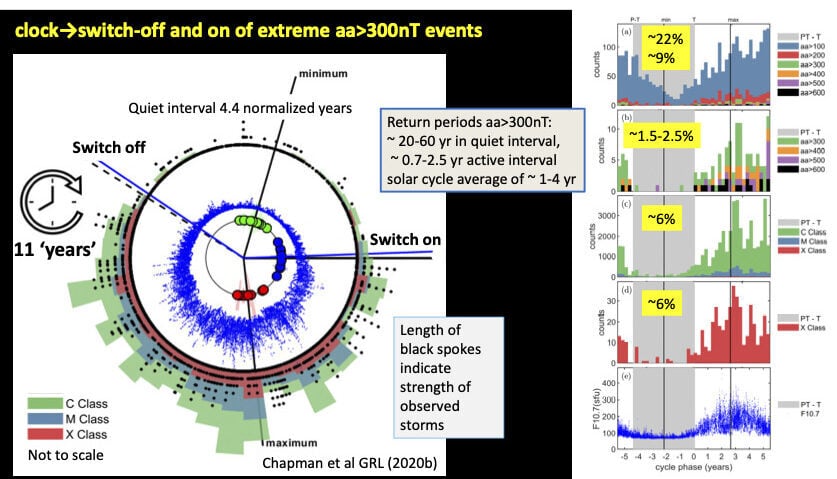
Chapman Et Al Sun Clock
A diagram of the “sun clock,” which maps the Sun’s irregular activity cycle onto a standard clock. The black spokes show extreme space weather events recorded on Earth. The new research identifies a distinct ‘switch-off’ point, after which the most severe space weather events largely disappear until the next solar cycle begins. Credit: Sandra Chapman/RAS

Currently, astronomers and space weather forecasters have to wait until the solar minimum to get an idea of what’s to come, so the new approach offers a huge improvement. Initial tests showed that the model successfully predicted the unusual strength of Solar Cycle 25, which many previous forecasts weren’t able to do. In the statement, Chapman said that the team intends to monitor Cycle 25 with the new model to refine its accuracy with empirical observations.

“We’re about two years away from the switch-off point for the current Solar Cycle 25,” she said. “At the moment, we have to estimate where that point will be, but once we reach it, we can use observations alone to make a much more precise prediction for Solar Cycle 26. That will still give us around seven years’ warning of how strong the cycle is likely to be.”

Read the full article here

You Might Also Like

Tropical Storm Bertha Is Arriving at the Worst Possible Time

The Truth Is Out There, We Need This ‘X-Files’ Lego Set

Ryan Reynolds Confirms a New ‘Deadpool’ Movie Is in the Works

Brand New Day’ Trailer Takes Us Back in Time

Nintendo Makes It Clear You Were Never Going to Get a Tariff Refund

Share This Article
Facebook Twitter Copy Link Print
Previous Article The Truth Is Out There, We Need This ‘X-Files’ Lego Set
Next Article Tropical Storm Bertha Is Arriving at the Worst Possible Time
Leave a comment

Leave a Reply Cancel reply

Your email address will not be published. Required fields are marked *

Stay Connected

248.1kLike
69.1kFollow
134kPin
54.3kFollow

Latest News

The Large Hadron Collider Is Getting Its Biggest Upgrade Yet. What Comes Next Could Change Physics
News
The 8 Best Alternatives to Buying a TV
News
With ‘Marvel Dimensions,’ Alex Ross Lights Up Superhero History [Exclusive]
News
Scientists Believed This Near-Earth Object Was an Asteroid for 28 Years. They Were Wrong
News
We Used AI to Catch the First Confirmed AI Agent Breach of a Major AI Platform
News
Weak AI Regulation Is Worse Than No Regulation, Researchers Claim
News
U.S. Average Gas Price Ticks Above $4 as World Fears Iran Is a New Forever War
News
Trump Quietly Deleted the Government’s Official Guide to Cutting Your Energy Bills
News

You Might also Like

News

The Great Freakout Over Open-Source AI Has Begun

News Room News Room 7 Min Read
News

Neill Blomkamp’s New Horror Clip Is Entirely AI-Generated, Sucks

News Room News Room 3 Min Read
News

Federal Judge Says Not So Fast to Paramount’s Takeover of Warner Bros. Discovery

News Room News Room 4 Min Read
Tech Consumer JournalTech Consumer Journal
Follow US
2024 © Prices.com LLC. All Rights Reserved.
  • Privacy Policy
  • Terms of use
  • For Advertisers
  • Contact
Welcome Back!

Sign in to your account

Username or Email Address
Password

Lost your password?