Artemis 2 was both a milestone and a test: how prepared are we to go back the Moon, and where can we improve? That said, it doesn’t take a historic mission for scientists to investigate critical safety measures—and sometimes, the breakthroughs on this front can coincide with particularly relevant developments in spaceflight.
The finding in question concerns the prevention of fire outbreaks in space. In a brief report presented at the Lunar and Planetary Science Conference, NASA researchers announced the Flammability of Materials on the Moon (FM2) mission, which will for the first time test how fires work on planetary bodies other than Earth. In late 2026, the mission will launch four solid fuel samples and record flame characteristics under lunar gravity for an extended period of time.
“The tests will provide benchmark data and are part of the larger effort to understand how Lunar gravity will affect material flammability,” wrote the researchers.
A drop of fire
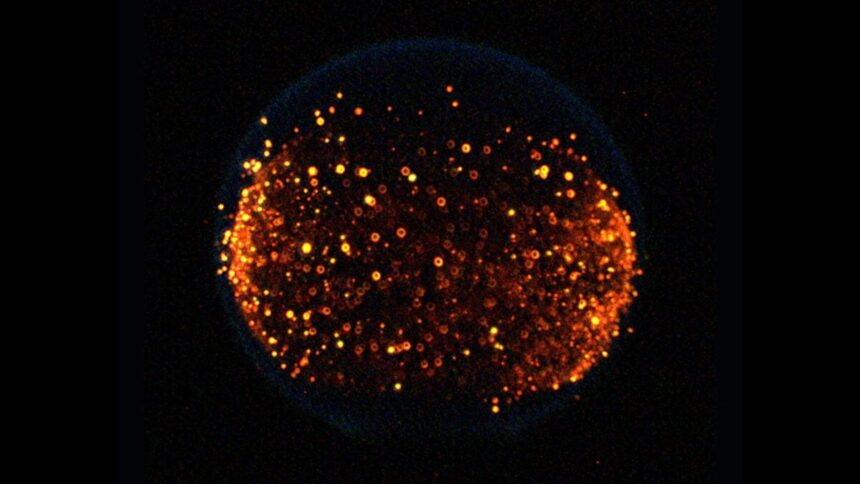
Fires during space missions can be catastrophic, as fire behaves differently under microgravity. On Earth, a small flame assumes a droplet-like shape due to a combination of rising hot gas and gravity’s downward pull on cooler, denser air. This type of motion doesn’t appear in microgravity, where flames tend to take a rounder, spherical shape, according to a NASA blog post on combustion science.
As such, NASA’s engineers have established a test called NASA-STD-6001B to determine which materials are suitable for spaceflight. Over the years, NASA has conducted numerous combustion experiments to gather information on the odd physics of fire in space.
The elephant in the room
Despite NASA’s extensive research into flammability in space, researchers only have a rough estimate of how our current knowledge on this matter could extend to lunar missions. According to the latest report on FM2, based on current numerical and experimental evidence, researchers predict that “lunar gravity could be more hazardous since flame spread rate is a function of gravity peaks” in certain partial gravity environments. This also has implications for designing space suits, the team added.
So, if FM2 launches as planned in late 2026, the timing couldn’t be better. After Artemis 2’s success, NASA officials began to tease Artemis 3, which will conduct some more preliminary tests before landing humans on the Moon with Artemis 4 and 5.
Eventually, engineers want to conduct material qualification tests directly on the Moon’s surface. In the latest report, the researchers admit this isn’t possible until “an extended human presence on the moon is established.”
So, it’s a cycle of sorts. If FM2 works out, Artemis crews will have a much safer trip. And if Artemis missions lead to more people flying to the Moon, scientists will get a much deeper understanding of physics in outer space.
Read the full article here