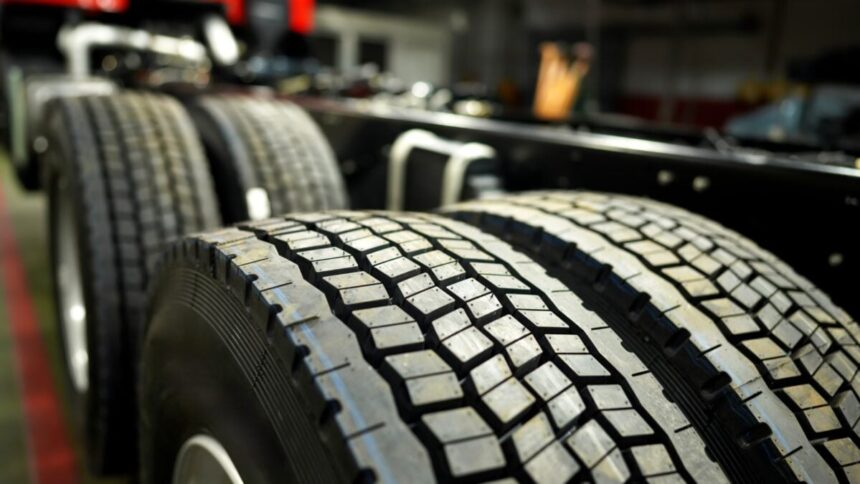
Plenty of familiar phenomena and materials are actually scientific mysteries. Reinforced rubber has long been on that list: why is it so efficient in so many applications, from aircraft tires to industrial seals to medical devices? One team of engineers believes it finally has the answer—and the solution unifies various theories on the resilience of rubber.
In a study published this week in Proceedings of the National Academy of Sciences, engineers at the University of South Florida identify the physical mechanism behind the versatility of reinforced rubber. This composite material—a combination of rubber and carbon black particles—has remained practically unchanged over the past century due to its high stiffness and strength. The new study found that adding microscopic particles to rubber transforms the inherently soft material into something “strong enough to support the weight of a fully loaded jet,” according to a USF statement.
This material property comes from a mismatch in what’s called Poisson’s ratio, a metric that defines how materials change shape when stretched. The team anticipates that the findings will guide future research on designing safer, more resilient materials.
If it works, it works
Chemically speaking, rubber is a type of polymer, a system of interlocking, large, chain-like molecules. This structure gives rubber its characteristic elasticity, or stretchiness, and therefore its extensive utilization. In 1944, researchers formally documented rubber’s tendency to grow stiffer with microparticle additives, although the phenomenon itself was known before.
This formula for reinforced rubber is so effective that scientists, engineers, and industry stakeholders have counted on it for nearly 100 years, the researchers explained in the paper. But scientists had never reached a verdict as to why that formula works so well.
“How is it that we’ve been using this for 80, 90, 100 years and haven’t really known how it works? It’s been through enormous trial and error,” David Simmons, the study’s senior author and an engineer at USF, said in a statement. “The tire companies can purchase many different grades of carbon black… and they just have to use trial and error to figure out what’s worth paying more for and what isn’t.”
Gathering puzzle pieces
Simmons explained in the statement that the debate over this mechanism has spanned at least multiple decades. Some argued that the particles formed additional chain-like networks inside rubber, whereas others proposed the particles just forced the rubber to stretch more by taking up extra space.
To determine which idea best represented reality, the team virtually recreated the molecular structure of reinforced rubber. They ran about 1,500 molecular simulations on hundreds of thousands of atoms.
Fascinatingly, the team found that previous theories weren’t necessarily wrong. Each hypothesis by itself couldn’t capture the full picture, but all of them together—particle networks, sticky interactions, and space-filling effects—contributed to the final result.
Rubbery formula
The team’s new, comprehensive framework goes as follows. Rubber inherently resists changes in volume. Imagine stretching a rubber band; the band becomes thinner as it stretches longer, but the overall volume remains constant.
When carbon black particles are added to form reinforced rubber, the composite material “fights against itself” and subsequently increases in volume, stiffness, and strength, according to the statement. The particles prevent rubber from thinning out when stretched, so the rubber is forced to increase in volume. This phenomenon is called Poisson’s ratio mismatch, where rubber basically fights against its own incompressibility.
The findings should help manufacturers move away from the trial-and-error processes for creating sturdy rubber, the team said. In addition to boosting industrial efficiency, the knowledge could even guide safer construction of critical infrastructure, such as power plants or aerospace systems.
“The reason the Challenger failed was a rubber gasket that got too cold,” Simmons said. “A lot of energy systems, power plants, have rubber parts. Everybody’s had a garden hose that started leaking because a rubber gasket failed. Now imagine that happening in a power plant or a chemical plant.”
Read the full article here