

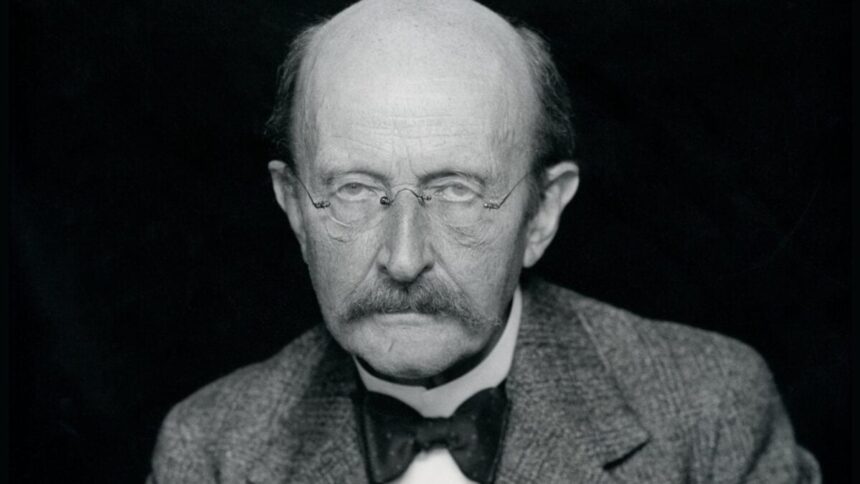
While reviewing a list titled “Retractions by Nobel Prize winners,” compiled by the industry watchdog Retraction Watch, historian Yves Gingras found that two essays by physics pioneer Max Planck had been retracted.
Gingras, a historian at the Université du Québec à Montréal, found that the papers were retracted decades after their publication in 1940 and 1942 in Die Naturwissenschaften. The German journal has been owned by publishing giant Springer Nature since 1913. What’s more, the publisher had removed the original texts from its platform “due to copyright violation,” such that they were no longer accessible. (Both papers are still available as physical scans at the Internet Archive.)
Working with co-author Mahdi Khelfaoui at Université du Québec à Trois-Rivières, Gingras sought to learn more about how the papers got retracted. In a preprint yet to be peer-reviewed, the authors argue that the retractions likely stemmed from modern digital standards that failed to account for historical academic publishing practices.
The paper prompted speculation that an internal Springer Nature algorithm, or bot, may have been responsible for the retractions. In a statement to Gizmodo, however, Springer Nature said that the papers were retracted in 2011 but that it was a human error and that no bots were involved.
Serious stuff
Retractions are serious and with wide-ranging implications, so it’s important to get them right. As Retraction Watch co-founders Ivan Oransky and Adam Marcus have pointed out, retractions are “born of many mothers.” Indeed, they’re often the result of major errors, plagiarism, data falsification, or ethical or procedural violations.
Now, in the case of Planck’s papers, none of this appears to have been the case. In their paper, Gingras and Khelfaoui wrote that the retracted articles were published when Planck was effectively “one of the most renowned living physicists” and that historians described him as an “upright man.”
“We therefore found it difficult to believe that these papers could really have been retracted during his lifetime, or even that there were good reasons to retract them later,” they concluded.
Copyright, not science
Springer Nature notes on the retracted papers’ landing pages that the articles were “withdrawn due to copyright violation.” The authors argued that this category fails to capture the nuances of mid-20th-century publishing practices and that the decision to flag and remove the papers reflects a modern “obsession with publication productivity.”
“In the first half of the twentieth century, republication across multiple journals, languages, or audiences was therefore not considered a breach of originality or copyright,” they explained, “but was instead understood as a legitimate means of extending the circulation of scientific ideas.”
Gingras and Khelfaoui argue that the retractions mostly have to do with “questions related to copyright ownership at the time the journal was digitized and made available on Springer’s platform” rather than the papers’ scientific validity. What’s more, Springer Nature decided to completely remove the text from its platform, which is uncommon for retractions, they added, as the original text “usually remains accessible…with the withdrawal notice.”
A mistake, but probably not a bot’s
Retraction Watch’s Ivan Oransky told Gizmodo that, given typical retraction practices, it’s “very difficult for me to believe that suddenly bots are retracting papers, especially because the [Planck] retractions didn’t happen this week—it happened years ago.” In other words, implying that a bot or algorithm was behind the retraction was likely a hasty conclusion.
Oransky’s hunch appears to have been correct, at least according to Springer Nature’s statement to Gizmodo. Tim Kersjes, the publisher’s head of research integrity, explained that the “decision to retract the papers was a human error and we can confirm that no software or ‘bot’ would have been involved in the process. Unfortunately, our records are limited, as the retractions occurred in 2011, the individuals involved have mostly left the company and the systems by which we record integrity matters have since changed.”
But perhaps most importantly, Kersjes added that the team was currently “working to address the situation and republish the papers.” Thankfully, that’s also the bottom line of Gingras and Khelfaoui’s request: Bring back the Planck essays, please.
Disclosure: One of Retraction Watch’s co-founders, Ivan Oransky, was a professor of mine at New York University.
Read the full article here