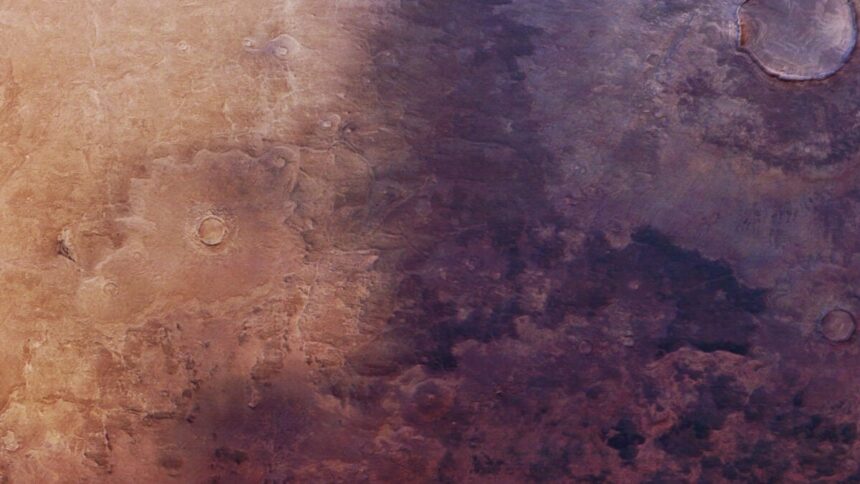
Incoming views of Mars usually show its dusty, tan-colored surface littered with rocks, a familiar desert-like world that has looked more or less the same for millions of years. However, a new image of the Red Planet revealed a rather unfamiliar sight: a blanket of volcanic ash creeping over Mars with a muted, darker hue.
The European Space Agency’s (ESA) Mars Express captured Mars split into two halves, with a cloud of dark ash pushing against its rusty-red surface. While change on Mars normally takes place over millions of years, the transforming landscape happened over mere decades. When NASA’s Viking Orbiters imaged this same region in 1976, the volcanic ash was noticeably less widespread than it is today.
The unusual spread of ash may either be due to Martian winds, or the removal of a layer of dust that was previously covering it, according to ESA.
The dark side
Mars has a long history of volcanic activity featuring the largest volcano in the solar system—Olympus Mons. Billions of years ago, Mars experienced massive super-eruptions which later dwindled down to less frequent activity and non-explosive lava flows.
The dark blanket spreading over Mars is believed to have been made and distributed by volcanoes. Volcanic material is rich in mafic minerals, which are dark-colored minerals that contain magnesium and iron.
Scientists have two theories over why the dark blanket of ash spread in the past 50 years. Either the volcanic ash was picked up and moved by wind, or the planet’s golden-colored dust that previously covered the ash was blown away.
A changing world
The recent image captured by Mars Express shows a striking contrast between Mars’ landscape today and what it looked like several decades ago. When NASA’s Viking orbiters captured the same region of the planet, they showed the familiar bright, tan-colored surface of Mars with a creeping blanket of darkness at the top.
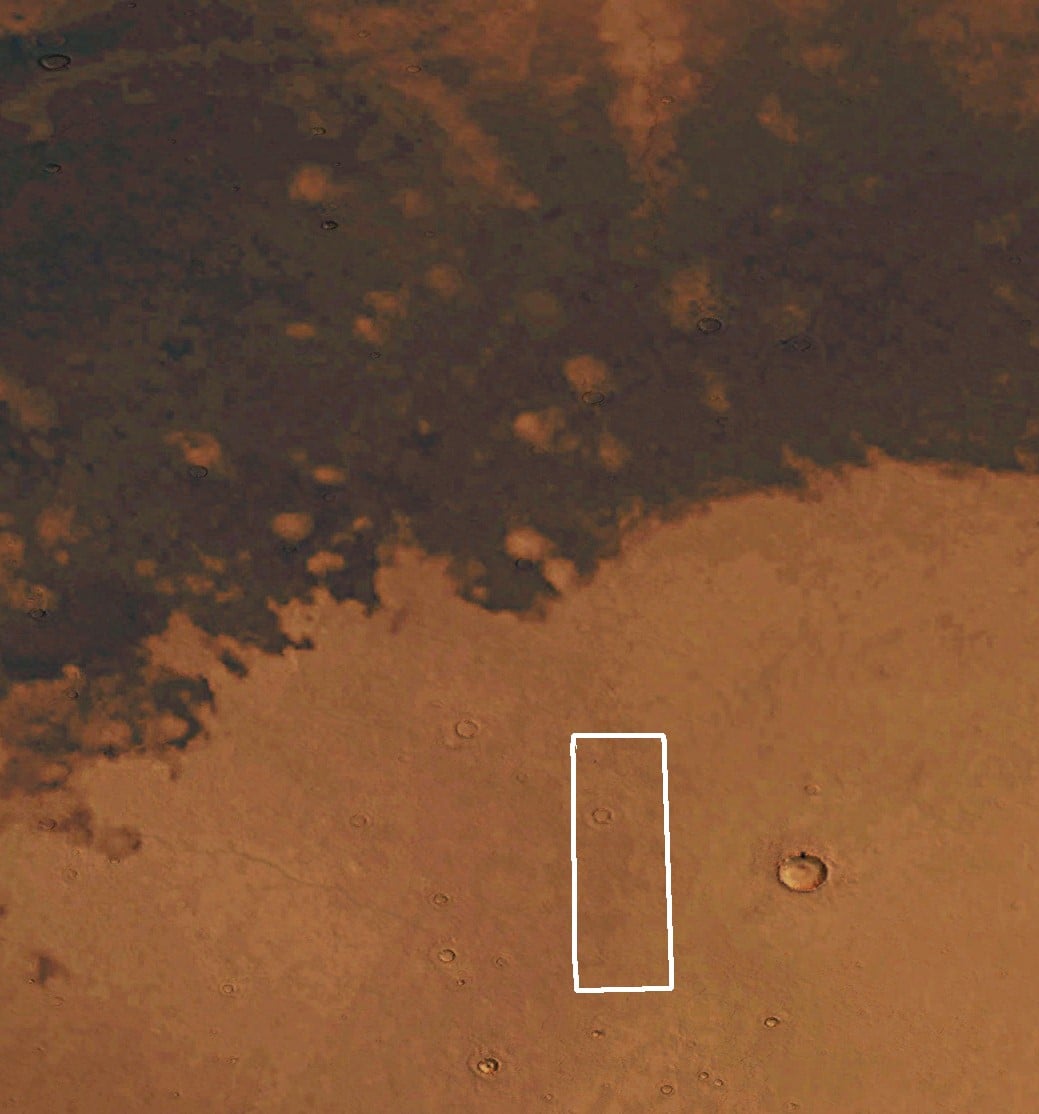
The new images, however, reveal how the dark-colored ash has altered the surface of Mars over the years and become much more widespread. The ash covered areas of the planet’s surface that were previously covered in sand.
The two missions were exploring a region on Mars surrounding Utopia Planitia, an ancient basin that is believed to have once hosted a body of water like a lake or an ocean.
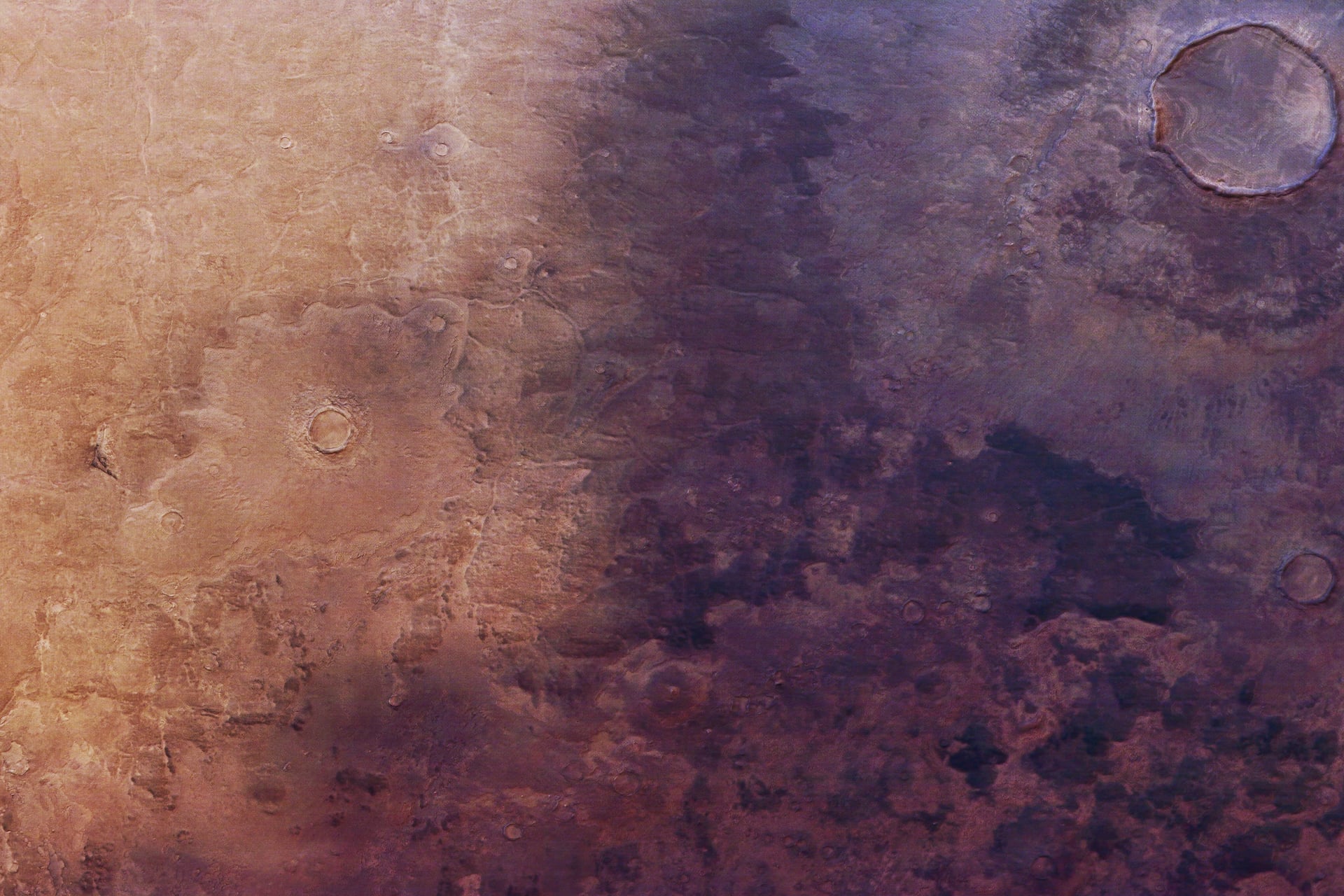
The above Mars Express image shows a large crater in Utopia Planitia. The crater in the image is surrounded by a ring of material that’s lighter in color than the rest of the landscape. The ring, also known as an ejecta blanket, is made up of material that was tossed out from the impact that created the crater itself.
While the basin itself is filled with rocks and sand, it still holds water ice beneath its surface, according to ESA. Within the dark blanket of ash, potential signs of water are still visible. In the lower right of the image, there are vaguely rounded pits with wavy edges that are known as scalloped depressions. These features indicate that the region is periglacial, possibly undergoing cycles of freezing and thawing due to buried ice.
The Mars Express mission has been exploring the Red Planet since 2003, mapping the planet’s surface with unprecedented resolution to gather clues on its geological and climatic history.
Read the full article here