When a powerful late-season storm dumped more than 3.5 feet (1 meter) of snow in California’s Eastern Sierra Nevada over the weekend, it was cause for celebration.
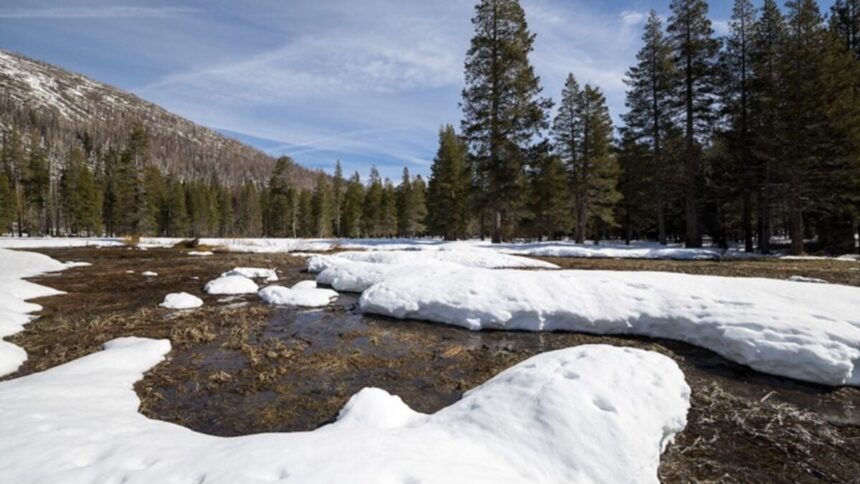
Mountain snowpack across the western U.S. has been historically low all winter, but in March, an unprecedented heat wave sent levels plummeting even lower. On April 1, the Sierra snowpack—which provides about 30% of California’s annual water supply—stood at just 18% of the average for that date. It was the second-lowest reading on record for April 1.
The weekend storm briefly shut down Interstate 80 and allowed Mammoth Mountain, a ski area in Mammoth Lakes, California, to extend its season. And with a snow drought this severe, any amount of precipitation is beneficial. But unfortunately, the storm did not offset the snowpack deficits that have accumulated over the past several months.
That means California—along with the rest of the West—could still be in for an early and ferocious wildfire season.
A brutal summer ahead
On Wednesday, Sierra snowpack levels were just 11% of normal in the northern part of the range, 25% in the central part, and 28% in the southern part, according to the California Department of Water Resources. While those numbers are notably higher than the levels recorded on Friday, before the storm hit, they’re still concerningly low.
Snow drought and wildfire don’t necessarily go hand-in-hand, but low snowpack can lead to an early start to the fire season. Without gradual mountain snowmelt, vegetation has more time to dry out, turning the landscape into a tinder box.
We’ve already begun to see this relationship play out across the West. On March 20, as temperatures soared to record-breaking highs, the National Interagency Fire Center (NIFC) reported that over 1.4 million U.S. acres had been consumed by wildfire since the start of 2026, more than doubling the 10-year average.
Fire activity has since quieted down, but according to Drought.gov, an extended fire season remains a critical concern. The NIFC’s outlook indicates strong potential for an early start to the season for parts of the West, particularly Northern California, Arizona, New Mexico, and West Texas.
Fortunately for California, its reservoirs remain at or above average. While this won’t prevent an earlier or more severe fire season from taking shape, it does mean the state will have ample water available for firefighting. Across the Great Basin and particularly the Rockies, it’s a different story.
Drought.gov shows “extreme” drought conditions affecting large swaths of Colorado, Utah, Nebraska, and Wyoming, with smaller pockets of “exceptional drought.” A significant portion of the Upper Colorado River Basin is experiencing exceptional conditions. This river feeds the two largest reservoirs in the country—Lake Mead and Lake Powell. As of April 7, Mead was 33% full and Powell was 24% full.
This could exacerbate the danger of an extended, severe fire season. With extremely limited water resources for large-scale firefighting, states across the Intermountain West could struggle to protect communities and infrastructure. This late-season storm may have given California’s snowpack a boost, but on a regional scale, the summer ahead still looks alarming.
Read the full article here