Shortly before his death, the physicist Richard Feynman inscribed these legendary words onto a blackboard: “What I cannot create, I do not understand.”
AI researchers have really taken this idea to heart. Since it kicked off in the middle of the last century, the field has sought to recreate the physical processes of the human brain—hence the phrase neural networks. So-called transhumanists have taken this a step further, arguing that human consciousness itself can ultimately be transferred to silicon. Now, a San Francisco startup called Eon Systems is aiming to achieve both goals. Its first major breakthrough? A virtual fly.
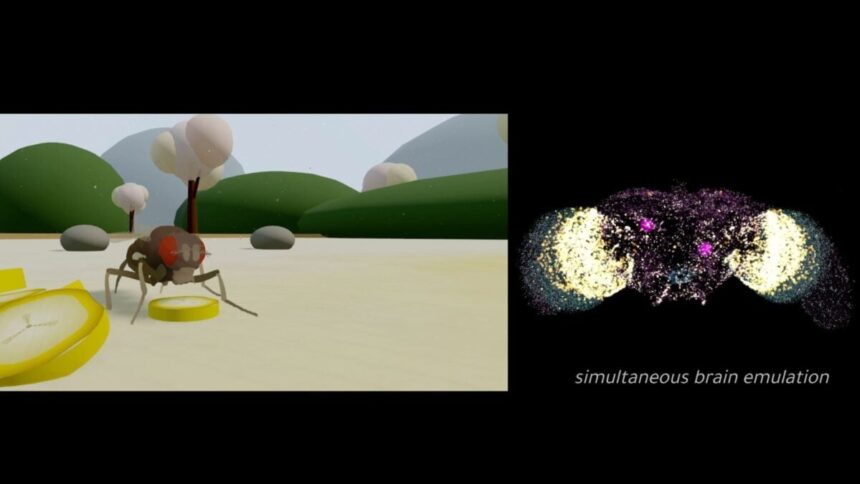
Last month, the company posted a video of a virtual fly scurrying around a Sims-like environment, pausing to wipe some digital dust off its antennae, and moments later arriving in front of some simulated banana slices, which it promptly slurped up. The video went viral, attracting the attention not only of AI researchers and roboticists but also that of the longevity influencer (and mind-uploading enthusiast) Bryan Johnson.
Why all the buzz (terrible pun intended) about a virtual fly? In short, the excitement stems from the technology working behind the scenes: The fly’s “body” is powered by a digital replica of a complete fruit fly connectome—i.e., a complete map of the neuronal pathways within its brain—comprising around 125,000 neurons and 50 million synaptic connections. Constructed using a powerful electron microscope, the digital connectome was paired with an AI algorithm that can match the firing of the virtual neurons to those found in an actual fruit fly brain with an accuracy of 95%, according to Eon.
This is as good as the real thing, according to Alex Wissner-Gross, a computer scientist and Eon’s cofounder: “What you are seeing is not an animation,” Wissner-Gross wrote in a Medium post following the video’s release. “It is not a reinforcement learning policy mimicking biology. It is a copy of a biological brain […] making a body move.”
Eon regards its virtual fly experiment as an early, albeit imperfect, form of mind-uploading: simulating neurons that can realistically respond to stimuli in a virtual environment is, as Wissner-Gross’ suggests, not a mere simulation but a digital twin in the truest possible sense. Some bugs still need to be worked out (sorry, last one), but Eon considers it to be only a matter of time before it’s technically possible to build an accurate simulation of a brain, be it a fruit fly’s or any other animal’s.
The company’s ultimate goal is complete, perfect simulation of the human brain. Which raises the question: Would such a simulation be conscious? Eon believes so, the idea being that if every single one of your neuronal firings can be digitally reproduced with perfect fidelity, then that digital replica will, by necessity, be imbued with all of the memories, feelings, and other qualia making up your unique mental life.
It’s an exciting possibility for the transhumanist community, which believes that technologies like AI can help humans to transcend the limitations placed upon them by biology, including death. But while Eon might take for granted that a simulation of the human brain and the simulation of human consciousness are one and the same, there are some leading consciousness experts who don’t.
Karl Friston, a neuroscientist and consciousness researcher at University College London, told me it’s “a category error” to infer subjective experience from the simulation of a conscious system. Similarly, Anil Seth, another neuroscientist, has famously compared this line of thinking to someone watching a computer simulation of a rainstorm and concluding that the computer itself must be wet on the inside. Such arguments have likewise been used to shoot down claims that large language models could ever be conscious simply because they soak up the entire corpus of human-generated data found on the internet.
Thorny philosophical issues about consciousness aside, Eon is now moving toward its next target: simulating the entire connectome of a mouse—which, weighing in at about 70 million neurons, is significantly larger than that of a fruit fly. The company is predicting it can achieve this within the next two years. It’s an ambitious timeline, to put it mildly: Just last year, researchers from Princeton announced that after nine years of work, they’d completely mapped out the visual system of a mouse brain—a huge achievement, but nowhere close to an entire mouse brain.
Even if Eon is somehow able to simulate an entire mouse connectome in the next two years, the prospect of going from there to mapping out the entire connectome of a human brain—many, many orders of magnitude more complicated than a mouse’s, and according to some estimates comprising as many as 99 billion neurons—seems like a long shot. Friston, for his part, believes the human connectome is far too complex to ever be fully simulated by a computer, since synaptic connections are in a constant state of flux, always being reshaped through our interactions with the physical environment.
That’s not to say that Eon’s approach to simulating animal brains can’t have truly practical benefits. If researchers can artificially recreate the mechanics of a brain and then run it iteratively like software, identifying glitches and possible solutions, it could help them ratchet up the speed of medical science.
The company’s mind-uploading-via-simulation ambition, on the other hand, is dubious. We’re a far cry from understanding consciousness, much less artificially creating it.
Read the full article here