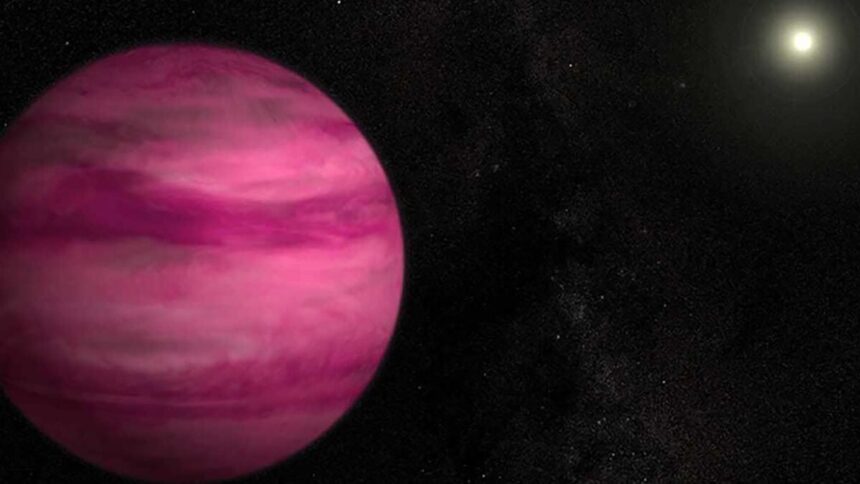
GJ 504 b, which NASA calls a “puffy pink planet,” shares two out of three catchphrases with Kirby. But unlike the video game character, the giant planet is cold, faint, and, as a new study has found, probably salty.
In a recent study published in The Astronomical Journal, astronomers present the first direct evidence of salt clouds encircling GJ 504 b, bolstering a theory from more than 15 years ago. At around 550 degrees Fahrenheit (290 degrees Celsius), the magenta-tinted world is among the coldest objects directly imaged by astronomers. Typically, these objects are too cold for ground-based instruments, but the team behind the new study was able to obtain its spectrum using the James Webb Space Telescope (JWST).
“When we finally obtained its spectrum, it immediately looked interesting,” Aneesh Baburaj, the study’s lead author and a postdoctoral associate at Northwestern University, said in a statement. “But once we started digging deeper into the data, we realized it was not like anything we have analyzed before.”
Pink, puffy, and ambiguous
According to NASA, GJ 504 b is a gas giant with a radius slightly larger than Jupiter. However, astronomers have long debated whether it should really be considered an exoplanet, given its unusually cool temperature and uncertainty surrounding its age. As a result, astronomers also refer to GJ 504 b as a planetary-mass companion, or a planet-sized object orbiting a star, the team explained in the statement.
These uncommon properties naturally drew astronomers’ interest, Baburaj said. However, many teams around the world “observed the companion for an entire night with some of the biggest telescopes in the world to obtain a spectrum,” he added. “And they could not see the object.”
Stripping the light
Impressively, the researchers only needed around two hours to complete observations of GJ 504 b’s spectrum and, therefore, its chemical profile. Using advanced data-processing techniques, the team was able to remove the glare of the object’s host star. Doing so enabled the team to retrieve “by-eye” detections of water vapor, methane, carbon dioxide, ammonia, and more, according to the paper. However, when the team fed this dataset into conventional astrophysical models, the numbers didn’t quite match.
But the conventional models assumed a lack of clouds. As a result, the team played around with a new hypothesis: What if this pink-tinted planet was covered in clouds? That hunch ended up being right on the mark. Baburaj explained that once clouds entered the picture, the simulations aligned nicely with what’s known about cold planets.
“We tried three different types of clouds, and salt clouds fit best,” he said. “When we accounted for salt clouds, it subdued the signature of molecules hidden deeper in the companion’s atmosphere. Then, the results became physically possible.”
Possibly unfinished
That said, there’s still much to learn about GJ 504 b. The new findings suggest that this “Pink Planet” is unusually rich in heavy elements and is likely between 2.5 billion and 4 billion years old. But while the metallic profile “provides tentative evidence for a planetlike formation,” it’s still possible there is a “brown-dwarf nature” to GJ 504 b’s evolution, the paper concluded.
On a more general note, the techniques used in the study will come in handy when studying similar cold, faint planets, Baburaj said. GJ 504 b is a “good reminder to account for clouds in our models,” he added.
Related article: Missions to Ocean Moons Face a Strange Hazard Scientists Didn’t Expect
Read the full article here