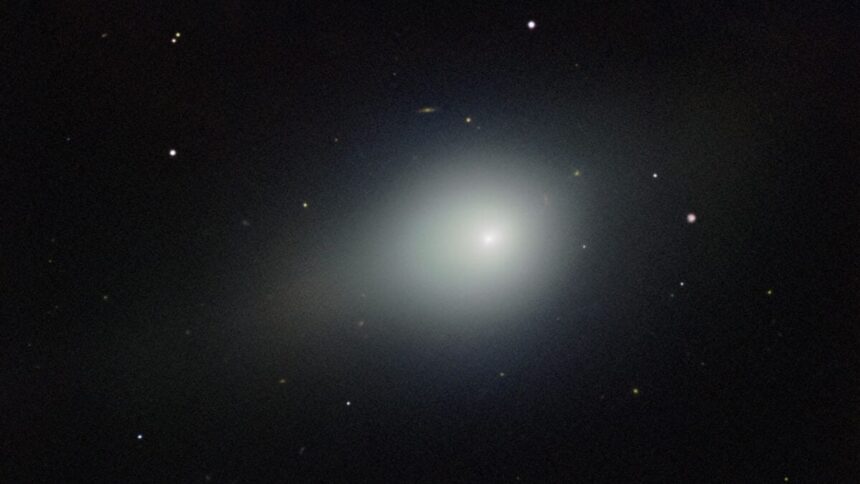
Comet 3I/ATLAS may have ended its journey through the solar system, but not before the Webb space telescope got one last glimpse of the rare interstellar visitor on its way out. Webb’s detailed measurements revealed the ancient origin story of the mysterious object, offering fresh insights into distant places of the galaxy.
Astronomers used Webb to observe the interstellar comet as it began moving away from the Sun in December 2025. The comet’s close approach to the star converted its ancient ice to a bright coma of gas, making it an ideal time to measure its chemical components. In a new study published Monday in Nature, a team of researchers reveals that Comet 3I/ATLAS likely formed 10 to 12 billion years ago in a very cold planetary system far away in the Milky Way. For context, the universe itself is approximately 13.8 billion years old, which means this comet formed relatively early in cosmological history.
Just passing through
Astronomers first spotted Comet 3I/ATLAS in June 2025, and it was later confirmed as an interstellar visitor that originated from outside our solar system. As the comet’s name indicates, it is the third discovery of its kind.
Interstellar comets are a rare find, providing a unique opportunity to study the composition of star systems outside of our own. Compared to the other interstellar objects previously discovered—‘Oumuamua and 2I/Borisov—Comet 3I/ATLAS is older and faster.
Comet 3I/ATLAS reached its closest point to the Sun on October 30, 2025, at a distance of about 130 million miles (210 million kilometers), coming just within the orbit of Mars. It reappeared on the other side of the Sun in December 2025, offering astronomers another chance at probing it for clues on its place of origin.
“This was a unique opportunity to study an ancient object from the distant galaxy, probably pre-dating our Sun and solar system,” Martin Cordiner, an astrochemist at NASA’s Goddard Space Flight Center and lead author of the study, said in a statement. “On the one hand, we get direct insight into that distant time and place, and on the other, we learn something about how unusual our own solar system may be.”
A cold, distant place
Using Webb’s NIRSpec (Near-Infrared Spectrograph) instrument, the team observed the comet in great detail. Webb’s observations revealed exceptionally high levels of deuterium, one of two stable isotopes of hydrogen, at about 30 times the level seen in comets within the solar system. This indicates that during its formation, the comet’s material was exposed to radiation but not to any long-term warmth that would convert its heavy water ice into the type of H2O ice that is familiar to us on Earth.
NIRSpec also showed traces of carbon-13 compared to lighter-weight carbon-12. Star systems became enriched with carbon-12 over time as generations of stars were born and died in the galaxy.
The findings suggest that the comet may have originated in a very cold system much earlier in the history of the Milky Way. The team estimates Comet 3I/ATLAS formed around 10 to 12 billion years ago following a period of intense, early star formation in its host environment.
The abundance of heavy water shows that 3I/ATLAS spent its formative years in a deeply frozen state and that the planetary system from which it originated was likely ensconced in a relatively cold, dense cloud.
Astronomers rushed to gather as much data as they could on the interstellar comet during its visit to our star system. By learning about objects from outside the solar system, scientists can gather more clues on whether conditions for the evolution of life are common throughout the universe.
Read the full article here