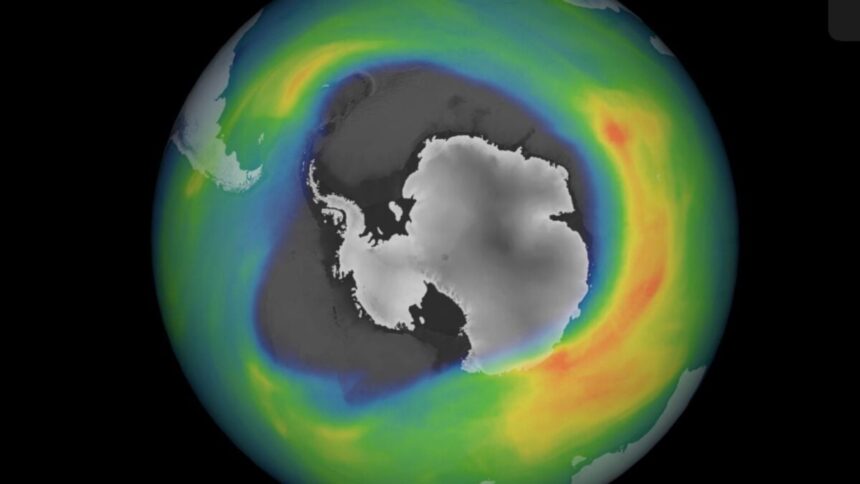
When researchers first discovered the Antarctic ozone hole in 1985, it was a shock to the scientific community. The wave of studies that followed suggested it began forming in the 1970s, driven primarily by chlorofluorocarbons (CFCs). Now, a new study offers a totally different perspective on its origin.
The findings, published today in the journal Proceedings of the National Academy of Sciences, suggest that the first signs of ozone depletion actually appeared as early as 1957. Though it took another 30 years for scientists to develop the atmospheric monitoring capabilities that led them to discover the hole, the ozone layer began thinning decades earlier.
The surprises don’t stop there. The researchers determined that the first signal of ozone loss appeared not in the Antarctic, but in the upper stratosphere of the tropics. What’s more, the early stages of depletion were not driven by CFCs but by carbon tetrachloride, another industrial chemical used as a dry-cleaning and degreasing agent in the 1930s.
“The fact that ozone depletion would have happened as early as the late 1950s, which is much earlier than I would have thought, just absolutely blew my mind,” lead author Susan Solomon, the Lee and Geraldine Martin Professor of Environmental Studies and Chemistry at the Massachusetts Institute of Technology, said in a statement. Solomon was an early pioneer in the study of ozone’s effects on the atmosphere and the first to show that CFCs were primarily responsible for eroding Antarctic ozone, according to MIT.
“It turns out there was another compound that caused ozone depletion much earlier than CFCs,” she said. “This was a big surprise.”
Rewriting the ozone hole’s history
The ozone layer sits in the stratosphere between 7 and 31 miles (11 and 50 kilometers) above Earth’s surface. It serves as the planet’s natural sunscreen, blocking out most of the Sun’s harmful ultraviolet (UV) radiation and protecting life down below.
In the late 1970s, British Antarctic Survey researcher Jonathan Shanklin noticed something strange while analyzing data from the Dobson ozone spectrophotometer at Halley Research Station. This instrument measures the amount of UV radiation reaching Earth to infer how much ozone is in the atmosphere. Since the late 1970s, there had been a systematic decline in the amount of spring ozone over Antarctica. By 1984, the ozone layer over Halley was only two-thirds as thick as it had been in earlier decades.
Shanklin and colleagues published their findings in 1985, marking the discovery of the ozone hole. To be clear, it isn’t technically a “hole” where ozone is never present. Rather, it’s a region of exceptionally depleted stratospheric ozone that forms over Antarctica at the beginning of Southern Hemisphere spring (August through October).
In the mid-1970s, researchers suggested that CFCs could deplete the ozone layer, but there was no direct evidence that this was actually taking place. After Shanklin discovered the ozone hole, Solomon led Antarctic expeditions to measure the stratosphere’s composition, ultimately confirming that CFC pollution was the primary driver of ozone depletion.
Since then, global efforts to reduce CFC emissions have led to significant recovery, but Solomon’s latest research suggests a different chemical was eating away at the ozone layer long before the ozone hole was discovered.
The first chemical culprit
Solomon and her colleagues carried out a thought experiment in which they imagined a world where today’s atmospheric monitoring capabilities were available in 1950. Under this scenario, they used modeling to simulate atmospheric chemistry over the past 76 years, finding that the earliest sign of ozone depletion would have been detectable over the tropics by 1957.
The only chemical pollutant that could explain this is carbon tetrachloride. “That’s the only ozone-depleting substance that was increasing that early,” Solomon said. “We started using carbon tetrachloride in the 1930s as a dry-cleaning agent, and as a degreasing solvent. We didn’t start using CFCs until quite a bit later.”
Fortunately for the ozone layer, carbon tetrachloride use was banned from consumer products in the 1970s due to health concerns, then further restricted by the Montreal Protocol in 1990. Still, Solomon believes this finding underscores the importance of long-term atmospheric monitoring so that we can fully understand how it responds to chemical pollution.
“We’ve gone through a big effort to get rid of these chemicals,” she said. “Don’t we have an obligation to keep monitoring to make sure the atmosphere responds the way we think it should?”
Read the full article here