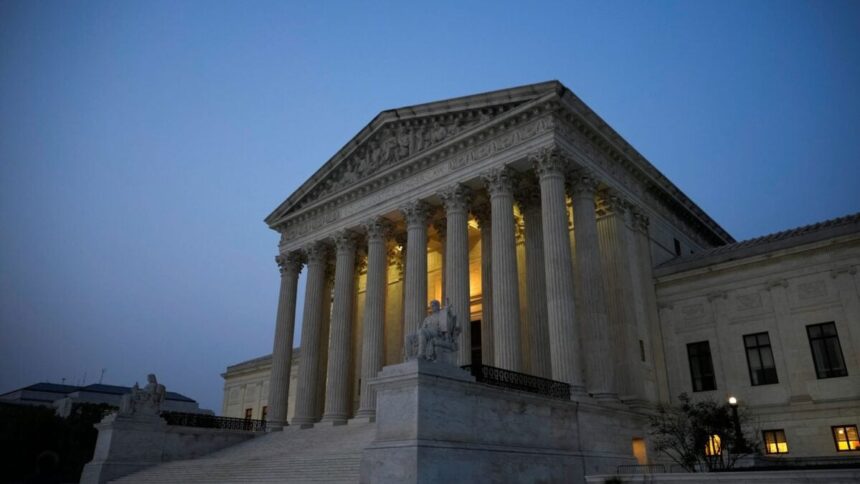
The U.S. Supreme Court ruled 6-3 on Monday that geofence warrants count as a “search” under the Fourth Amendment, a decision that will likely impact how police departments around the country seek cellphone location data in the future.
Geofence warrants compel tech companies like Google to provide information about electronic devices that are present in a given area on a particular date during a specific window of time. The case, Chatrie v. United States, involved a man who was convicted of robbing a credit union outside Richmond, Virginia, in 2019.
Local police used a three-step process to find Okello Chatrie, first requiring Google to produce anonymized location data for all phones within a 150-meter radius of the credit union from 30 minutes before to 30 minutes after the time of the robbery. In step two, police narrowed down the list from that anonymized data and retrieved more data from phones both inside and outside the geofence for two hours on each side of the robbery. In the third step, police narrowed it down further, and Google produced names and phone numbers for the people on the list.
Chatrie was one of three people who were fully identified by the geofencing warrant, which reportedly showed him entering the geofenced area ten minutes before the robbery and leaving for a residential area after the robbery. Police later found a gun, about $100,000 of cash, and a demand note.
The question at hand was whether these geofencing techniques are considered a “search” under the Fourth Amendment, which protects against unreasonable searches and seizures. The Supreme Court found on Monday that police had conducted a Fourth Amendment search when they acquired Chatrie’s location data from Google “because an individual has a reasonable expectation of privacy in his cell-phone location information.” But it didn’t ban the practice completely. Police will now need to show probable cause.
EFF Surveillance Litigation Director Andrew Crocker, who co-authored the organization’s amicus brief in the case, told Gizmodo in a statement Monday that he applauds the Supreme Court’s decision, even if it didn’t go far enough.
“The Court reaffirmed that you have an expectation of privacy in location data that reveals your movements in the physical world, and that even short-term surveillance of these movements is a search subject to the Fourth Amendment,” said Crocker.
“In recent years, police around the country have relied on geofence warrants like the one in this case tens of thousands of times to cast dragnets that violate the privacy of innocent bystanders, all without even targeting a known suspect or device. Although the Court stopped short of striking down these warrants as inherently unconstitutional, we look forward to pressing lower courts to eliminate these warrants once and for all.”
Chatrie v. United States was the first geofencing case to reach the Supreme Court, though it had previously found in a 2018 decision, Carpenter v. United States, that police must obtain a search warrant to access cellphone location data. Justice Elena Kagan wrote about the cell site location information (CSLI) at issue in the Carpenter case, comparing it to the Chatrie case, where location history was central.
“Most cell-phone users have no awareness of CSLI records, and would never try to retrieve them; by contrast, Google users regularly employ Location History as a personal journal,” Kagan wrote. “In that way, Location History resembles other private materials—e.g., emails, documents, photographs, or calendars—that even if stored on Google’s servers, a user reasonably views as his own and expects to be shielded from the ‘inquisitive eyes’ of the government.”
Conservative justices Samuel Alito, Clarence Thomas, and Amy Coney Barrett dissented, with Alito writing that, “the Court sheds Carpenter’s self-imposed boundaries and further de-stabilizes longstanding Fourth Amendment jurisprudence.”
Chatrie pleaded guilty to the bank robbery, but his case sought to appeal the use of evidence obtained as a result of the geofencing warrant. He was sentenced to 12 years in prison, and Monday’s ruling kicks the decision back to a lower court for consideration now that SCOTUS has determined a geofence warrant is a form of search. Alito seems to believe that it will have little impact on Chatrie’s actual case.
“Although today’s decision will send seismic waves through our Fourth Amendment doctrine, not one iota of the majority opinion will affect the outcome of this case,” wrote Alito. “The Court knows this and does not claim otherwise. Indeed, by refusing to review the one question that could have at least theoretically given Chatrie some hope of relief, the Court carefully set the stage for its planned performance: striking a pose as a great champion of privacy in the digital age.”
In 2023, Google made a change to the way that location data is stored, meaning that most of that information in Google Maps stays on a given device. And that means Google has less information to hand over if the police present a geofenced warrant.
The ACLU celebrated the decision on Monday, with Brett Max Kaufman, senior counsel with ACLU’s Center for Democracy, telling Gizmodo that the court’s decision “provides critical protection against invasive and overbroad government searches of our personal information.”
“Although Google already changed its system so it no longer has access to the same data the government had been seeking through geofence warrants, similar kinds of reverse searches of sensitive data held by other companies will continue to be a threat to privacy,” said Kaufman. “Law enforcement and courts are on notice that new technology does not open up surveillance loopholes, and strict adherence to the Fourth Amendment’s protections is required.”
Read the full article here