

The Pentagon got serious about mitigating climate disasters after the 155-mile-per-hour winds of Hurricane Michael left Tyndall Air Force Base “virtually leveled,” as one military spokesperson described the damage. The unsparing Category 5 storm flipped fighter jets and somehow crumpled entire hangars intended to keep aircraft safe from the elements as the hurricane ripped through northwest Florida on October 10, 2018.
The military’s Defense Advanced Research Projects Agency (DARPA) called this new plan “Reefense”—a program to develop “self-healing, hybrid biological and engineered reef-mimicking structures” to radically reduce any future damage caused by coastal flooding, erosion, and all those increasingly common episodes of extreme weather. And, surprisingly, the program appears to be succeeding far better than anyone could have reasonably expected.
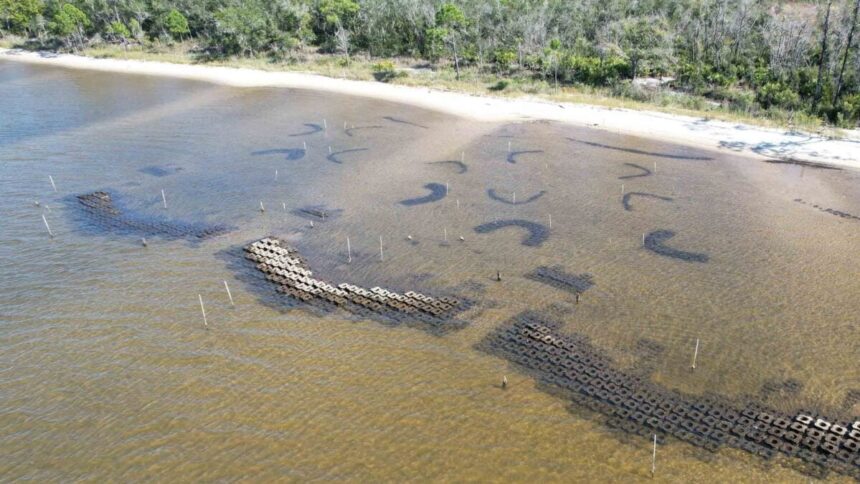
DARPA-developed hybrid reefs installed between October 2024 and March 2025 at Tyndall AFB have cut ocean wave power to shore by more than 90% in tests, according to the agency’s university collaborators at Rutgers, all while supporting local reef growth and coastal habitats.
“We set out to build a kind of living reef, something that combines natural and engineered materials and can repair itself over time,” David Bushek, a professor of marine and coastal studies at Rutgers, explained in a statement.
“So far, the results are encouraging,” Bushek said. “What we built is working.”
Oyster bars
Bushek and his colleagues call their primary (trademarked) innovation the “Living Shoreline Mosaic.” Tailor-engineered, porous concrete modules were installed offshore from Tyndall AFB, along the Florida Panhandle, seeded with tiny juvenile oysters to jump-start a natural reef formation designed to grow seamlessly into the surrounding marsh and seagrass habitats.
According to Bushek, the system “can be applied anywhere oysters form reefs.” Colonies of oysters and other marine species, in fact, have already started to occupy and build upon the team’s artificial reef, enhancing its resilience and wave-breaking capabilities.
“Vertical height of reef-building oysters occurs when spat, or juvenile oysters, settle on the shells of dead or live adults,” as the team explained in its newly published study in the Proceedings of the National Academy of Sciences. Their “Living Shoreline Mosaic” method mimics natural reefs, the team wrote, which “have a core of dead shells with a layer of live oysters that maintain reef integrity.”
Heroes in a half shell
If DARPA’s Reefense initiative continues to mature as expected, Bushek and his team believe these semi-artificial oyster reefs could blossom into a dual-use technology that both protects human infrastructure along coastlines beyond military applications while also rejuvenating local aquatic ecosystems.
“In the face of increasing storms and rising seas, it is critical to develop strategies that protect our coasts,” Bushek said.
But there is a long way to go before the project achieves its own definition of success. The team noted in its supplemental material that it hopes the reefs constructed near Tyndall AFB will demonstrate the ability to “remain anchored and intact under 50-year storm/wave conditions using in-water measurements and modelling,” a process that will take time to verify.
The team also hopes its artificial reefs will achieve a living oyster cover of at least 90% as well as boost local marsh grass growth by 50% compared to what had been measured on site before the concrete mosaic was installed.
While the researchers’ physical modeling of their reef design suggests that these concrete and oyster shell structures should meet these expectations, they recognize that these long-term infrastructure projects typically also require local and national political will that science can’t fully account for.
“Permitting is a frequently cited barrier to the implementation of living shorelines,” the team wrote in its study. “While a solution may be technically effective and sustainable, its widespread adoption depends on a combination of political, sociocultural, and economic factors.”
Read the full article here