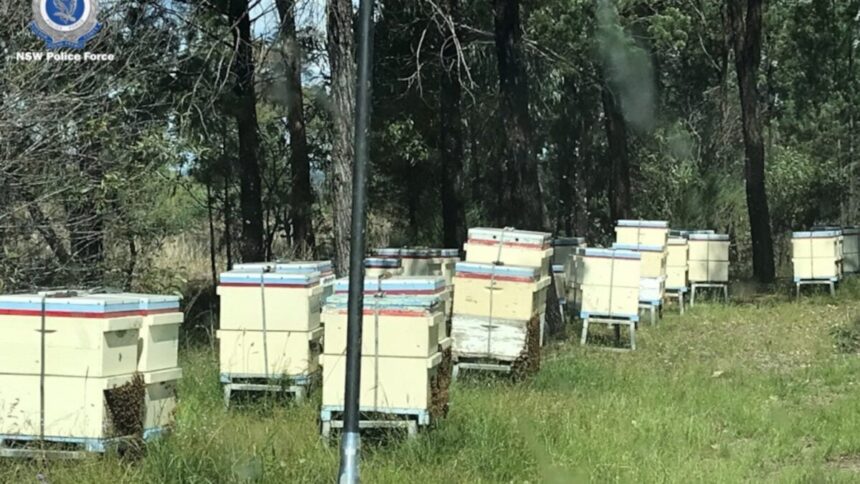
Have any of you seen 80 boxes of bees lying around? Mostly cream in color, with blue baseboards, blue-and-white lids, and red clear boards through which, perhaps, one might be able to glimpse some honeybees or honeycombs.
Consider this an all-points bulletin: Police with the rural crime prevention team in the Australian state of New South Wales are on the lookout for an estimated $150,000 worth of missing beehives, presumed stolen. The bees disappeared from a property in the high-elevation agricultural region of the state’s northern tablelands, about 9.32 miles (15 kilometers) west of the village of Bonshaw, along Bruxner Way, and 62.14 miles (100 km) northwest of the town of Glen Innes. NSW police believe this apparently daring heist (bees can sting) would most likely have been executed sometime between Tuesday March 31 and Wednesday May 6, 2026.
One local apiarist who spoke to The Guardian, Mitch McLennan at The Honey Shed in the nearby village of Tabulam, described the alleged crime as likely a “devastating” loss for the bees’ owner.
“It’s terrible, it’s such a big loss,” McLennan told the British newspaper—adding that such crimes have “become quite commonplace now” as many desperate beekeepers struggle with the economic toll of hives ravaged by the invasive Varroa destructor species of mite.
The usual suspects
“The only people that steal bees are beekeepers,” according to McLennan. “Like, no one else goes in and steals any hives of bees… What else are you going to do with them unless you’re a beekeeper?”
Farmland across the world has seen a rise in apiary burglaries over the past decade. Over 10,000 hives were reported stolen in California during this period, for example, estimated at $3.5 million in lost profits, according to a white paper put out by the California State Beekeepers Association in 2025. Hive thefts have “escalated”—as the paper’s author, University of California, Davis entomologist Elina L. Niño, noted—“particularly during almond pollination when hive rental prices peak.”
“Thieves may place stolen hives under fraudulent pollination contracts, collect payments, and abandon the colonies,” Niño wrote.
After a messy smash-and-grab looted beehives from an apiarist’s boxes in NSW’s Benandarah State Forest back in 2023, local Australian beekeeper groups advised that their members start deploying GPS trackers and CCTV cameras to protect their colonies.
“You put a microchip inside the beehive and the signal can be picked up by your mobile phone,” Laurie Kershaw, a branch president with the NSW Apiarists’ Association, told the Australian Broadcasting Corporation, and “if that beehive moves, say, 6 or 7 inches from its location, you can see that someone’s even tampering with your bees.”
Curse of the ‘werewolf’ bee parasite
The spooky-sounding parasitic mite Varroa destructor first began leaping from its native host, the Asian honey bee or Apis cerana, into hives across Europe and the Americas during the 1970s and 80s. For decades, scientists had initially likened the mite to a blood-sucking vampire until research from the U.S. Department of Agriculture’s Bee Research Laboratory in Beltsville, Maryland, discovered that the mite actually lives off the fat of honeybees.
As USDA entomologist Samuel Ramsey rather vividly put it to Science News in 2019, the Varroa destructor “is feeding on flesh more like a werewolf.”

Biologists have come to view the mites as a “major driver of honeybee declines worldwide,” but this stress on beekeepers (and inducement to bee theft) appears to be creating a destructive feedback loop. According to Kershaw, the blackmarket movement of purloined hives risks exacerbating the damage done by the parasite, given that criminals would likely want to avoid exposing themselves via the routine mandatory inspections conducted by the NSW Department of Primary Industries (NSW DPI).
“Stolen bees can cross state borders without NSW DPI knowing,” Kershaw told ABC, “and they could cart varroa with them.”
NSW police are encouraging anyone with information on this latest bee heist, or anyone with potentially relevant dashcam or mobile phone footage, to contact Crime Stoppers at 1800-333-000.
Read the full article here