News broke this week that Disneyland’s Autopia attraction will retire some of its gasoline-powered engines next year, the things that power those noisy and smelly gas vehicles that have been around since the park first opened in 1955. Disney will begin testing electric prototypes, though it’s still unclear whether the ride will go all-electric anytime soon.
But the news raises a few questions about Disneyland’s Tomorrowland. Specifically, what took so long? And does an electric car even qualify as “futurism” in the year 2026? Or 2027. Or 2028…
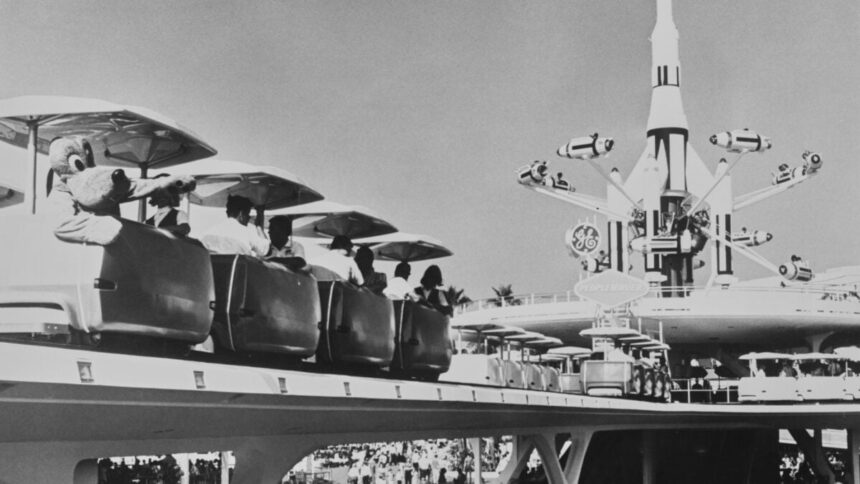
When Disneyland first opened in 1955, Tomorrowland was meant to depict what life in the distant year 1986 would look like. Tomorrowland was the most rushed and least developed land in 1955 (others included Fantasyland, Main Street U.S.A., Frontierland, and Adventureland), but it did have a ride called Autopia, which allowed guests to drive on a highway of the future.
Highways may not seem very futuristic to us in 2026, but it was a legitimate idea in 1955. The Federal Aid Highway Act of 1956 would create the largest public works projects in the country’s history. The future of transportation was everyone hopping into their gas-powered vehicles to move much quicker along interstate highways.
But the Autopia ride has largely remained the same since it was first introduced, with a few incremental improvements here and there. In 1977, for example, a Disney engineer replaced the bearings of the cars’ axles with a more durable bearing material, according to an annual report from NASA highlighting how space tech has improved private industry.
Another change from 1955 was the introduction of guide rails to prevent the cars from turning into a chaotic bumper car ride. In the 1991 paper “There’s Always Tomorrowland: Disney and the Hypercinematic Experience,” Scott Bukatman writes about the change:
In the early days of Disneyland, one Tomorrowland attraction was the Autopia, where youngsters could drive actual, though miniature, automobiles. Disney intended these young citizens-to-be to thus learn traffic safety at an early age and hence to be prepared to enter the L.A. freeway system. Unfortunately, the children took “demented delight” in crashing the cars, and the ride had to be put on tracks. One can hardly blame the kids for resisting the park’s immaculately conceived system of guidance, but the Disney ethos could not tolerate these signs of technological breakdown.
And it’s not like electric vehicles are this newfangled thing in the 2020s. When Hong Kong Disneyland opened in 2006, that park’s version of Autopia was fully electric before the attraction eventually closed in 2016. We have the technology. We’ve had the technology for decades.
The original Autopia cars were 5/8-scale vehicles weighing just 160 pounds each, with fiberglass bodies created by boat builder Bill Tritt of Glasspar, chassis developed by Johnny Hartman of Hartman Engineering, and assembly handled by Ted Mangels and Ed Martindale of Mameco… pic.twitter.com/ZJn8P6MlcI
— Uncle Walt’s Little Known Facts (@UncleWalt1971) January 9, 2026
Much of Tomorrowland at Disneyland feels pretty dated. The attractions include Astro Orbiter, a space-themed ride opened in 1998, Buzz Lightyear Astro Blasters (2005), Finding Nemo Submarine Voyage (2007), Space Mountain (1977), and Star Tours: The Adventure Continues (2011). None of it is particularly tomorrow-y.
There have been mixed signals over the years about the transition away from gas-powered vehicles at Autopia in the California park. The L.A. Times reported in 2024 that Disney had promised it would go “fully electric” by 2026. That timeline doesn’t appear to be in place anymore, and the company wouldn’t comment on the record about its specific plans for Autopia, other than to say they’d keep us posted.
As a different article in the L.A. Times noted in 2024, it’s entirely possible that Disney could be working on hybrid vehicles for the Autopia attraction. But whether it’s hybrid or fully electric, neither feels like a truly futuristic version of Tomorrowland. That article asked about incorporating other forms of transportation, such as electric bikes and scooters, self-driving cars, and autonomous buses. And while those are all decent ideas, they may suffer from the fact that the appeal of Autopia is having at least a little freedom to feel like you’re steering the vehicle.
That may give us a hint as to how difficult it can be to present a modern version of the future, especially in the age of AI. We are building a world, whether the broader public likes it or not, that is autonomous. The computer can generate images for you. The computer can write your essay for you. The computer can drive your car for you—at least in theory, even if there are plenty of nuances still being worked out.
What version of the future makes for something enjoyable? Do we derive any pleasure from the act of creating a prompt that generates hundreds of pages of text nobody will ever read? Is the experience of creating an animation where Mickey Mouse rap battles Goofy something that we actually like to do? Or are we being sold a slop future where nothing matters and nobody feels joy?
Unfortunately for the future of humanity, the stinking fumes of Autopia and the relative freedom to jerk that wheel around can be fun. It’s a visceral experience that’s dirty and maybe even slightly unsafe, at least as far as very safe Disney attractions go.
Read the full article here