Of the hundreds of confirmed moons orbiting Jupiter and Saturn, NASA describes Europa and Enceladus as “promising” and “compelling.” Researchers suspect that these icy moons have liquid water oceans beneath their frozen surface, making them top research targets for big stakeholders like ESA or NASA. But a new study identifies a strange hazard for ocean-moon-bound missions: “fluffy” ice.
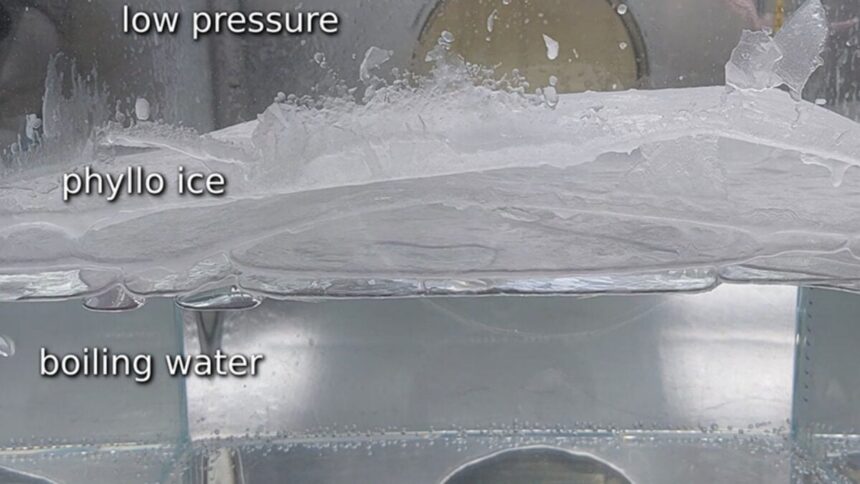
If, as researchers predict, cryovolcanic eruptions contribute to the formation of the moons’ icy shells, the extremely low pressures would generate a layered, highly porous ice with a texture reminiscent of, well, a croissant. In a recent Earth and Planetary Science Letters paper, the team describes a vacuum chamber experiment that simulated the low-gravity environment of Jupiter’s Europa and Saturn’s Enceladus. According to the tests, on (mock) Europa, water freezes into brittle sheets around 7.8 inches (20 centimeters), whereas on (mock) Enceladus these sheets can grow up to 787 feet (20 meters) thick.
These conditions are potentially hazardous for future landers to moons like Europa. I mean, imagine an expensive lander, after years of flying over to Europa, proceeding to burst through the brittle ice and sink into the freezing depths. Not ideal! In that sense, the findings highlight important considerations for upcoming missions to outer space moons.
“The low-pressure freezing of water is strongly affected by the escaping vapor,” Vojtěch Patočka, the study’s first author and a geophysicist at Charles University in the Czech Republic, told Gizmodo. “The highly porous and fragile layers that we observe could be several meters thick on the small icy worlds, which is enough to endanger a landed mission.”
Elusive icy worlds
Humanity got its first real peek at Europa in 1979, during Voyager 1’s flyby of Jupiter. Its successor, Voyager 2, captured a higher-resolution view of Enceladus in 1981. Although the two moons were discovered much earlier, a clearer look at the moons’ icy surfaces got scientists fairly excited about the prospects of finding water, and, therefore, some sign of habitability beyond Earth.
Subsequent expeditions by missions like Galileo (named for the guy who found the thing) or Cassini-Huygens sent back fascinating observations about the distant moons. As a result, researchers confirmed active cryovolcanism—eruptions of gases and other volatile materials that quickly freeze after reaching the surface—on Enceladus and suspect the same for Europa, according to the U.S. Geological Survey.
Of course, researchers know that water isn’t necessarily the smoking gun for alien life. Even so, the unique composition of icy moon surfaces offers key insights into astrobiological and chemical dynamics unknown to those on Earth.
An icy pastry
Given scientific interest, the latest study “seems like the kind of thing that would have been done already,” Patočka admitted to Science. Since nobody had, Patočka and colleagues ran a large-scale vacuum chamber experiment in “George,” a big simulation chamber at the Open University in the U.K., used to simulate Martian conditions. For the experiment, the team prepared 88 pounds (49 kilograms) of low-salinity water in a fish tank, dropping the temperature and pressure to reproduce the conditions of outer solar system moons.
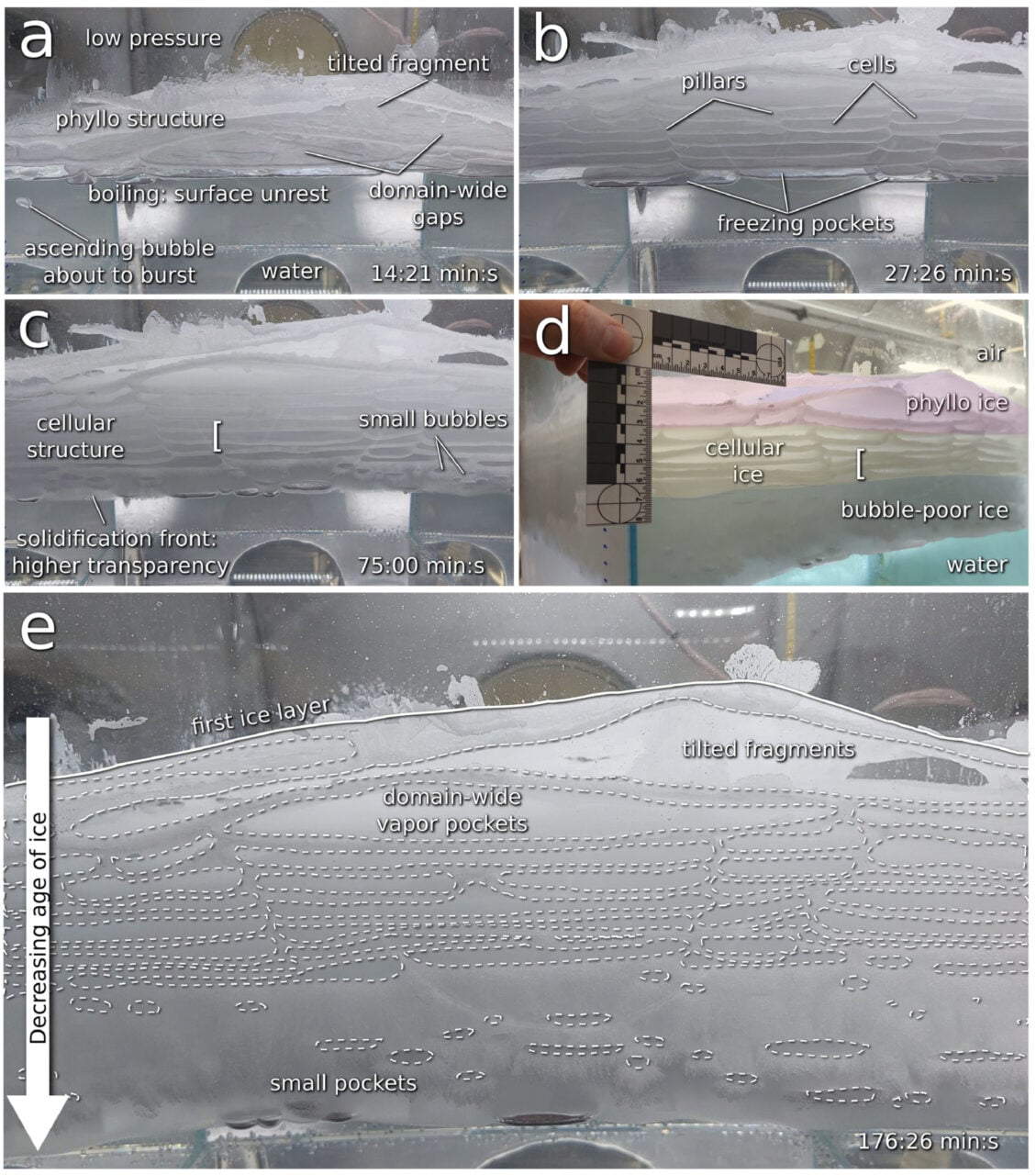
The researchers identified three distinct stages of freezing. First, the lack of pressure makes the water boil, as layers of crusty ice accumulate while escaping vapors push the layers upward. Then, the vapor pockets freeze too, until eventually a lower layer of more transparent ice with fewer bubbles forms at the bottom. The cross section of the resulting structure (labeled “e” in the photo above) indeed resembles that of a puffy croissant—hence, “fluffy ice.”
Looking ahead
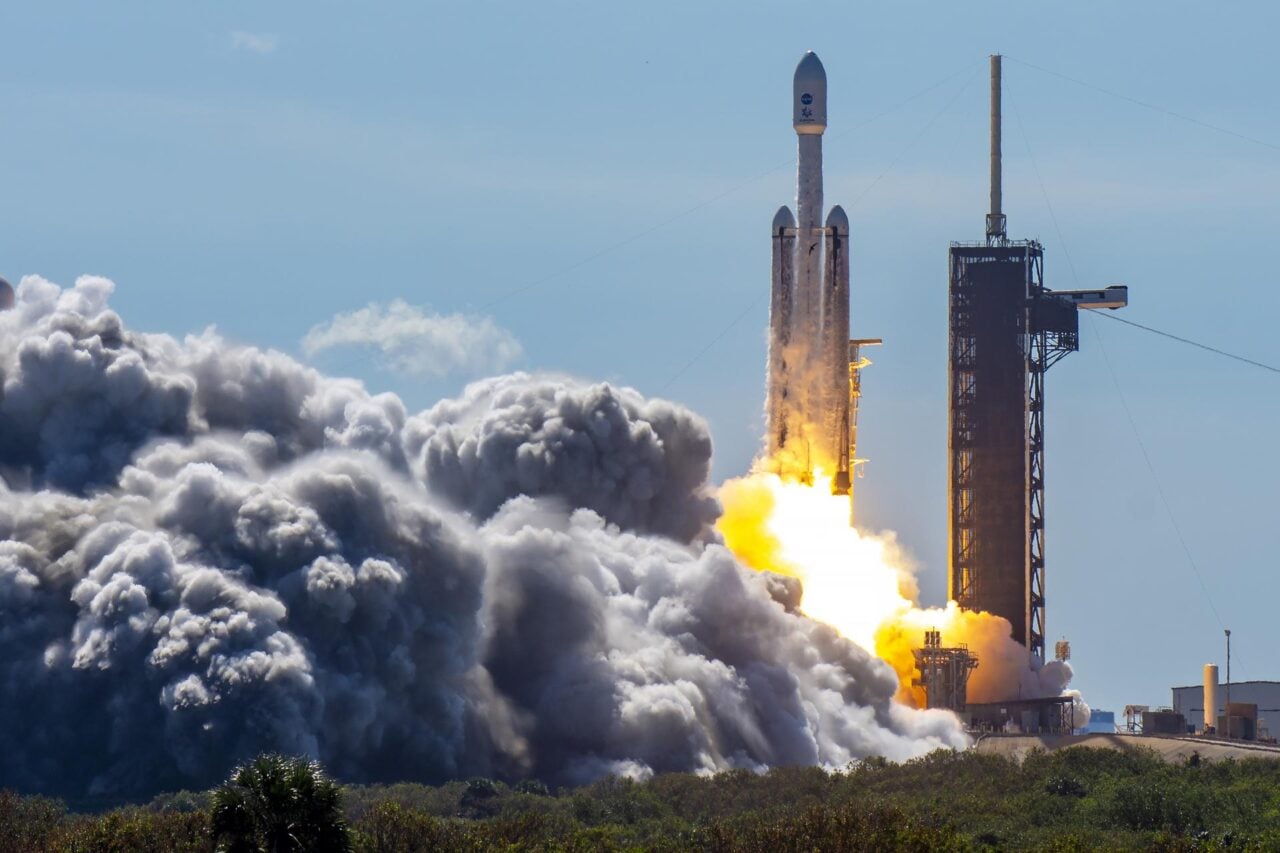
Meanwhile, global institutions continue to send over spacecraft to the solar system’s far side to study these systems. ESA’s JUICE is on its way and will reach Jupiter in 2031, whereas NASA’s Europa Clipper will get there by 2030. But these are just the ongoing missions, and both NASA and ESA (in collaboration with others like JAXA) are actively planning their successors.
So the latest findings are a good thing to be aware of. Ingrid Daubar, a planetary scientist on NASA’s Europa Clipper orbiter mission who wasn’t involved in the new work, told Science that this type of porous, fragile ice would “definitely pose some serious engineering issues,” and researchers would have to “re-envision the types of landing mechanisms we thought might work on Europa.”
The paper also alluded to this challenge; the cryovolcanic features on Europa and similar bodies won’t be ideal to “support a safe and stable landing due to the highly porous nature of phyllo and cellular ice structures reaching several to tens of meters deep, with smaller gravity implying greater depths.” If we want to plan landers to, well, land, engineers will have to take the local terrain into consideration.
Meanwhile, Patočka’s team plans to probe this phenomenon further. Patočka told Gizmodo that the plan is to return to George next week. This time, the team will see how this distinct freezing process works with flowing water so that the experiment is more true to the “conditions of cryovolcanic effusive flows,” he said.
Read the full article here