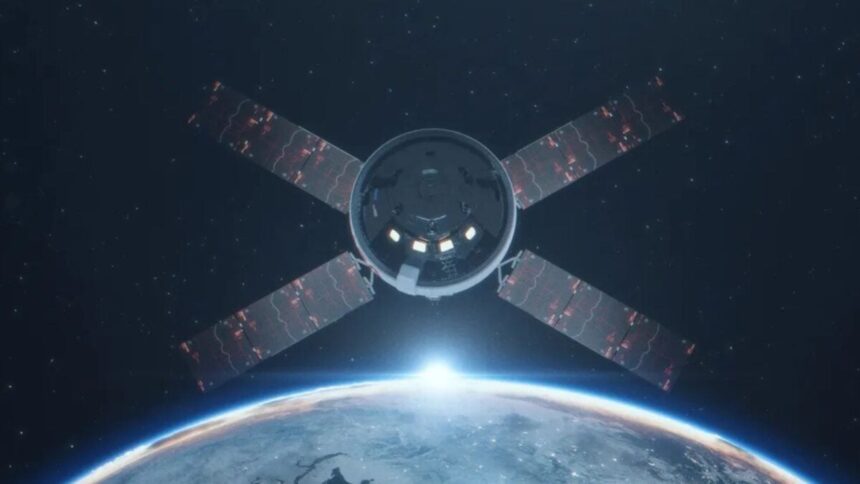
After the Artemis 2 astronauts returned from their historic journey around the Moon, NASA quickly shifted its attention to Artemis 3. Now, the agency has revealed some details from its preliminary flight plan. And, well, it’s not exactly what we expected.
Artemis 3, launching no earlier than late 2027, will aim to test rendezvous and docking capabilities between NASA’s Orion spacecraft and lunar landers built by SpaceX and Blue Origin, paving the way for the Artemis 4 crewed Moon landing. In a press release published Wednesday, the agency said engineers have been evaluating mission profile options and operational considerations since February, when NASA revamped the Artemis program architecture to reduce risk, increase launch cadence, and more effectively execute plans to establish a sustained lunar presence.
Officials still have key decisions to make, but this update provides the clearest insight into the Artemis 3 flight plan yet. Some of the choices are quite surprising.
SLS will fly without its upper stage
During Artemis 3, NASA’s Space Launch System (SLS) rocket will launch the Orion spacecraft from Kennedy Space Center in Cape Canaveral, Florida. A crew of four astronauts will be inside Orion. This is the same launch configuration NASA used for Artemis 2, but this time, SLS will fly without its Interim Cryogenic Propulsion Stage (ICPS).
Before NASA began launching Artemis missions, United Launch Alliance manufactured three ICPS stages for the agency. Two of them were used during Artemis 1 and Artemis 2, respectively, and now NASA only has one left. This stage of the rocket boosts Orion to a high-Earth orbit such that it can set course to the Moon, so the agency will definitely need it for Artemis 4. Fortunately, Artemis 3 can launch without it because the mission will not leave low-Earth orbit.
For this mission, the SLS will launch with a “spacer,” according to NASA. It’s kind of like a dummy ICPS—it mimics the mass and overall dimensions of the upper stage without the propulsive capabilities. This should allow the agency to meet its “test like you fly” objective without wasting its last ICPS.
No crewed lander test, no problem
Orion will launch separately from NASA’s commercial landers, SpaceX’s Starship Human Landing System (HLS), and Blue Origin’s Blue Moon Mark 2 (MK2) lander. The final mission profile hinges on whether the two landers will be ready for a crewed demo flight by late 2027—both are still in development.
Plan A is to have Orion dock with each lander to allow the Artemis 3 astronauts to climb aboard and test them out. Plan B is to have them test only one if the other isn’t mature enough yet. But the NASA release seems to suggest there is also a plan C.
“Informed by Blue Origin and SpaceX capabilities, NASA also is defining the concept of operations for the mission. While some decisions are yet to be determined, astronauts could potentially enter at least one lander test article,” the release states.
This implies that the Artemis 3 astronauts may not get to enter either lander, hinting at the possibility that neither will have viable life support systems by late 2027.
NASA recently began using a prototype of Blue Origin’s MK2 lander for Artemis 3 training and testing, suggesting some degree of confidence that it could be ready on time. Blue Origin is also getting ready to launch a demonstration mission for the first iteration of that spacecraft, the Blue Moon Mark 1 (MK1) cargo lander.
Meanwhile, SpaceX said in October that it had completed 49 milestones “tied to developing the subsystems, infrastructure, and operations needed to land astronauts on the Moon.” The biggest hurdle to HLS development is getting Starship V3 off the ground and accelerating its launch cadence, as HLS will essentially be a modified version of the V3 upper stage. The company plans to launch its new rocket for the first time on May 19.
More time aboard Orion than Artemis 2
Artemis 2 astronauts Reid Wiseman, Victor Glover, Christina Koch, and Jeremy Hansen lived inside Orion for 10 days as it flew around the far side of the Moon and back to Earth. Artemis 3 won’t even leave low-Earth orbit, but according to NASA, the crew will inhabit Orion for a longer period of time.
“The crew will spend more time aboard Orion than during Artemis II, further advancing the evaluation of life support systems, and for the first time will demonstrate the docking system performance,” the release states.
It’s unclear exactly how long the Artemis 3 astronauts will be aboard Orion or why they will need so much time inside the spacecraft. This could have to do with the fact that the commercial landers are launching separately and may not be able to do so in quick succession. It could also be related to the level of testing the Artemis 3 astronauts will need to complete aboard the spacecraft.
NASA should reveal more information about the mission profile as its target launch date approaches. Nearer-term missions will also offer some insight into lander readiness, namely next week’s inaugural flight of Starship V3 and the MK1 Moon landing demonstration slated for later this year. Gizmodo will be following along every step of the way, so watch this space for more updates on all things Artemis 3.
Read the full article here