If you’ve spent any amount of time in Los Angeles, you’re likely intimately familiar with the sound of police helicopters buzzing through residential neighborhoods at all hours of the day and night. For years, the cops claimed these deafening strafes and spotlight beam blasts into bedroom windows from the world’s largest municipal air fleet were an instrumental part of their “predictive policing” strategy to stop crime before it’s committed, a claim that is patently impossible to prove.
But in 2023, that narrative was finally challenged when one of the most popular elected officials in L.A. history, city controller Ken Mejia, conducted the first-ever audit into the ways the LAPD’s Air Support Division (ASD) uses its 17-chopper fleet. Not only did Mejia’s analysis find no tight relationship between the number of helicopter patrols over a neighborhood and the volume of crime reported there, it also found that 61 percent of these joyrides were flown for low-priority reasons. And—you may want to sit down for this—they were also found to be disproportionately targeting low-income communities of color in South and East Los Angeles.
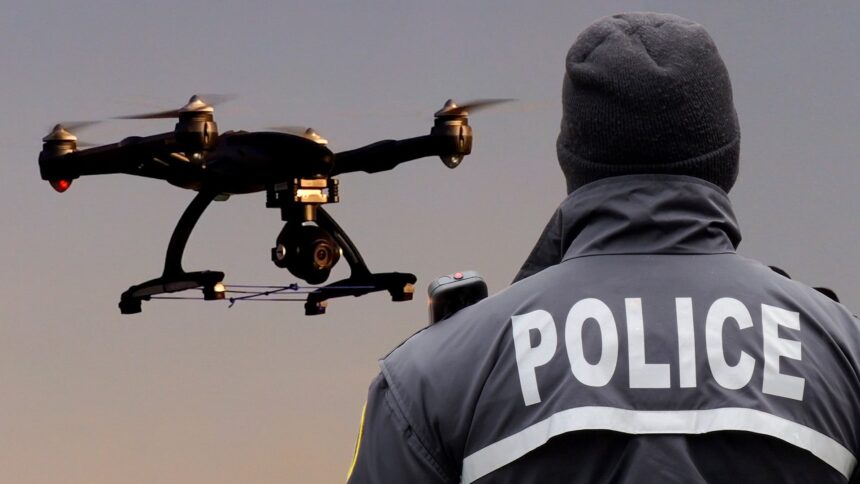
With this copter context, as well as the broader issue of cops habitually abusing modern surveillance tech, it’s hard to read the news of the LAPD’s aerial expansion into drone policing as anything but another sign of dystopian creep. After 3,500 drone flights in 2025 and a $2.1 million donation from the Los Angeles Police Foundation, the city’s Board of Police Commissioners unanimously (and unilaterally) voted this February to expand the city’s Drone as First Responder (DFR) program with the purchase of 24 more HD-camera and thermal-imaging equipped drone units via a 3-year contract with San Mateo, California-based manufacturer Skydio.
But it’s not just SoCal LEOs signing up as eager field testers for Silicon Valley’s latest technofascist products. All around the state, police departments are excitedly showing off their new toys. Take the June 22 video posted to the Sacramento County Sheriff’s Office showcasing their DFR entering a garage to disarm a suspect.
As the copaganda video’s four-paragraph caption reads, the suspect—only referred to as a “known felon” and “parolee-at-large”—was “not responding to negotiators,” so a drone (also manufactured by Skydio) was “deployed inside the residence” with a “powerful magnet” dangling below. Then, “in an incredible display of creativity, skill, and precision by the drone pilot,” the drone “safely remove[d] the knife from the suspect’s hand before deputies moved in.”
What is actually shown in the video is a bit less heart-racing, despite the Mission: Impossible soundtrack blaring throughout it. After a shot of the goggled drone pilot, we switch to the drone cam and watch it navigate through a messy garage over to the motionless suspect-in-question, face down on what appeared to be a mattress with his right hand extended, holding a knife. With its helpfully stationary target locked, the little police drone descends until its magnet finds purchase. A few tugs later, the knife is free and being flown back to the officers milling about in the street. But the threat’s not yet neutralized.
In a follow-up video posted to the department’s Instagram account today, this one set to Iron Maiden’s War Pigs without a hint of irony, we learn that the situation also gave Sacramento’s finest the opportunity to play with their robotic K9 unit, “Buster,” and their armored mini-bulldozer, “The Rook,” during the SWAT team’s efforts to apprehend the stationary suspect. As this video’s caption and subsequent interviews indicate, the suspect was not moving because he was “playing dead” or “lying in wait” like the previous video posited, but instead had likely overdosed after “consum[ing] all his drugs” once the cops started chasing him.
Nonetheless elated by their “first in the nation” tactical aeronautical de-bladification, Sacramento Sheriff Jim Cooper made the press rounds evangelizing the tech.
“The future is drones,” Cooper told NewsNation’s “The Hill” host Blake Burman. “Obviously, we use them a lot to make entry into houses, I mean, on a regular basis.”
As reported in SFGate, the Skydio drones in Yucaipa, California’s DFR program have “responded to 114 calls for service” and “contributed to 12 arrests,” according to a statement by Yucaipa PD. The statement included no further clarification as to how that contribution manifested, but it’s safe to assume police drones aren’t yet able to cuff humans. That tech’s still in the R&D stage.
With about 1,500 drone programs now operating across America, according to the LAPD, it seems Cooper’s claim about this tech being part of our future, whether we like it or not, isn’t far-fetched. But that doesn’t mean we can’t and shouldn’t still fight to put limits on how and when these units are deployed. Because as nice as it would be if their application was nothing but heroic public-serving feats like that knife snatch, drones are most likely going to be primarily used to widen the state’s panopticon—as they did when deployed to surveil peaceful protestors at LA’s recent “No Kings” protest. And if the LAPD’s history of helicopter misuse is any indicator, everyone should be concerned for their privacy, peace, and other rights now that pigs can fly nationwide.
Read the full article here