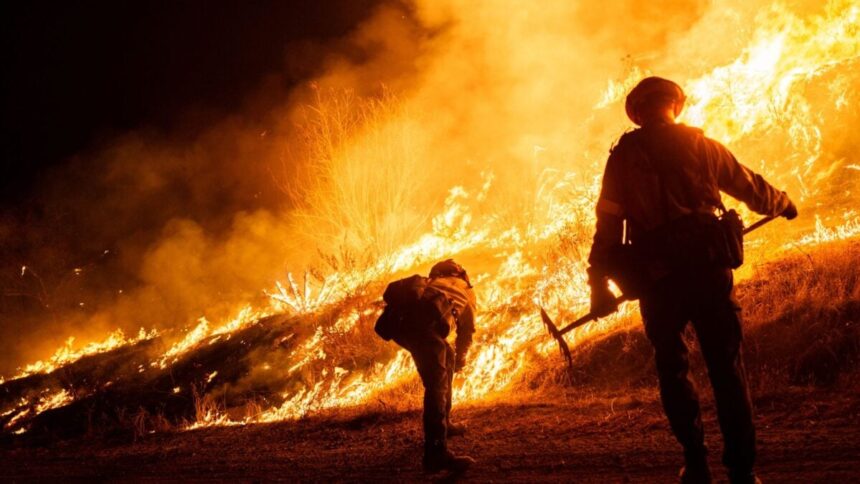
As the U.S. wildfire season approaches, experts warn it could be one of the worst in recent memory. This will also be the first season managed by the Trump administration’s U.S. Wildland Fire Service, and the agency is pursuing a risky fire management strategy.
Earlier this month, Interior Secretary Doug Bergum told senior career leaders that his department’s new wildfire agency should put out every fire that ignites on public lands, E&E News reports. Bergum established the U.S. Wildland Fire Service in January, consolidating the firefighting operations of the Bureau of Indian Affairs, the Bureau of Land Management, the Fish and Wildlife Service, the National Park Service, the Office of Aviation Services, and the Office of Wildland Fire under one chain of command.
“We will enter this season with the presumption of a full suppression strategy applied to every wildfire under DOI management,” Burgum reportedly wrote in the April 8 memorandum, emphasizing a responsibility to protect communities, landscapes, habitat, and critical infrastructure.
Full suppression fire management—which aims to extinguish all wildfires as quickly as possible—is highly controversial. As widespread drought conditions, historically low mountain snowpack, and record-warm temperatures set the stage for a longer season with a greater risk of large, fast-moving fires, some experts are raising concerns about the potential consequences of the new agency’s strategy.
Full suppression leads to more severe fires
The scientific consensus on full suppression fire management is that it is unsustainable and counterproductive in fire-adapted regions like the American West, the Great Plains, and the Southeast. Research has shown that immediately extinguishing smaller fires that don’t threaten life or property—rather than letting them burn under careful management—sets the stage for more severe, hazardous fires to ignite in that area.
That’s because fire suppression leads to fuel accumulation. In fire-adapted ecosystems, low- to moderate-intensity fires play an essential role in reducing the leaf litter, pine needles, and shrubs that turn into tinder as the landscape dries out. They also encourage the growth of fire-adapted native plant species, improving ecosystem resilience to severe fires.
The U.S. Wildland Fire Service’s full suppression approach “paints a troubling picture for the future of public lands,” Steve Ellis, a former Forest Service official who also served as the deputy director of the Bureau of Land Management before retiring in 2016, told E&E News. While the agency will be allowed to perform some prescribed burns (which are intentionally set by firefighters to reduce fuel for wildfires), it will be forced to do so under tighter restrictions.
An exceptional fire season ahead
It’s only April, and it’s already been an exceptional year for wildfires. As of April 17, the National Interagency Fire Center reported that over 1.7 million U.S. acres had already been consumed by wildfire since the start of 2026. That’s double the 10-year average.
As summer approaches and temperatures climb, a major Pacific marine heat wave—and the potential emergence of a “super” El Niño—could push them even higher. This will likely exacerbate the hot, dry conditions that fuel wildfires. Without a healthy snowpack to help moisten the landscape before summer arrives, experts worry that the West is in for a longer, more severe wildfire season.
It’s not uncommon for agencies to take a more conservative approach to controlled burning under these conditions, but going all-in on suppression could make the season more dangerous overall and strain firefighting resources. The U.S. Wildland Fire Service will certainly be put to the test this year, and the decisions it makes could have dire consequences.
Read the full article here