Plastic pollution doesn’t seem to be getting better. But what if we could engineer plastics to get rid of themselves?
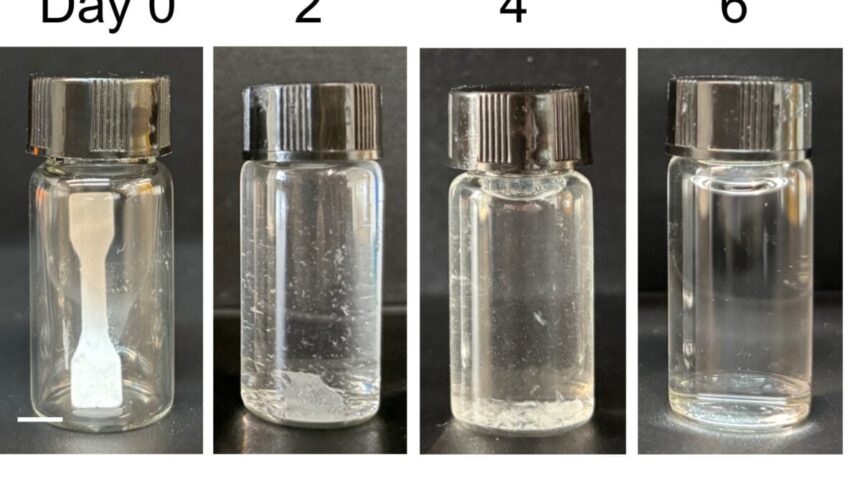
A team of scientists in China recently demonstrated this somewhat comically idealistic solution, reporting their findings in a recent paper published in ACS Applied Polymer Materials. This new “living” plastic, as the team describes it, contains plastic-degrading microbes that activate and self-destruct on command. Although this isn’t the first time scientists have tested similar materials, the new experiment looks promising. A proof-of-concept test with a wearable plastic electrode confirmed that, as intended, the plastic degraded completely within two weeks.
“The realization that traditional plastics persist for centuries, while many applications, like packaging, are short-lived, led us to ask: Could we build degradation directly into the material’s life cycle?” explained Zhuojun Dai, a study co-author and a synthetic biologist at the Shenzhen Institutes of Advanced Technology in China, in a statement.
Chained to last
Plastics are composed primarily of polymers—long, repeating chains of molecules that, once chained together, prefer to stay that way. This makes plastic very durable but difficult to break apart. Even if time passes and larger plastics break down, the smaller, particulate microplastics persist and cause various problems for both living beings and the environment.
Scientists had consistently explored whether some bacteria known to be capable of breaking down polymers could be engineered within plastic. In 2016, Japanese chemists planted a polymer-eating bacterium next to a plastic bottle to study how this could work. Other labs in the U.S. also developed biodegradable plastic prototypes built on similar premises.
The plastic is alive
The team behind the latest findings had investigated this possibility before. While the newest prototype builds on earlier attempts, it differs by using two enzymes instead of one, which had typically been the case so far. The goal was to engineer the bacterium Bacillus subtilis to produce two cooperative enzymes: one to snip the polymer chain and another to chew up these smaller bits into smaller molecules—essentially nothing.
To “activate” the enzymes, the plastic was treated with a nutrient broth of 122 degrees Fahrenheit (50 degrees Celsius). This brought the dormant spore of B. subtilis to life, and it took around six days for the plastic film—created to mimic commonly used plastic materials—to decompose. Impressively, the enzymes were such a good team that they didn’t leave any room for microplastic particles to emerge during the breakdown.
“By embedding these microbes, plastics could effectively ‘come alive’ and self-destruct on command,” Dai said. This turns “durability from a problem into a programmable feature,” she added.
Chasing an ideal
That said, the experiments worked with one type of polymer, polycaprolactone, commonly used in 3D printing and biomedical technology. The team believes a similar strategy could be extended to other plastic types. The researchers are keen to develop the “trigger” for the spores in water.
If they’re successful on both fronts, this would offer a viable way to manage plastic waste in oceans, which has been hit hard by plastic pollution. And again, this team isn’t the only lab entertaining self-destructing plastic. So perhaps this isn’t as big of an “if” as it may seem.
Read the full article here