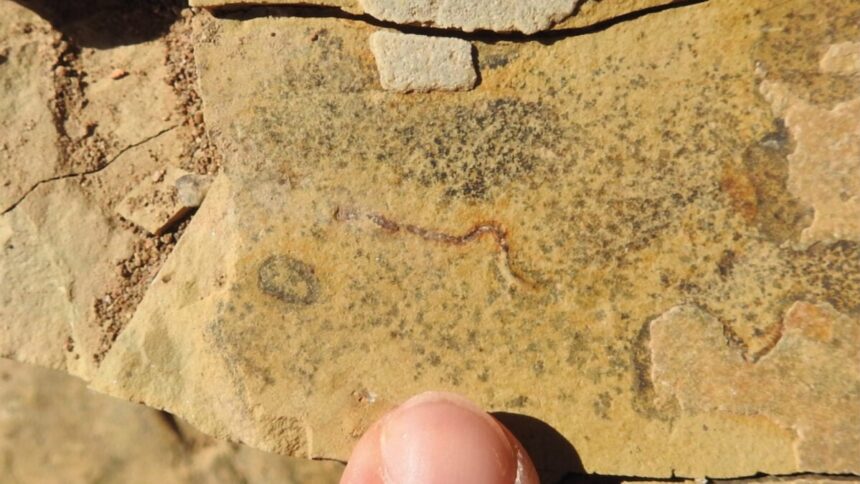
In 2017, researchers found tiny, fossilized filaments that, at the time, appeared to be trace fossils of worms or other small marine animals between 542 and 555 million years old. Their astounding age easily made the fossils one of the oldest discovered instances of animals on Earth—if, that is, the traces truly came from animals.
According to new research published in Gondwana Research, the answer is a disappointing “no.” When a different team revisited the fossils with advanced imaging techniques, it uncovered evidence strongly suggesting that the filaments were algae and bacteria. Considering Earth’s history, this conclusion actually makes more sense, as 540 million years ago, the atmosphere’s oxygen may have been too thin to support meiofauna, or invertebrates shorter than one millimeter in length.
“Using microtomography and spectroscopy techniques, we observed that the microfossils have cellular structures consistent with bacteria or algae that existed during that period—these aren’t traces of animals that may have passed through the area,” Bruno Becker-Kerber, the study’s first author and currently a postdoctoral researcher at Harvard University, said in a statement.
“I am not sold that they have effectively disputed the trace fossil nature of the slightly younger specimens that we investigated,” Luke A. Parry, the first author of the 2017 study, told Gizmodo in an email. “But it is good to see these fossils reanalyzed with higher-resolution methods.”
Inklings of life
The Cambrian explosion refers to the first 20 million years or so of the Cambrian period, which lasted around 539 million to 480 million years ago, according to the Natural History Museum in the U.K. This explosion marked a “defining moment in the diversification of large, multicellular lifeforms, including animals,” as a result of increased oxygen and mineral-forming elements in oceans, explained the museum.
On the other hand, the 2017 discovery in Corumbá, Brazil, suggested that relatively “complex” meiofauna would have been active before the explosion, during the Ediacaran period. At the time, however, there wasn’t a relatively noninvasive way to dissect the microfossil at high resolutions, noted Becker-Kerber, who worked on the new research during a fellowship at the University of São Paulo in Brazil.
To answer a tricky question
Well, in the nine years since, scientists (not necessarily for these microfossils) invented imaging techniques advanced enough to examine these types of microfossils, which, as their names suggest, are extremely tiny, ranging from a few micrometers to a few millimeters.
In addition to the 2017 fossils, the team found new samples from a nearby site with similar properties. The researchers analyzed the fossils using the Sirius particle accelerator in Brazil, nanometer-scale imaging techniques, and Raman spectroscopy. As a result, they identified preserved cell walls, cell wall divisions, and other organic remnants “much closer to bacteria or algae than to mere marks of disturbance caused by animals,” Becker-Kerber explained.
An ongoing challenge
That said, even if the fossils aren’t from animals, the preserved specimens are still remarkable, he added. Some of the fossilized bacteria and algae are large enough to be visible to the naked eye and rank among the largest ever recorded for their species, suggesting these tiny organisms coexisted in a microbial consortium.
Parry, who told Gizmodo he wasn’t contacted by the authors on the study prior to its publication, commended the team’s use of advanced imaging techniques. However, he noted that the picture becomes more complicated when considering the full range of fossils examined in the 2017 study, particularly the relatively younger specimens that the new paper did not address.
“This highlights that structures with quite different origins can look similar in the fossil record due to similar preservation,” Parry added. “Regardless of the precise interpretation of the Brazilian structures, the 2017 paper provided a potential search image for the action of microscopic animals in the early trace fossil record.”
A few years back, another team found similarly aged rocks from Namibia that displayed similar traces of meiofaunal burrows, he said. But that’s not all. Just last month, a new fossil site in China—an expedition Parry was involved in—turned up 700 well-preserved specimens dating from between 554 and 539 million years ago. These fossils included taxa previously found exclusively in the Cambrian period.
“I don’t think that this will be the last word on the fossils and similar ones, which, due to their small size, are pushing the limits of our ability to analyze them,” Parry concluded.
If these fossils withstand independent review and technological advances, we might really need to officially rethink the Cambrian explosion. But as with all else, we’ll just have to see.
Read the full article here