By using this site, you agree to the Privacy Policy and Terms of Use.
Accept
Tech Consumer JournalTech Consumer JournalTech Consumer Journal
  • News
  • Phones
  • Tablets
  • Wearable
  • Home Tech
  • Streaming
  • More Articles
Reading: Scientists Create Miniature Fireballs to Study Fallout From Nuclear Accidents
Share
Sign In
Notification Show More
Font ResizerAa
Tech Consumer JournalTech Consumer Journal
Font ResizerAa
  • News
  • Phones
  • Tablets
  • Wearable
  • Home Tech
  • Streaming
  • More Articles
Search
  • News
  • Phones
  • Tablets
  • Wearable
  • Home Tech
  • Streaming
  • More Articles
Have an existing account? Sign In
Follow US
  • Contact
  • Blog
  • Complaint
  • Advertise
© 2022 Foxiz News Network. Ruby Design Company. All Rights Reserved.
Tech Consumer Journal > News > Scientists Create Miniature Fireballs to Study Fallout From Nuclear Accidents
News

Scientists Create Miniature Fireballs to Study Fallout From Nuclear Accidents

News Room
Last updated: May 27, 2026 12:25 pm
News Room
Share
SHARE

In the aftermath of nuclear accidents, radionuclides mix with the debris and soil in their vicinity. When this dangerous mixture “falls back” to us, the resulting nuclear fallout can cause lasting damage. For practical reasons, current fallout models fall short in fully describing these toxic events—but a clever miniature may finally offer scientists a better way to study them.

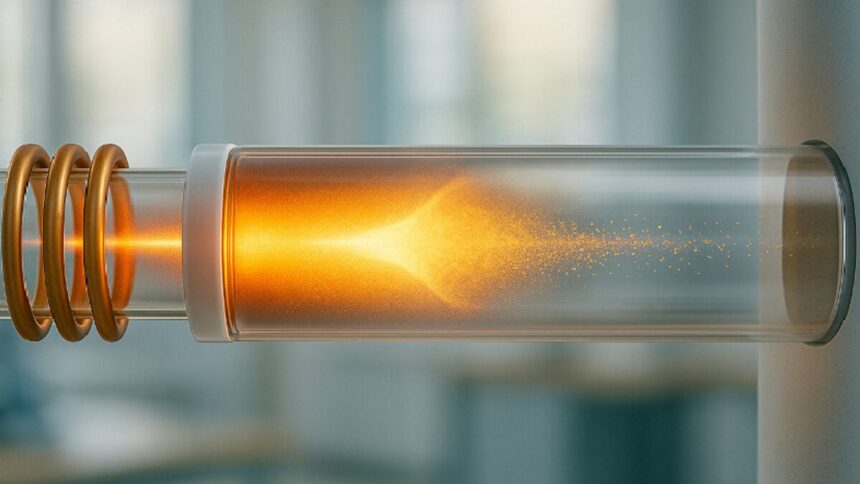
Researchers at Lawrence Livermore National Laboratory (LLNL) created a small replica of the fireballs that trigger nuclear fallout inside a plasma flow reactor. The carefully controlled experiment allowed them to investigate how uranium, cerium, and cesium vaporize and behave. As a result, the team was able to identify limitations in current fallout models under more realistic conditions. They published their findings in a recent Analytical Chemistry paper.

“By studying these processes in a controlled system, we can replace assumptions with measurements, improve the models used to interpret nuclear debris, and support decision-making when it matters most,” Rakia Dhaoui, the study’s first author and a scientist at LLNL, said in a statement.

A mini fireball

For the experiment, the team customized a plasma flow reactor to freely program different temperatures and oxygen fugacities (i.e., how easily chemicals move and react). The miniature represents a portion of the fireball process, which triggers nuclear fallout by expanding and mixing into air after a nuclear accident, according to LLNL.

Annotated photograph of the modified plasma flow reactor. © Dhaoui et al., 2026

Specifically, fallout is when the fireball begins to cool and condense into tiny solid particles, so the experimental setup was designed to replicate these steps. The researchers set up two scenarios: one imposed a consistent temperature decrease along the tube, whereas the other kept the heat at around 2,060 degrees Fahrenheit (1,127 degrees Celsius) before rapid quenching, according to the study.

“Historical fallout studies indicate that the path materials take as they cool is important,” Dhaoui explained. “Cooling rate and time at elevated temperature can alter chemical speciation and particle formation.”

A fork in the fire

The lab tests found that the three elements studied all behaved differently. Uranium condensed early on, with cerium condensing in a similar temperature range. Both elements’ chemistry varied depending on the cooling scenarios. On the other hand, cesium took much longer to condense and interacted more with other elements when kept for longer at a higher temperature.

“These results suggest that fallout formation depends not only on when elements condense, but also on how elements chemically interact during cooling,” LLNL explained. This is in contrast to existing models that tend to consider each element individually, but these complex interactions are likely “essential” for improving predictive models of processes relevant to nuclear fallout, according to the paper.

Read the full article here

You Might Also Like

The Best Tech Gifts for Father’s Day 2026

Comic-Con Will Have a ‘Transformers’ Concert and ‘Jem’ Crossover

Layoffs Reportedly Hit Sam Altman’s Creepy Eyeball-Scanning Startup

We’d Bet on This ‘Odyssey’ Trojan Horse Popcorn Bucket

Seattle Passes Most Symbolically Potent Data Center Moratorium Yet

Share This Article
Facebook Twitter Copy Link Print
Previous Article ‘Backrooms’ Is a Total Vibe and We Are Here for It
Next Article ‘Widow’s Bay’ Pulls the Past Into the Present in Hilariously Gruesome Ways
Leave a comment

Leave a Reply Cancel reply

Your email address will not be published. Required fields are marked *

Stay Connected

248.1kLike
69.1kFollow
134kPin
54.3kFollow

Latest News

I’m More Excited for the Tiny Changes in Apple’s ’27’ Software Updates Than Siri AI, TBH
News
Trump Family Reportedly Made About $2.3 Billion on Crypto While Investors Lost About $2.3 Billion on Trump-Related Crypto
News
iOS 27 Fixes the Liquid Glass Optical Illusion That Broke My Brain
News
The Apple Car Is Dead, and Waymo Just Bought Its Gravesite
News
Democrats Want a Military AI Restriction Law Following Anthropic’s Pentagon Fallout
News
Judge Cancels Whole Case After Lawyers Admit They Didn’t Read AI-Generated Filings
News
There’s Nothing Sus About How Good the ‘Among Us’ Animated Series Is
News
First Human Receives Experimental Therapy to Reverse Cellular Aging
News

You Might also Like

News

NASA’s Crew Safety Alert Exposed a Bigger ISS Leak Problem

News Room News Room 5 Min Read
News

FDA Approves First New Sunscreen Ingredient for Americans in 20 Years

News Room News Room 4 Min Read
News

Anthropic Releases a Safer Version of Its ‘Too Dangerous’ Mythos AI

News Room News Room 4 Min Read
Tech Consumer JournalTech Consumer Journal
Follow US
2024 © Prices.com LLC. All Rights Reserved.
  • Privacy Policy
  • Terms of use
  • For Advertisers
  • Contact
Welcome Back!

Sign in to your account

Username or Email Address
Password

Lost your password?