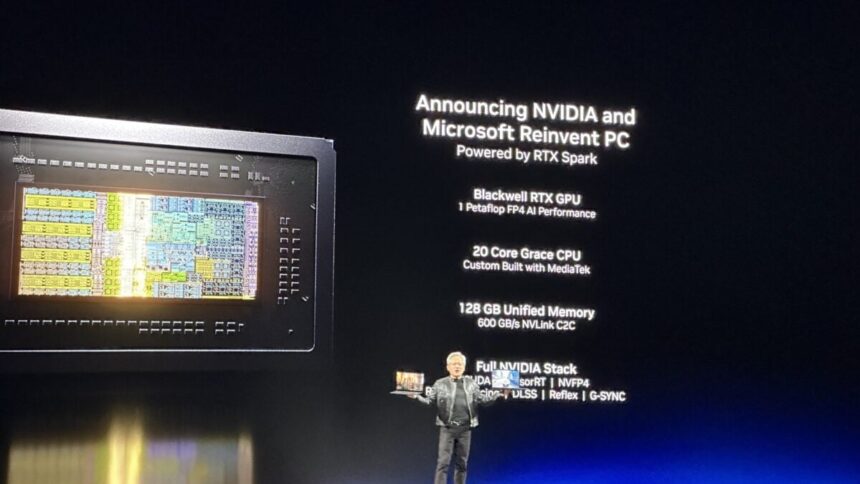
After storming onto the stage in Taipei, Taiwan, Nvidia CEO Jensen Huang has finally showcased the company’s long-awaited laptop-grade CPUs. They’re just as promising, and just as perplexing, as we imagined based on nearly a year’s worth of rumors and leaks.
Huang claimed Nvidia was effectively reinventing PCs with the newfangled RTX Spark platform. He went as far as to state that RTX Spark will handle “every application that Windows has ever run.”
Huang walked onto the stage holding a PC in both hands, one running 007 First Light and the other Forza Horizon 6. He claimed both titles were running “well.” Just how well, we’ll have to find out for ourselves.
First in this stack is the N1X. The N1X is exciting because of what it represents for the company’s GPU architecture. The chip features a Blackwell-series GPU, the same architecture used in the Nvidia GeForce RTX 50-series discrete graphics cards you’ll find in many professional or gaming laptops. It uses a 20-core GPU developed in part by MediaTek. The chip supports up to 128GB of unified memory, but beyond these figures, Huang didn’t detail what people can expect.
But, of course, the point of these chips is to run AI, or at least to run some AI on-device and then rely on the cloud for everything else. Nvidia promised we’ll see laptops from practically all the major PC makers, including the likes of Microsoft, Lenovo, Acer, Dell, Gigabyte, and MSI.
The N1X will be an ARM-based chip, meaning they use a similar RISC-based microarchitecture to Qualcomm’s recent Snapdragon X series. Qualcomm has struggled since it launched its first PC SoC (system-on-chip) to achieve greater compatibility with older x86 apps and drivers.
Nvidia may be reaping some of the rewards of Qualcomm’s hard work, but it’s not all sunshine and rainbows for Team Green. There are still lingering compatibility issues inherent to ARM-based chips, especially when you’re working with legacy drivers.
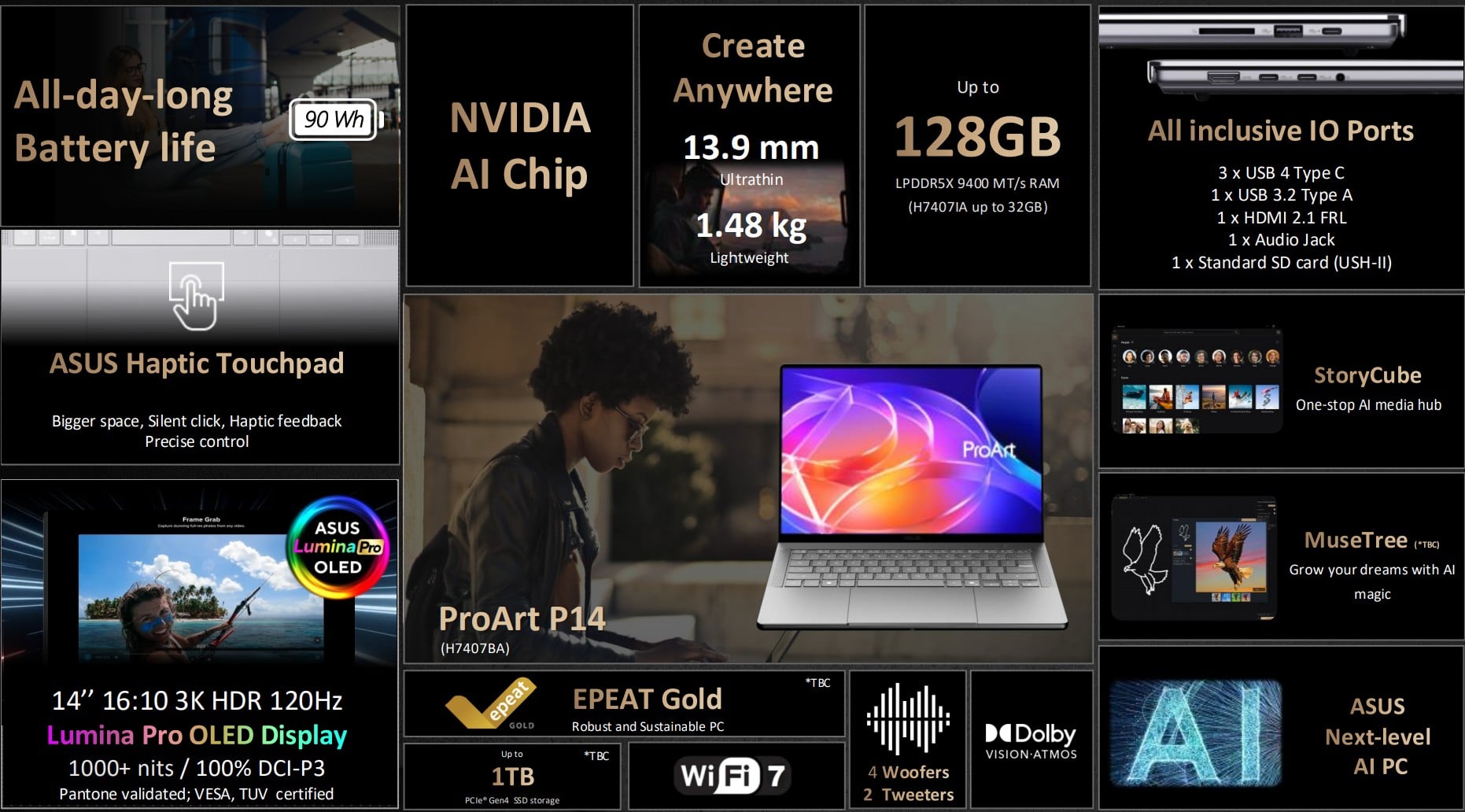
Asus has confirmed that its ProArt P14 and ProArt P16 will be among its first models to include the N1X. These devices are made for professional video and graphics work, with options up to 128GB of RAM (on the larger model) and 14- or 16-inch 120Hz OLED displays with 3K and 4K resolution, respectively.
One of these Blackwell GPUs on a single SoC may be attractive to the creative sphere. Whether the same chip will be equally impressive for gamers on the go remains to be seen. In that same vein, Nvidia is crafting a whole ecosystem of Spark-type PCs, including more mini PC-like devices built to run agentic software such as Nvidia’s own NemoClaw. Huang also showed off a desktop built with a custom SoC that he promised would run Windows. That so-called DGX Station supports up to 760GB of memory and should be able to run a 1-trillion-parameter model on-device.
It’s certainly interesting to see the world’s wealthiest company try its hand at a full laptop processor after putting all its eggs into the AI basket. Moreover, this appears to be a stepping stone toward better graphics and greater efficiency on PCs. That is, if all of Nvidia’s claims actually pan out in practice.
Read the full article here