

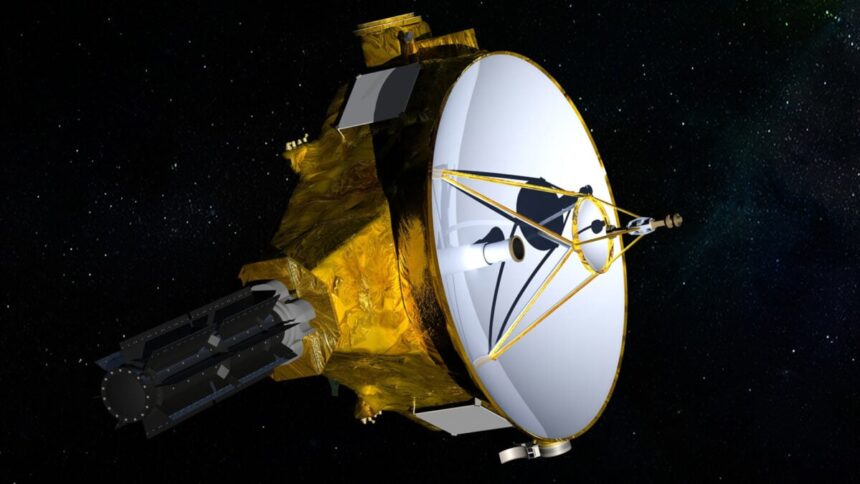
In late June, NASA’s New Horizons spacecraft woke up from a nearly year-long slumber at a distance of approximately 5.9 billion miles (9.5 billion kilometers) from Earth. As it continues its mission deep in the Kuiper Belt, the spacecraft enters a planned hibernation mode during long cruise periods to conserve resources for the journey ahead.
New Horizons is currently exploring the outer regions of the solar system as it prepares to cross into interstellar space, surpassing a large bubble of plasma carved out by the Sun’s wind. The exact boundary of this bubble, however, has yet to be determined. Researchers from Southwest Research Institute (SwRI) set out to find out where the edge of the solar system bubble lies, hoping to get a better estimate of when New Horizons might hit that boundary.
In two papers, published in the Astrophysical Journal and Advances in Space Research, scientists estimate that New Horizons will exit the solar system as early as 2029 or as late as 2040.
Protective bubble
To get a better sense of what New Horizons is up against, first we must understand the solar system’s protective bubble. The Sun sends out a constant flow of charged particles, known as solar wind, which travels past all the planets.
This forms a giant, comet-shaped bubble around the solar system, known as the heliosphere. The heliosphere ultimately acts as a giant shield, protecting the solar system from galactic cosmic radiation.
So far, the only spacecraft to have traveled beyond the heliosphere are NASA’s Voyager 1 and 2. When the spacecraft crossed that boundary in 2012 and 2018, respectively, scientists noticed the first major threshold in leaving the solar system’s environment, known as the termination shock. This boundary is marked by the sudden drop of solar wind speed as it collides with interstellar wind.
“We want to understand when the [New Horizons] spacecraft will reach the termination shock to prepare to take measurements and download data about this region,” Jonathan Gasser, a researcher at SwRi and lead author of one of the papers, said in a statement.
Beyond the horizon
The researchers behind the new study set out to predict the location of the termination shock in the direction New Horizons is traveling. They did so by studying the heliosphere’s outer boundaries, including the termination shock and the heliopause, where the solar wind abruptly slows as it interacts with interstellar material.
“Based on our research, we predict that New Horizons will encounter the termination shock as early as 2029 or as late as 2040,” Gasser said. That may seem like a loose estimate but that’s because these boundaries constantly expand and contract in response to the changing conditions of the Sun.
The Sun goes through an 11-year cycle marked by fluctuations in its magnetic activity. During solar maximum, the peak of the cycle, the heliosphere expands. In solar minimum, when the Sun is relatively calm, the ebbing solar wind causes the heliosphere to contract.
“It is possible that [New Horizons] could cross the boundary more than once as the heliosphere continues to expand and contract,” Gasser added.
New Horizons launched on January 19, 2006, and spent nearly 15 years on a journey toward the far reaches of the solar system (around 50 times farther away than Earth is from the Sun). From there, the spacecraft has been exploring the Kuiper belt, a donut-shaped ring of icy objects that extends just beyond the orbit of Neptune.
The spacecraft was the first to visit Pluto in July 2015, conducting the farthest flyby in history. In 2019, New Horizons approached its next target, a binary object later named Arrokoth (which is Native American for “sky”,) the most distant and most primitive object ever explored by a spacecraft.
As New Horizons continues on its trip to reach interstellar space, scientists are learning more about the bubble that protects the solar system. “Studying the heliosphere is like solving a cosmic puzzle,” Heather Elliott, a researcher at SwRi and lead author of one of the studies, said in a statement. “Not only do we learn more about how the Sun’s influence ends, but we also gain a deeper understanding of the boundary between our solar system and interstellar space—a critical step toward planning future interstellar travel.”
Read the full article here