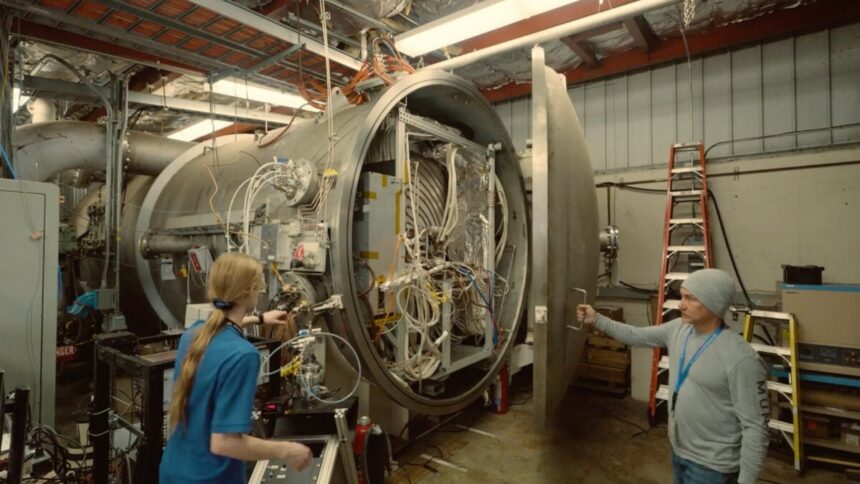
NASA engineers recently tested a next-generation electric propulsion system that could one day power a crewed mission to Mars.
NASA fired up a prototype of its electromagnetic thruster inside a vacuum chamber, reaching power levels of up to 120 kilowatts—the highest achieved in U.S. tests of an electric propulsion system. That’s over 25 times the power of the electric thrusters aboard the current Psyche mission, which launched in 2023 on a journey to explore a metal-rich asteroid.
“Designing and building these thrusters over the last couple of years has been a long lead-up to this first test,” James Polk, senior research scientist at NASA’s Jet Propulsion Laboratory (JPL), said in a statement. “It’s a huge moment for us because we not only showed the thruster works, but we also hit the power levels we were targeting. And we know we have a good testbed to begin addressing the challenges to scaling up.”
Fired up
Electric propulsion systems use magnetic fields and electric currents to accelerate propellant to high speeds. This type of propulsion uses up to 90% less propellant than traditional, high-thrust chemical rockets, according to NASA.
Current electric propulsion thrusters rely on solar power to accelerate propellant, reaching high speeds over time through a low continuous thrust. NASA’s recently tested electromagnetic thruster, on the other hand, runs on lithium metal vapor. The lithium-fed magnetoplasmadynamic (MPD) thruster uses high currents interacting with a magnetic field to electromagnetically accelerate lithium plasma.
Lithium-fed thrusters could potentially operate at high-power levels, using propellant efficiently and providing greater thrust power than the electrical thrusters currently in use, according to NASA. Once fully developed and paired with a nuclear power source, the MPD could help reduce launch mass to support larger payloads for human Mars missions.
During the test, the electric thruster was placed inside a 26-foot-long (8-meter-long) water-cooled vacuum chamber at JPL’s Electric Propulsion Lab. Engineers fired up the thruster and watched it come to life. During five ignitions, the thruster reached temperatures over 5,000 degrees Fahrenheit (2,800 degrees Celsius). The thruster’s nozzle-shaped outer electrode emitted a vibrant red plume, while the tungsten electrode at its center glowed bright white.
Ticket to Mars?
NASA’s JPL has been developing the MPD thruster for the past two and a half years in collaboration with Princeton University and NASA’s Glenn Research. The work is funded by NASA’s Space Nuclear Propulsion project, with the aim of launching a human mission to Mars by supporting a megawatt-class nuclear electric propulsion program.
“At NASA, we work on many things at once, and we haven’t lost sight of Mars,” NASA Administrator Jared Isaacman said in a statement. “The successful performance of our thruster in this test demonstrates real progress toward sending an American astronaut to set foot on the Red Planet.”
Data from the first demonstration will help inform an upcoming series of tests of the electromagnetic thruster. The team is aiming to reach power levels between 500 kilowatts and 1 megawatt per thruster in coming years.
Launching a crewed spacecraft to Mars might require 2 to 4 megawatts of power, meaning multiple MPD thrusters operating for more than 23,000 hours. This presents a challenge as the hardware operates at high temperatures, and the team needs to prove that the thruster’s components can withstand the heat for multiple hours during upcoming tests.
“We will continue to make strategic investments that will propel that next giant leap,” Isaacman added.
Read the full article here