NASA suspended all scientific activity onboard its Neil Gehrels Swift Observatory this past February, in the hopes of reducing drag and buying time before the space telescope’s orbital decay drags it down into a fiery death by friction through Earth’s atmosphere. In the months since, the U.S. space agency has raced to put together a “reboost” mission that will reposition the device into a higher, safer orbit.
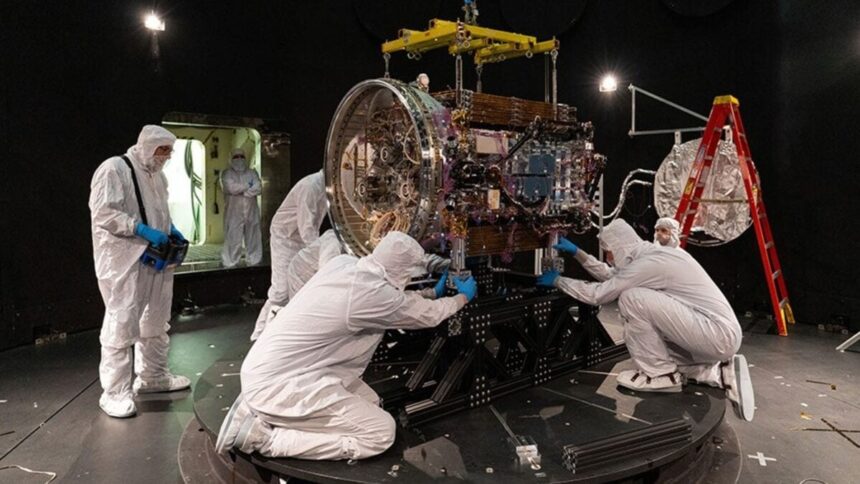
This unusual operation—reportedly the first satellite servicing of its kind—plans to deploy a $30 million orbital craft with three robotic arms called LINK, developed by private aerospace firm Katalyst Space, to “slowly raise Swift’s altitude over several months,” as NASA put it in a press statement. But, as of this morning, NASA’s mission to save Swift has been postponed three times in less than a week, due to inhospitable weather conditions Tuesday and Wednesday, and now a “launch vehicle issue” on Thursday, temporarily grounding Katalyst’s rescue robot.
“The date of the next launch attempt for this mission […] will be determined after teams have reviewed data from today’s attempt,” NASA public affairs specialist Alise Fisher wrote in an update.
Reboost, reuse, recycle
Over the course of Swift’s roughly 21 years in orbit, the space satellite has already exceeded its original purpose: recording gamma-ray bursts, meaning the electromagnetic evidence of distant, dense stars as they collapse into the creation of newborn black holes. The telescope, which cost $250 million to make in 2004 (or about $452 million in today’s dollars), has since shown utility spotting X-ray flares, mapping galaxies, tracking an asteroid whizzing past Earth, and even documenting a black hole leeching material off its nearby star, among other lateral use cases.
“This is a high-risk, high-reward mission,” the director of NASA’s astrophysics division, Shawn Domagal-Goldman, said ahead of the first attempted launch this week.
“We have much to gain by attempting this boost, which is more affordable than trying to replace Swift’s capabilities and allows NASA to advance the nation’s satellite servicing industry, for the benefit of all.”
The LINK robotic spacecraft will head into space from Kwajalein Atoll in the Republic of the Marshall Islands, a long-time U.S. strategic ally in the South Pacific, onboard a modified Lockheed Martin L-1011 aircraft. From there, NASA plans to launch the LINK into orbit from midair, via a Northrop Grumman Pegasus XL rocket, which will take it on an intersecting path toward the Swift Observatory.
A LINK to the past
Katalyst Space’s LINK spacecraft reportedly weighs about 880 pounds (400 kilograms) with a height of roughly 5 feet (1.5 meters). It’s at best one third the size of the Swift itself—but will be propelled by three solar-powered ion thrusters as its robotic arms maneuver the NASA satellite to safety, preserving its ability to peer deep into space and recording cosmic events from the earliest eras of the known universe.
“Swift is NASA’s multitool when it comes to studying the cosmos,” said S. Bradley Cenko, principal investigator for NASA’s Swift research. “For the last two decades, Swift has been a key player in NASA’s efforts to understand how the universe works, and we’re looking forward to getting back to that work after the boost is complete.”
Katalyst has only had since this past September to put together its LINK craft, when NASA reached out to commission the design, construction, and testing of a device capable of gently moving its sensitive scientific instrument into a new orbit.
“Swift wasn’t designed to be serviced,” Katalyst’s CEO Ghonhee Lee noted. “By demonstrating we can quickly and cost-effectively extend its lifetime, we’re creating a blueprint for servicing spacecraft that were never designed for on-orbit maintenance.”
Lee framed it as more than just one rescue mission, but proof of concept humanity needs to prove itself as a spacefaring species: “If we’re going to build an enduring presence beyond Earth, we need the capability to manipulate our environment in space,” he said. “That means deploying robotic spacecraft that can reposition, repair, refuel, and refit satellites after launch.”
Read the full article here