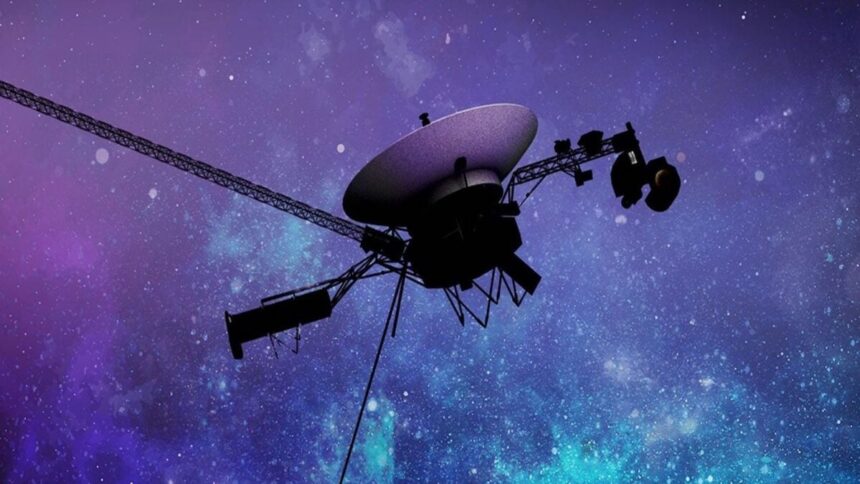
NASA engineers are working to keep the Voyager mission alive as it cruises through interstellar space, opting to shut down components of the spacecraft to save power.
Engineers at NASA’s Jet Propulsion Laboratory (JPL) sent commands to Voyager 1 to shut off one of its science instruments after the spacecraft’s power levels fell unexpectedly. Out of the 10 instruments on board Voyager 1, only two are still operating as the mission team figures out new ways to keep the spacecraft alive for longer.
“While shutting down a science instrument is not anybody’s preference, it is the best option available,” Kareem Badaruddin, Voyager mission manager at JPL, said in a statement.
Forced shutdown
In late February, Voyager 1’s power levels dropped during a routine roll maneuver. The Voyager team had to act fast; any additional drop in power could trigger a safeguard system that would begin shutting down components on its own.
Voyager is powered by heat from decaying plutonium that is converted into electricity. Each year, the aging spacecraft loses about 4 watts of power. In an effort to extend the mission duration, the team has turned off systems deemed unnecessary to keep the spacecraft going, including a few of the science instruments.
The team of engineers agreed on the order in which they would shut down instruments on board Voyager, and the Low-energy Charged Particles experiment, or LECP, was next on that list. LECP measures low-energy charged particles, including ions, electrons, and cosmic rays originating from our solar system and galaxy, and has been providing critical data on the structure of the interstellar medium for the past 49 years.
On April 17, the team was forced to send commands to shut off LECP. The sequence of commands took around 23 hours to reach Voyager 1, while the shutdown process itself took about three hours and 15 minutes to complete.
It’s not over yet
The Voyager 1 spacecraft launched on an unprecedented journey to interstellar space in 1977, becoming the farthest human-made object at a distance of 15 billion miles (25 billion kilometers) from Earth.
The twin Voyager probes have far surpassed their original mission timeline. The original mission was designed to last just five years, but Voyager 1 and 2 are still going nearly 50 years later. The journey, however, has taken a toll on the spacecraft, and NASA engineers are forced to come up with new ways to extend the mission.
Shutting down Voyager 1’s LECP will give the spacecraft around a year of breathing room while engineers finalize a more ambitious energy-saving fix for both spacecraft. The long-term plan, called “the Big Bang,” will attempt to swap out a group of powered devices and replace them with lower-power alternatives. The idea is to keep the spacecraft warm enough to continue gathering science data and further extend its operations in interstellar space.
Engineers kept one part of LECP on, a small motor that spins the sensor in a circle to scan in all directions, in the hopes that they can turn the instrument back on someday if they can garner enough extra power.
“Voyager 1 still has two remaining operating science instruments—one that listens to plasma waves and one that measures magnetic fields. They are still working great, sending back data from a region of space no other human-made craft has ever explored,” Badaruddin said. “The team remains focused on keeping both Voyagers going for as long as possible.”
Read the full article here