Space is full of odd light sources astronomers don’t quite understand, like double supernovas, weird blue flashes, random Venn diagrams, and more. And just when we thought we’d seen it all, there’s a new addition to the list—a natural “space laser” from the universe’s early days.
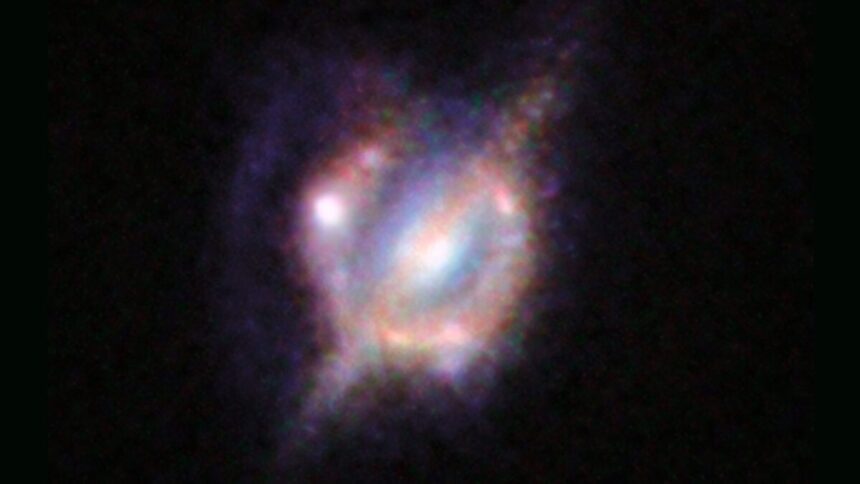
Researchers using the MeerKAT radio telescope spotted an extremely bright, laser-like beam of microwave radiation—a “maser”—which they tracked back to a violent galaxy merger, designated H-ATLAS J142935.3–002836. The system, located more than 8 billion light-years away, would normally be too distant to detect. But a lucky alignment with an unrelated foreground galaxy boosted the already powerful signal, pushing it within MeerKAT’s reach.
A paper detailing the findings has been accepted for publication in Monthly Notices of the Royal Astronomical Society and is currently available as a preprint on arXiv.
“This system is truly extraordinary,” Thato Manamela, the study’s lead author and a postdoctoral researcher at the University of Pretoria in South Africa, said in a release. “We are seeing the radio equivalent of a laser halfway across the universe.”
Galactic lasers
Human-made lasers are focused, or coherent, streams of high-energy photons—light particles—that travel at the same frequency. Something similar can happen in space, when galactic collisions lead to extreme pressures that compress gas from both galaxies. Those conditions also stimulate tiny dust particles containing hydroxyl ions—molecules made of hydrogen and oxygen.
When powerful sources like black holes emit radio waves, already excited particles fall into a concentrated beam of light known as a hydroxyl maser. Such light sources have been observed before but are rather rare, mostly because they typically operate at wavelengths of about 7 inches (18 centimeters)—much longer than those in the optical spectrum.
A perfect alignment
The new discovery was truly serendipitous. Notwithstanding the general rarity of masers, the sheer distance between Earth and the galactic system would normally have made observing it nearly impossible. But when the team pointed MeerKAT at that section of the sky, it just so happened that a completely unrelated—yet perfectly aligned—galaxy passed in front of the faraway signal, acting as a gravitational lens to further amplify the maser.
“This galaxy acts as a lens—the way a water droplet on a windowpane would behave—because its mass curves the local space-time,” Manamela explained. Essentially, we are “seeing it as it was when the universe was less than half its present age,” the researchers added.
The first-ever gigamaser
The signal is seriously bright—so much so that it warrants its own category. If particularly bright masers until now were called “megamasers,” the new signal is so luminous that it makes more sense to call it a gigamaser, the researchers said in the release.
“This is about 100,000 times the luminosity of a star, but in a distant galaxy, concentrated into a very, very small part of the [electromagnetic] spectrum,” Roger Deane, study co-author and an astrophysicist at the University of Pretoria, told New Scientist.
Masers, including this particular discovery, are often associated with particularly violent, dusty galactic mergers. As such, astronomers thought they could be useful markers for studying cosmic evolution. Accordingly, the team intends to continue the search for similar cosmic lasers, the study noted.
“This is just the beginning,” Manamela said in the statement. “We don’t want to find just one system—we want to find hundreds to thousands.”
Read the full article here