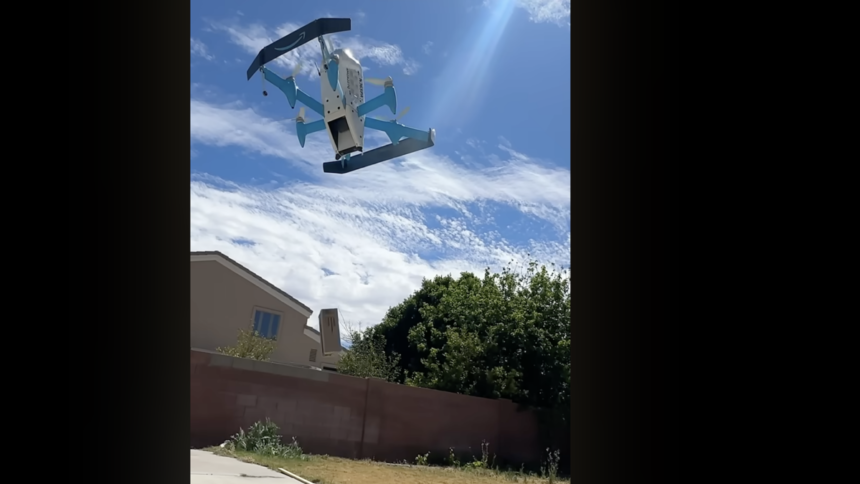
It seemed like this might have been a rare week without a “robot doing dumb shit” story—but never fear, because Jeff Bezos’s squadron of airborne delivery drones is here to save the day. Prime Air, Amazon’s drone delivery service, has been rolling out in a number of US cities over the last few months and—surprise!—it looks like they kinda suck compared to their human equivalents. (And that’s really saying something considering those human equivalents’ propensity for running up to your front door, whacking a “Sorry we missed you!” sticker right below the note you left saying “BUZZER DOESN’T WORK—PLEASE CALL THIS NUMBER”, and then driving away.)*
Still, whatever else your local Amazon driver might do, one thing they won’t do is casually drop your precious package onto concrete from 10 feet in the air. Amazon’s drones, however…
Several stories videos have surfaced of late, apparently showing Amazon-branded drones hovering above customers’ driveways/stoops/etc and then just dropping their cargo onto the ground below. In one video, YouTuber Tamara Hancock orders a plastic bottle of blue raspberry syrup—which is apparently a substance one can order—and watches as the drone dumps it unceremoniously on her driveway. She opens the package and, sure enough, the video depicts a smashed and leaking screw top.
Given the unholy racket these things make, you can probably hear them approaching a mile off, so perhaps the best course of action is to just run outside and try to catch your package before it smashes into the ground. This isn’t the seamless service Amazon promised, but then again, it’s not all that different from waiting to hear the delivery driver approaching and then booking it outside to grab your package before he gets a chance to whack the dreaded “Sorry we missed you!” sticker on your door. Plus ça change, etc.
Anyway, it’s not easy to see how this issue might be mitigated. The obvious answer is “hover closer to the ground”, but given delivery robots’ record in failing to detect obstacles in their path, it feels like that strategy would eventually result in a headline like “Florida Grandmother Beheaded by Drone As She Tries to Collect Her Order of Trump Memorabilia.”
All jokes aside, the question of how drones actually avoid doing things like beheading grandmothers is, unsurprisingly, controversial. Last week Chad Butler, a former head of information security at Amazon’s commercial drone program, posted a video about the regulatory regime surrounding drones like the ones Amazon use, which are referred to as “beyond visual line of sight”, or BVLOS, drones. As the name suggests, these are drones that are able to fly autonomously beyond the line of sight of a human operator. Without a human directing them, drones need to be able to ensure they don’t fly into a wall.
Butler explains that there are two competing schools of thought about how to do this. The first requires the use of a system called ADS-B, which maintains a consistent broadcast of the drone’s altitude, heading and air speed, creating a sort of virtual environment that lets every drone know where every other drone is. The second, championed by Amazon, is more like the technology used on ground-based robots—it uses onboard “detect and avoid” systems like camera and radar, which allow drones to “see” what’s around them and navigate themselves around obstacles.
Amazon recently left the Commercial Drone Alliance, which advocates for the first system, and Butler actually endorses his former employer’s stance. He argues that if drones are constantly broadcasting an unencrypted record of their position, and they have no independent on-board methods to verify that position, then it becomes pretty easy for hackers to hijack them by simply spoofing a GPS signal. This scenario certainly sounds credible—and, frankly, kinda frightening. (Reassuringly, Butler says, “This is not a drone problem—it’s a design pattern problem, and I see it everywhere in AI and autonomous system design.” So that’s great.)
Having said that, we’ve seen with ground-based robots that the use of on-board sensors alone is also, um, less than perfect—and if navigating a drone in two dimensions is hard, adding a whole other dimension seems to just increase the difficulty and the chance of things going wrong. And on that note, there does seem to be one straightforward way of avoiding the possibility of a hacked delivery drone delivering a bomb to the White House or something, which is just getting rid of the bloody things. However, capitalism will not abide such good sense, so I guess we’ll just see how this whole thing pans out.
*To be clear, we don’t necessarily blame drivers working to insane schedules for doing this; it is frustrating, though.
Read the full article here