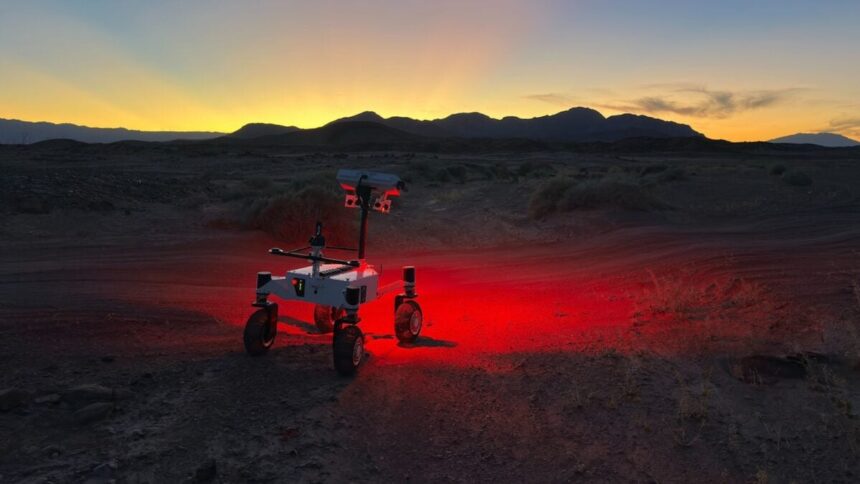
During a recent field test in the Colorado desert, a four-wheeled rover traveled across 16 miles (25 kilometers) in a little over a day and a half, lifting its mesh wheels to drive over obstacles in the rough terrain using enhanced decision-making capabilities.
ERNEST, short for Exploration Rover for Navigating Extreme Sloped Terrain, is a small prototype rover built to be more capable of traversing across rugged terrain for future missions that require higher speeds and greater milage. Engineers from NASA’s Jet Propulsion Laboratory recently put the rover to the test, trailing behind it as it traveled across the Southern California desert for 37 hours.
A worthy successor
Since 1997, NASA has sent a total of five rovers to Mars, each with enhanced capabilities to explore the otherworldly terrain and gather data on its potentially habitable past. The Curiosity and Perseverance rovers, which landed in 2012 and 2021, are still roaming Mars to this day.
For future missions to the Moon and Mars, NASA needs its robotic explorers to be more capable of wheeling past obstacles on rugged terrains. That’s where ERNEST comes in. The next-generation rover is equipped with more advanced mobility and autonomy that could be used to venture to previously inaccessible regions on upcoming missions.
During the recent field test, ERNEST traveled at speeds up to 0.6 miles per hour (1 kilometer per hour) across seven days of intermittent testing. That’s an order of magnitude above the top speed Perseverance and Curiosity can navigate, according to NASA.
“You could do a science road trip across the Moon — or Mars — with this vehicle,” James Keane, a JPL planetary scientist working on lunar missions, said in a statement.
ERNEST is equipped with a suspension system that lets the rover manage weight distribution among its wheels. The rover can drive using different gaits like squirming, wheel-walking, and obstacle-climbing thanks to two powered joints in the front. Using its four steerable wheels, ERNEST can drive in any direction, including sideways.
“We started by postulating that we could do better in designing a planetary surface robotic mobility system,” Hari Nayar, a JPL principal technologist leading the ERNEST team, said in a statement. “While the rocker-bogie system has been very successful over the past 30 years, there’s been a lot of research in that time on mobility and understanding terrain interaction.”
The making of ERNEST
ERNEST is smaller than its SUV-sized predecessors at only 4 feet (1.2 meters) long. Before building this current version of the rover, the team designed two earlier prototypes at about 2 feet (0.6 meters) long for earlier experiments in a trailer filled with material to simulate lunar regolith.
After scaling up to ERNEST’s current design, the team decided they wanted the rover to think on its own. The engineers used reinforcement learning, a type of artificial intelligence where the robot learns by interacting with its environment.
The autonomous algorithm was first put to the test in an obstacle course with sand ripples, rubble piles, steps, and steep slopes in JPL’s Mars Yard. Finally, in March, the team took ERNEST out for its first field test, following the rover as it traversed autonomously across the desert. ERNEST was even put to the test in complete darkness to see how well it could travel at dusk and dawn on the Moon, when shadows are long.
“This testing is helping us refine the mobility hardware and autonomy software to navigate extreme distances across a wide range of terrain and lighting conditions anticipated on the Moon,” Issa Nesnas, a principal technologist at JPL, said in a statement.
One day, a larger, faster version of ERNEST could potentially be used in a future mission to the Moon.
Read the full article here