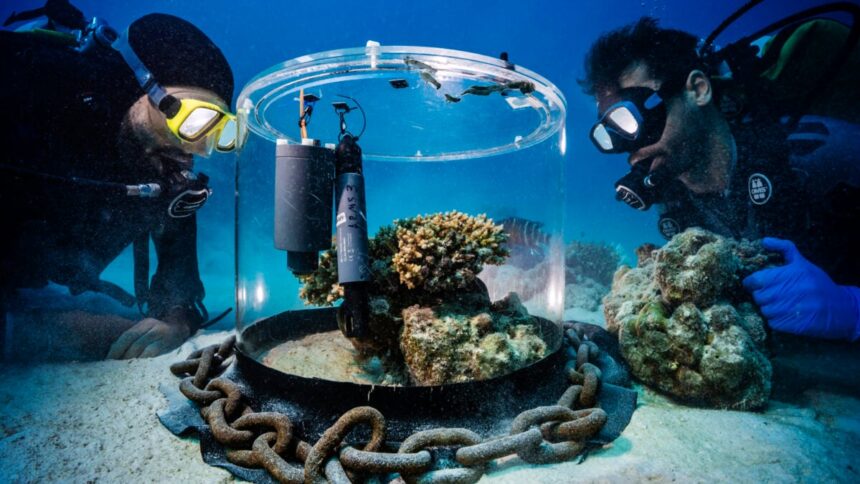
In the photo above, marine biologists Nauras Daraghmeh and Yusuf El-Khaled install an incubation chamber over a coral reef community deep underwater in the Red Sea. The chambers measure the amount of oxygen consumed and produced by corals and their symbiotic algae, allowing researchers to sneak a peek into how this valuable yet endangered ecosystem operates.
But this photograph—captured by freelance marine biologist Uli Kunz—is also special in that it offers a rare snapshot into the people behind essential research. Accordingly, the image was one of five finalists in this year’s Scientists at Work competition, hosted by Nature.
This year, scientists across the world submitted more than 220 entries, and a panel consisting of Nature’s staff selected the winners, which can be seen here.
Algal bloom
Seen from above, the toxic algal blooms in Dog Lake, Ontario, instill a certain calmness that underlies their menacing presence. Things are even worse if you’re actually on the tiny boat, according to Haolun “Allen” Tian, a PhD student at Queen’s University in Canada, who took this winning photograph. Nearer to the lake surface, there’s a distinct “toxic, vile-smelling layer of rot,” Tian told Nature News.
“During the fall, they actually rot and die,” he explained. “Basically, there’s very few species that can eat them, so they don’t enter the food web.”
Tian leads a project that investigates how the algae interact with other lake species. To do so, the team must collect and extract the algae of interest—even if things get stinky.
Microscopic mosquito
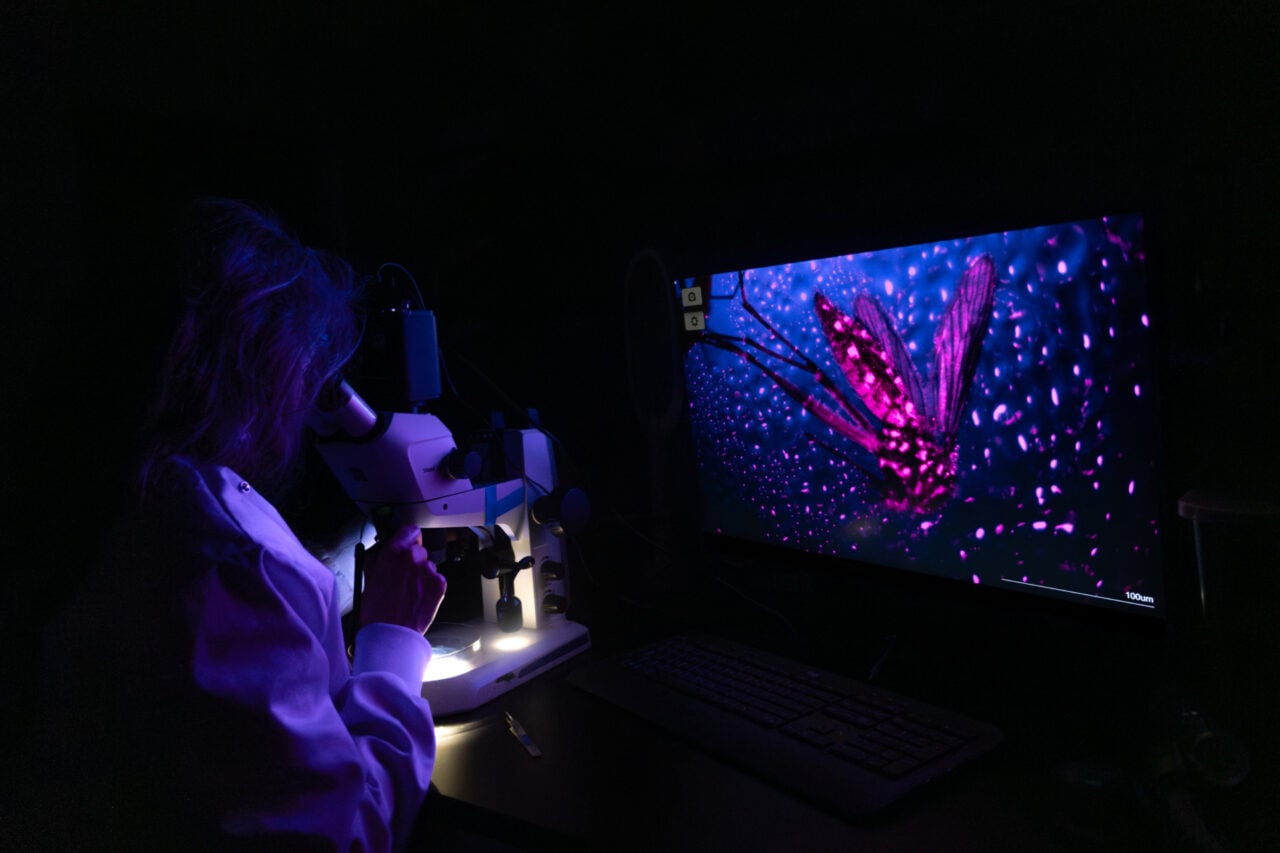
Incidentally, the competition’s winning photographs share a good chunk of aesthetics with art and cinema. But this finalist isn’t a scientist watching a movie—it’s an entomologist at work, studying a yellow fever mosquito spiked with fluorescent dye and a mosquito-killing agent. The project’s goal is to study how the drug nitisinone could curtail the activity of blood-feeding insects.
“The UV illumination created striking colors from both the tiny mosquito and the condensation that formed beneath the cold Petri dish,” photographer Shayanta Chowdhury, a PhD student at the University of Notre Dame, explained to Nature News.
Whale shark
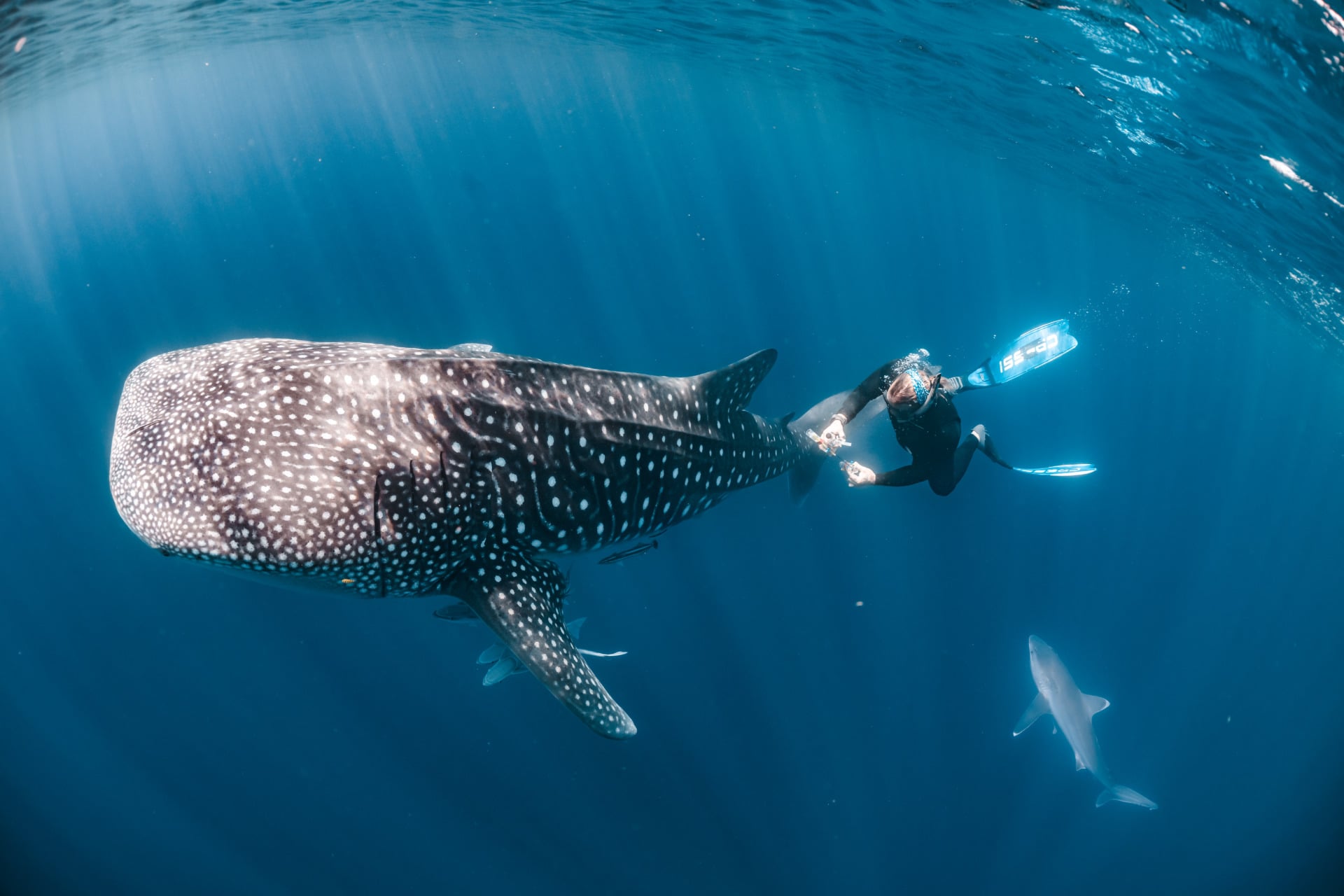
In this mesmerizing photograph, marine biologist Michael Doane carefully collects a sample of microorganisms living on the skin of a whale shark. Peeking out of the corner is a silvertip shark, whose looming presence “got all our hearts racing—except Mike, who was focused on microbes,” Rob Hartcourt, who took the photograph, told Nature News.
“Swimming next to a 12-meter [39-foot] whale shark as it cruises through the blue, gulping away and seemingly non-plussed by our presence is both humbling and exhilarating,” recalled Harcourt, a marine ecologist at Macquarie University in Australia. The moment reminded him of how everything was “unfolding within a broader, interconnected marine community.”
Migrating ibis
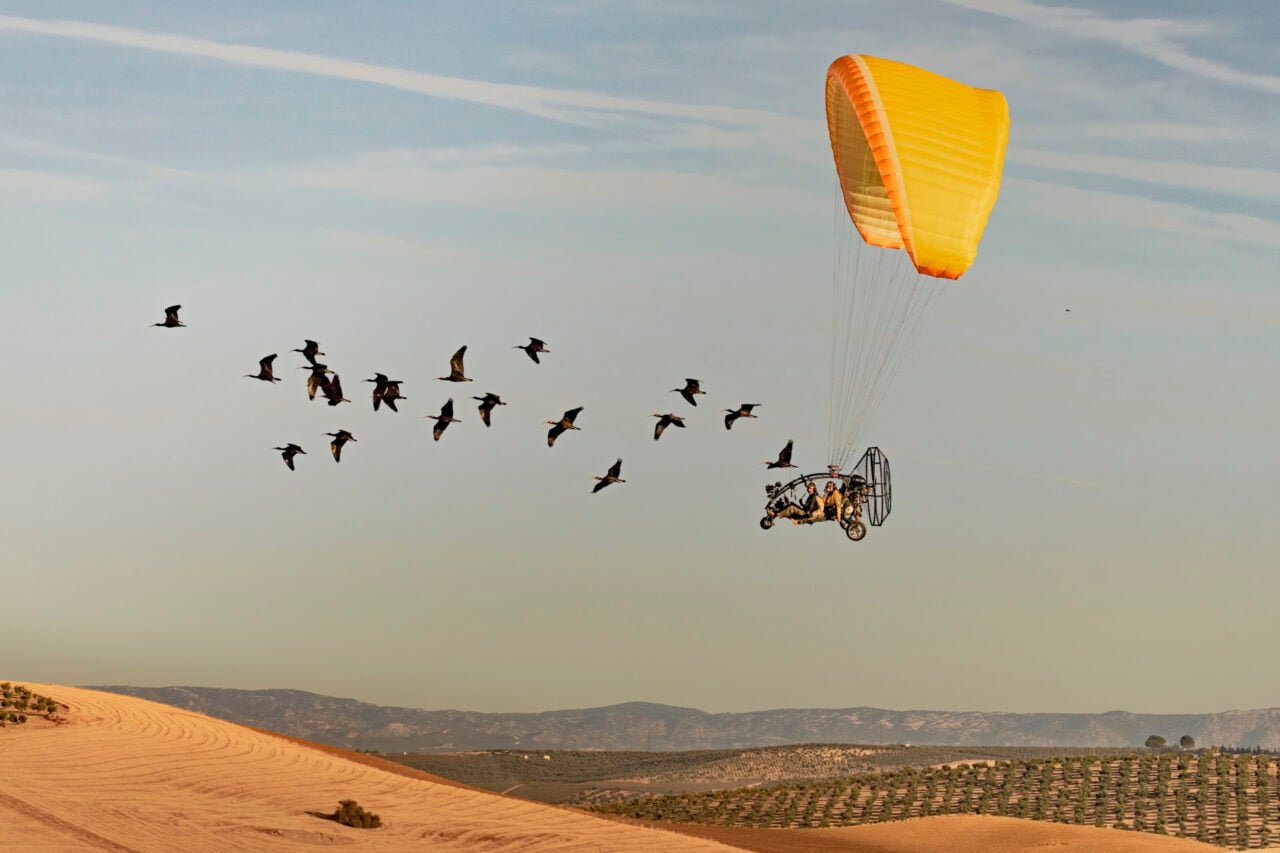
Lastly, this photograph—reminiscent of an iconic scene from E.T.—was designated the overall winner of this year’s competition. To be clear, it’s not the humans following the northern bald ibises. The birds are following their human foster parents as they call out a “rhythmic, German tune to guide them on their way to their winter steadings” over 50 days and 1,700 miles (2,800 kilometers), according to the Nature report.
This photograph was taken by student Gunnar Hartmann in Jaén, Spain. In the image, members of an Austrian conservation and research group—riding in an ultralight aircraft—fly alongside a flock of northern bald ibises, which the researchers hand-raised.
Read the full article here