Most gamers don’t want to hear more talk about AI in games. But you know who does? Intel fellow Tom “TAP” Petersen, who told me in a sit-down interview late one muggy night in Taipei, Taiwan, that he enjoys frame generation, the software often derided as “fake frames.” But he admits that it could be better. Specifically, Intel wants “fake frames” to predict the future.
What Petersen is talking about is a technology Intel is working on called “frame extrapolation.” Essentially, software would be able to insert the images ahead of rendered frames—artificially increasing frame rates and making games look a bit more “smooth.”
Intel has been working on extrapolation for years now. It first hinted at the technology in 2023 but has been mum ever since. Petersen told me that work was still ongoing and that the feature is “almost” ready for a full showcase, but that it wasn’t quite there in time for Computex 2026. While the interview didn’t provide the concrete information that a full demo would have, it was at least a look behind the curtain at Intel’s next AI gaming venture.
How does this all work?
According to the Intel exec, like this: “I’ve got one frame. I’ve rastered it. I’m showing it to a user. And while I’m not quite ready to raster a new one, I’m going to predict where he’s going to move his mouse… all you’re trying to do is figure out how this image is going to be translated.”
This idea raises a metric ton of questions that Intel isn’t quite ready to answer. The biggest quandary, of course, is what impact frame extrapolation will have on players. If Intel’s predictive software gets things wrong, gamers will immediately notice. If you move your mouse right and the camera twitches left, for example, that will be quite apparent.
“The question really is: how often do people change their choices, and how quickly can you respond to the change of choices?” Petersen explained. Whether you’re moving in straight lines or parabolic arcs, he argued, everything is “predictable.” Unless, of course, “there’s a very notable physical change in your hand or your thumb.”
What the Intel exec described to me is essentially mouse prediction (though it would work similarly with a controller thumbstick). Device data is used to generate a frame before the PC can render one. Petersen suggested Intel could predict where a player would position their player character, and in the time it takes for the model to work, it could spit out a frame at just the right moment. “Think of it as: you can either render a frame where you are right now and then try to modify it to match the predicted motion of a mouse, or you can just say, ‘What is the predicament of the mouse?’ and I’m going to move the image to match that.”
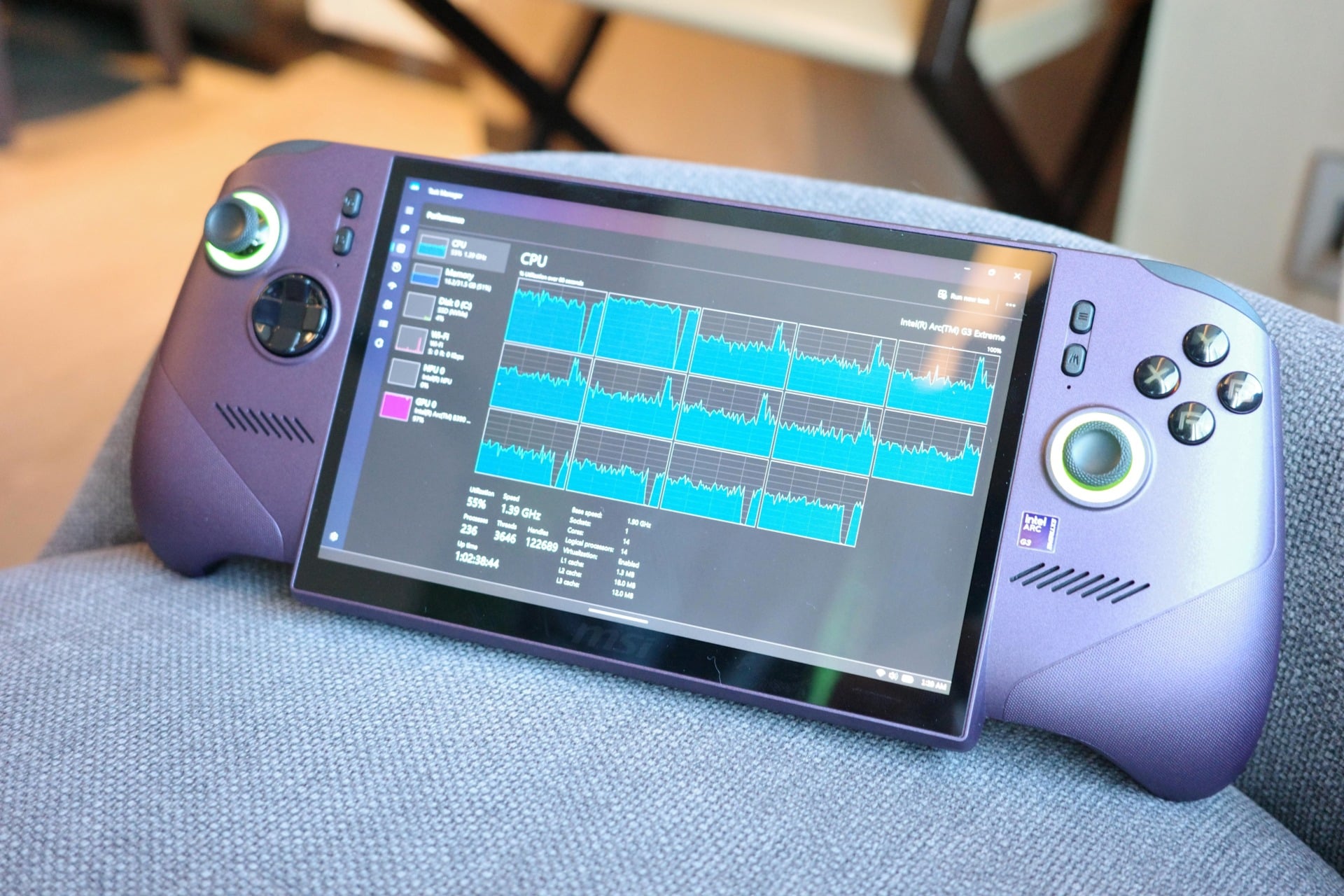
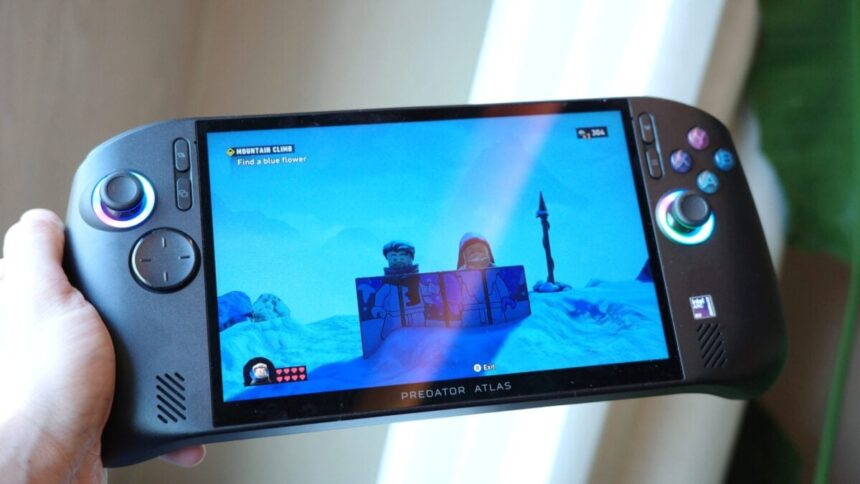
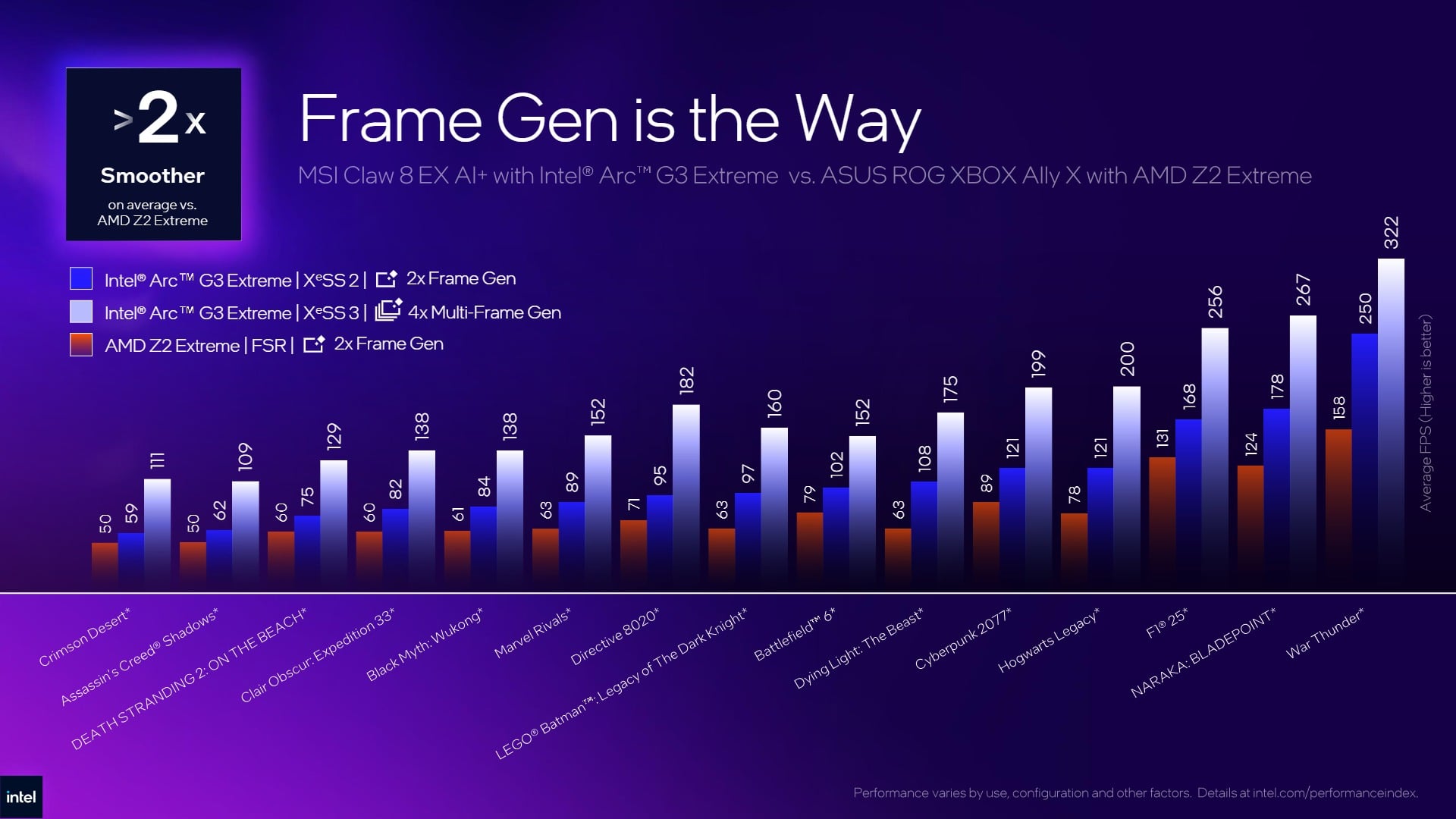
Petersen has a relatively laissez-faire attitude about frame rates. He said he doesn’t mind playing his games with frame generation enabled, especially on a handheld, even if he’s only getting 30 fps. Lower frame rates normally lead to more artifacts and issues, but they’re less noticeable on a smaller screen. Intel’s new handheld-centric chips, the Arc G3 and Arc G3 Extreme, both support XeSS 3 upscaling and multi-frame generation. It’s supposed to be a major selling point for these handhelds—if players can get over their reticence to use AI.
Extrapolation, though, is similar to, but not the same as, frame generation, which is technically called frame interpolation. With interpolation, the game renders two frames, then sticks one or several AI-generated frames in between. The problem is that the game has already rendered the two frames, so while your overall frame rate is boosted, playing the game may feel off, like there’s a floatiness or lag to all your actions.
Extrapolation is meant to alleviate this issue. At least, in an ideal situation. But of course, there are so many ways this technology could screw up, whether it fails to predict correctly or the AI-generated frame creates odd visual artifacts. And then there’s the fact that humans are naturally unpredictable. I’d argue it’s one of our best qualities as a species. But Intel claims that, like a card shark at a poker table, its extrapolation software has to become tuned to players’ tells.
Nvidia ‘fucked up’ its messaging around DLSS
Beyond software specifics, we still don’t know if the AI-averse gaming crowd will actually use this thing. Petersen thinks they should, though he understands the reticence. He’s pinning the blame for players’ AI antagonism on Nvidia.
Petersen, who worked as Nvidia’s director of technical marketing until 2019, said the reason for gamers’ antagonism toward AI assistance is that, when it comes to last year’s big rollout of frame generation, “Nvidia fucked it up.”
Per the executive, “They took AI and said, ‘this is the new baseline of performance, and you’re going to pay us for that,’ rather than saying, ‘raster is what you’re paying for, and AI is a technique to make it better.’”
Intel, for its part, is no longer maintaining that frame generation enhances actual frame rates: it’s now claiming to be “smoothing” the play experience. That means that, unlike Nvidia, Intel isn’t promising to suddenly make your low-end GPU as capable as a $2,000+ flagship graphics card. There’s something to that.
Frame extrapolation certainly won’t work perfectly all the time, but no AI software ever does. What’s more important is that it’s an option, and less discerning gamers who just want to play a smooth game may be able to ignore the fact that half of what they see in their games was generated by AI.
Read the full article here