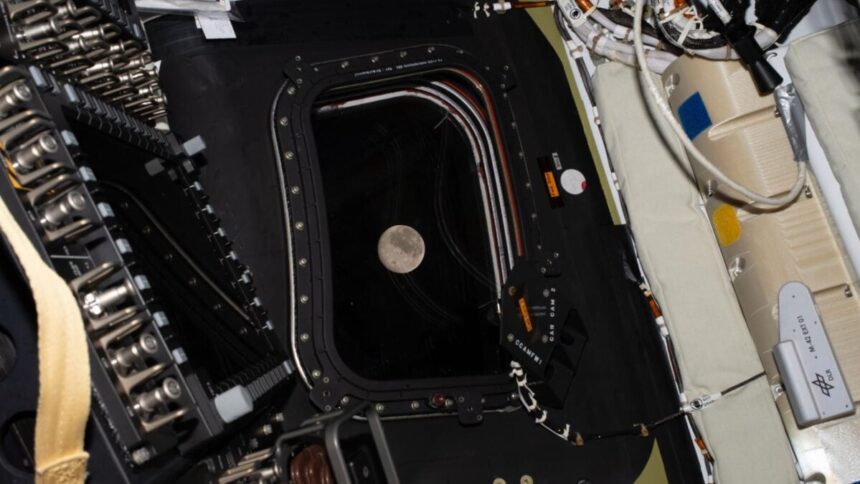
The Artemis 2 mission will achieve another key milestone today as it flies around the far side of the Moon. The crew will view parts of the lunar surface never before seen with the naked eye—and travel farther from Earth than any astronauts in history.
This historic flyby will take place over the course of Monday, April 6. NASA’s live coverage will kick off at 1:00 p.m. ET and continue through 9:45 p.m. You can watch right here via the livestream below, and Gizmodo will also bring you the latest updates via our live blog.
At 1:30, NASA will host a conversation between the Artemis 2 astronauts and the science officer in NASA’s Mission Control Center at the agency’s Johnson Space Center in Houston, Texas. During this conference, the crew will be briefed on the objectives and timeline for the lunar flyby.
Then, at approximately 1:56 p.m., NASA expects Artemis 2 to surpass the record previously set by the Apollo 13 crew in 1970 for the farthest distance humans have ever traveled from Earth. Apollo 13 reached a maximum distance of 248,655 miles, and Artemis 2 will break that record by just over 4,100 miles. Around 2:10 p.m., you should be able to hear the crew discuss the milestone over the comms system.
An unprecedented scientific opportunity
With history made, the seven-hour lunar observation period should begin at roughly 2:45 p.m. The four astronauts will split up into pairs, with one pair observing for 55 to 85 minutes while the other exercises or works on other tasks. Then they will switch.
The Artemis 2 crew will be able to see parts of the far side that the Apollo astronauts couldn’t. That’s because NASA launched the Apollo missions to reach the Moon when the landing sites were lit by early morning sunlight, a time when surface temperatures were manageable and shadows could help guide lander navigation.
The downside of this approach was that large portions of the surface—especially parts on the far side—were shrouded in darkness, or at least too poorly illuminated for the Apollo astronauts to observe with the naked eye from orbit. Their view was also limited by their low orbital altitude, which was typically just 70 miles (110 kilometers) above the surface.
The Artemis 2 astronauts will not encounter the same limitations. Their spacecraft, Orion, will fly by the Moon at a minimum distance of 4,070 miles (6,550 km). About 20% of the far side will be illuminated, allowing them to observe 30 target features. The list includes the Orientale basin, a nearly 600-mile-wide (966-kilometer) crater that straddles the Moon’s near and far sides. The 3.6-billion-year-old crater will be fully sunlit as Orion approaches the Moon.
Humans have never directly laid eyes on the far-side portion of this mare before. As the youngest and best-preserved multi-ring impact basin on the lunar surface, Orientale is a natural laboratory for investigating the Moon’s impact history and how ringed craters form.
Orion will experience a planned communications blackout lasting approximately 41 minutes as it passes behind the Moon, blocking radio frequency signals to and from Earth. NASA expects this to occur around 6:44 p.m. The agency also notes that video coverage during the flyby may be limited while the spacecraft flies through an eclipse between 8:35 p.m. and 9:32 p.m.
The spacecraft should make its closest approach to the Moon at 7:02 p.m. and its farthest point from Earth at 7:07 p.m. At that distance, the Moon will appear to be about the same size as a basketball held at arm’s length from the Artemis 2 astronauts. At 7:25 p.m., Mission Control should re-acquire communication with the crew.
The lunar observation period will wrap up around 9:20 p.m., and the crew will begin downlinking some of the photos they took to ground control. NASA’s science team will review the images and observations overnight and debrief with the crew on Tuesday.
Today is by far the most exciting day of the mission. It’s going to be jam-packed with lunar science and spaceflight feats, so be sure to follow along with Gizmodo as Artemis 2 finally reaches its destination.
Read the full article here