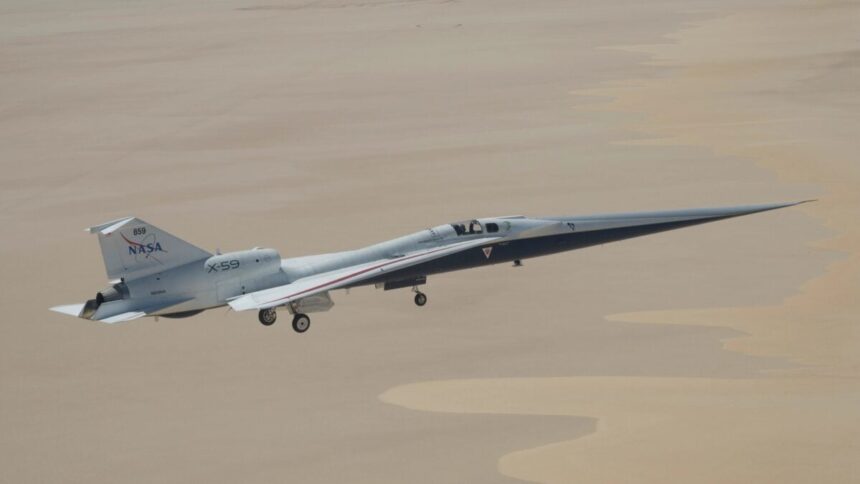
After months of test flights, NASA’s X-59 aircraft is gearing up for its biggest challenge yet: breaking the sound barrier without producing a loud, thunder-like clap.
The experimental aircraft is set to embark on a new round of test flights this month, which will include its first time flying faster than the speed of sound, NASA recently announced. The team behind X-59 reviewed the aircraft’s progress throughout the past several months and gave it the green light for the next series of test flights.
“What comes next is the first time this one-of-a-kind aircraft will fly supersonic,” Cathy Bahm, project manager for NASA’s Low Boom Flight Demonstrator, said in a statement. “We are starting toward the mission conditions test point that X-59 was designed for.”
Onward and upward
The experimental aircraft, built by aerospace contractor Lockheed Martin, took to the skies for its inaugural flight on October 28, 2025.
For its first flight, the aircraft operated slower than the speed of sound at 230 miles per hour (370 kilometers per hour) and a maximum altitude of about 12,000 feet (3.6 kilometers). X-59 spent around one hour in the air before landing near NASA’s Armstrong Flight Research Center in Edwards, California.
Since then, the team at NASA has been testing X-59’s performance at higher altitudes and faster speeds. The aircraft also pulled some in-flight maneuvers during a test flight in April, pushing it beyond its validated limits in a process known as envelope expansion.
For its upcoming series of test flights, the team expects the X-59 to fly supersonic for the first time in early June. The aircraft will reach speeds over 630 miles per hour (1,013 kilometers per hour) at an altitude of 43,000 feet (13,100 meters).
After that, the aircraft will conduct a so-called mission conditions flight, where it will hit Mach 1.4, or fly at 925 miles per hour (1,488 km/hr) at approximately 55,000 feet (16,764 meters). “That speed and altitude are important because they’re NASA’s performance targets for the X-59 to eventually fly over U.S. communities to demonstrate quiet supersonic flight and collect feedback data about the aircraft’s quiet sonic “thump” from the public,” NASA wrote.
Fast and quiet
When planes fly faster than the speed of sound at around 767 miles per hour (1,234 km/hr), they create a loud, explosive noise, known as a sonic boom. That sound is the result of the shock waves created by the extreme speeds.
X-59 is designed to break the sound barrier without producing a sonic boom. In doing so, the experimental aircraft could make quiet supersonic flight a viable option for commercial aircraft.
The 99.7-foot (30.39-meter) long aircraft has a wingspan of just 29.5 feet (9 meters) and a needle-like nose. The X-59’s sharp design is meant to reduce the pressure change that flows over the ground, while the engine is mounted on top to reduce the amount of noise from the plane that reaches the ground. Instead of producing a sonic boom, the aircraft is designed to mitigate the noise and release a sonic thump as it breaks the sound barrier, according to NASA.
The aircraft’s upcoming test flights, however, may not be as quiet. Instead, the X-59 will be accompanied by a supersonic chase plane to obscure any quiet thump it produces with the more traditional, loud sonic booms.
NASA eventually plans on flying X-59 over selected U.S. communities to collect feedback data about the aircraft’s quiet sonic thump from the public. In the meantime, this phase of the test flights is “not yet intended to demonstrate its quiet supersonic capabilities,” according to NASA.
Read the full article here